
U.S. law enforcement charges 13 in connection with gun trafficking into Canada
Advertisement
Read this article for free:
or
Already have an account? Log in here »
We need your support!
Local journalism needs your support!
As we navigate through unprecedented times, our journalists are working harder than ever to bring you the latest local updates to keep you safe and informed.
Now, more than ever, we need your support.
Starting at $15.99 plus taxes every four weeks you can access your Brandon Sun online and full access to all content as it appears on our website.
Subscribe Nowor call circulation directly at (204) 727-0527.
Your pledge helps to ensure we provide the news that matters most to your community!
To continue reading, please subscribe:
Add Brandon Sun access to your Free Press subscription for only an additional
$1 for the first 4 weeks*
- Enjoy unlimited reading on brandonsun.com
- Read the Brandon Sun E-Edition, our digital replica newspaper
*Your next Free Press subscription payment will increase by $1.00 and you will be charged $20.95 plus GST for four weeks. After four weeks, your payment will increase to $24.95 plus GST every four weeks.
Read unlimited articles for free today:
or
Already have an account? Log in here »
WASHINGTON – The United States has charged 13 people for trafficking firearms from New Hampshire into Canada in a law enforcement operation that traced guns to Canadian crime scenes.
“This tracking network allegedly exploited border geography and reservation corridors to move firearms into Canada while attempting to avoid law enforcement detection,” said U.S. Attorney for New Hampshire Erin Creegan at a news conference in Concord, N.H. on Thursday.
Court documents said members of the Akwesasne reservation in New York travelled to Vermont, where they enlisted Justin Jackson to purchase firearms on their behalf.
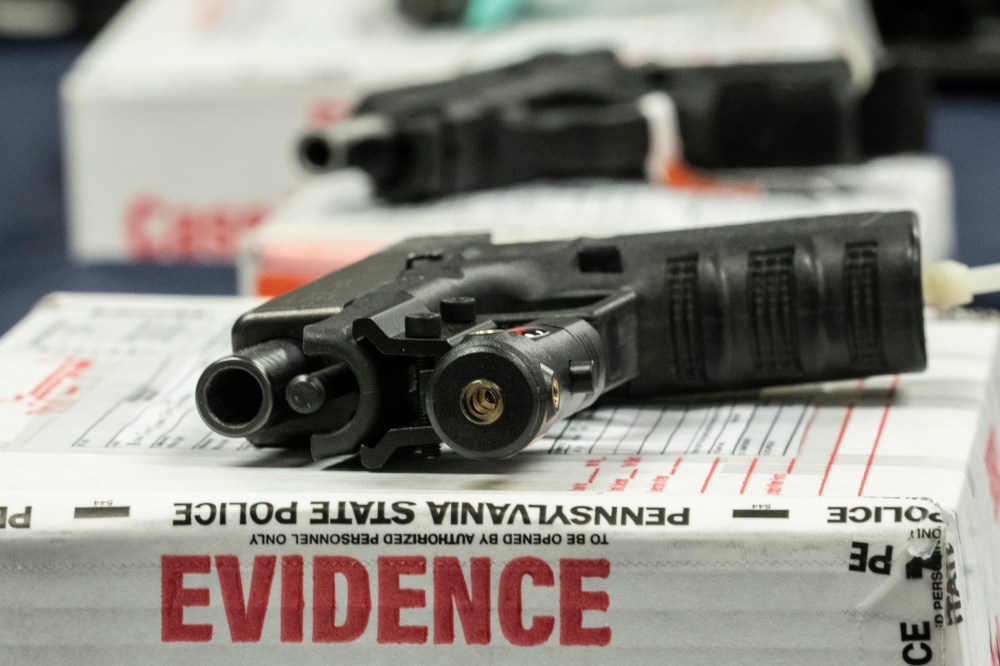
The documents allege that since Jackson was prohibited from purchasing firearms, he got Melissa Longe, Dustin Tuttle, Caleb Wilcott and Doug Mulligan to buy guns from licensed dealers in New Hampshire — a scheme known as “straw” purchasing.
“The allegations paint a troubling picture of how straw purchasing fuels violent criminal networks across the northeast and into Canada,” Creegan said.
The firearm trafficking began in 2021 and ran until at least 2024, the documents said.
Jackson, Longe, Tuttle, Wilcott and Mulligan pleaded guilty to federal firearms offences earlier this year.
Eight others, all of whom are residents of the Akwesasne Mohawk Indian Reservation, were indicted by a federal grand jury in connection to international firearms trafficking earlier this month.
Four were brought into custody this week during a multi-agency takedown. U.S. law enforcement said Jonathan Hart, Io-Rateka Swamp and Blade Oakes are considered fugitives at large.
U.S. law enforcement tracked 51 firearms that may have been trafficked through the ring. Several were subsequently recovered in Canada at scenes of crimes — including one kidnapping and one attempted murder.
Creegan said the takedown of the sophisticated trafficking network was possible because of co-ordination between U.S., Canadian and tribal law enforcement agencies.
Thomas Greco, a special agent with the U.S. Bureau of Alcohol, Tobacco, Firearms and Explosives, said the investigation shows the growing complexity of cross-border firearms trafficking.
Canadian authorities recover approximately 17,000 to 20,000 crime guns a year, Greco said, and up to half of them are smuggled into the country from the United States.
“In the major metropolitan areas of Canada, between 78 per cent and 90 per cent of handguns recovered are sourced and smuggled from the United States,” Greco said.
He said the U.S. Bureau of Alcohol, Tobacco, Firearms and Explosives expanded its partnerships with Canada in 2023, with an emphasis on Ontario and Quebec. That has led to a significant increase in the ability of Canadian authorities to trace guns used in crimes, Greco added.
Chief Supt. Mike Stoddart of the Ontario Provincial Police said the investigation shows the “value of integrated enforcement teams and strong international partnerships.”
“Our collective efforts help prevent firearms and drugs from reaching our communities and underscore the shared responsibility we have for border security,” Stoddart said in a news release.
This report by The Canadian Press was first published May 14, 2026.