
Cuban dancer finds meaning and work in the streets as the island’s art scene fades
Advertisement
Read this article for free:
or
Already have an account? Log in here »
We need your support!
Local journalism needs your support!
As we navigate through unprecedented times, our journalists are working harder than ever to bring you the latest local updates to keep you safe and informed.
Now, more than ever, we need your support.
Starting at $15.99 plus taxes every four weeks you can access your Brandon Sun online and full access to all content as it appears on our website.
Subscribe Nowor call circulation directly at (204) 727-0527.
Your pledge helps to ensure we provide the news that matters most to your community!
To continue reading, please subscribe:
Add Brandon Sun access to your Free Press subscription for only an additional
$1 for the first 4 weeks*
- Enjoy unlimited reading on brandonsun.com
- Read the Brandon Sun E-Edition, our digital replica newspaper
*Your next Free Press subscription payment will increase by $1.00 and you will be charged $20.95 plus GST for four weeks. After four weeks, your payment will increase to $24.95 plus GST every four weeks.
Read unlimited articles for free today:
or
Already have an account? Log in here »
HAVANA (AP) — For nearly three decades, performances by Cuba’s Danza Voluminosa regularly filled prestigious venues like the 2,000-seat National Theater. Directed by Juan Miguel Mas, the troupe pioneered a new movement by working exclusively with larger-bodied dancers — a creative process that was captured in a Canadian documentary.
Today, the 60-year-old dancer and choreographer from Havana is far from the big stages where he once thrived and rehearsed alongside professional artists. Instead, he spends his days conducting dance workshops and classes for children and coordinating performances within his community.
Like many Cubans navigating one of the island’s worst economic crises in decades, Mas’ daily life has been upended by persistent blackouts, water outages, soaring costs and a lack of transportation.
But for artists like him, the situation is a little worse, compounded by the cancellation of shows, a lack of production budgets and a mass exodus from the cultural sector. In fact, he was recently notified that his teaching contract with the National Theater of Cuba has been suspended.
“The outlook for the arts is complex and bleak,” said essayist and arts journalist Michel Hernández. He noted that Cuba’s cultural spaces — once affordable and state-run — have deteriorated significantly, leaving artists with few venues beyond a handful of expensive private spaces.
Yet, Mas won’t give up.
“I am very interested in staying in Cuba,” he told The Associated Press on a recent Saturday as he prepared for a rehearsal with children from a nearby community. “Were I to emigrate, I would lose contact with that ‘Cubanness’ that exists here, with the audience, the people, the folks next door.”
Transforming a street corner into a dance stage
Born in Havana in 1965, Mas trained as a dancer and choreographer under the tutelage of Laura Alonso, a renowned ballerina, and Ramiro Guerra, the father of contemporary dance on the island. He also studied with the Cuban-American dancer and choreographer Lorna Burdsall, who encouraged him to persevere despite the discrimination he faced from dance schools because he weighed 160 kilograms (352 pounds).
He made his debut in 1996 with his own company, Danza Voluminosa (or Voluminous Dance), which remained active until 2024 and provided a home for dancers whose bodies diverged significantly from the industry’s prevailing aesthetic norms. He also worked as an actor and in 2025 he starred in “Cherri,” a fictional film based on his own life experiences.
These days, to supplement the modest income he makes working with children, Mas leases a small area of his home for business use and hosts weekend garage sales featuring curated recycled clothing, tableware and household goods.
Since his sister and teenage nephew relocated to Spain last year, he has lived alone and managed his expenses by shopping at a local farmers’ market just two blocks away. Conveniently, he also accesses subsidized medications at a state-run pharmacy directly across the street.
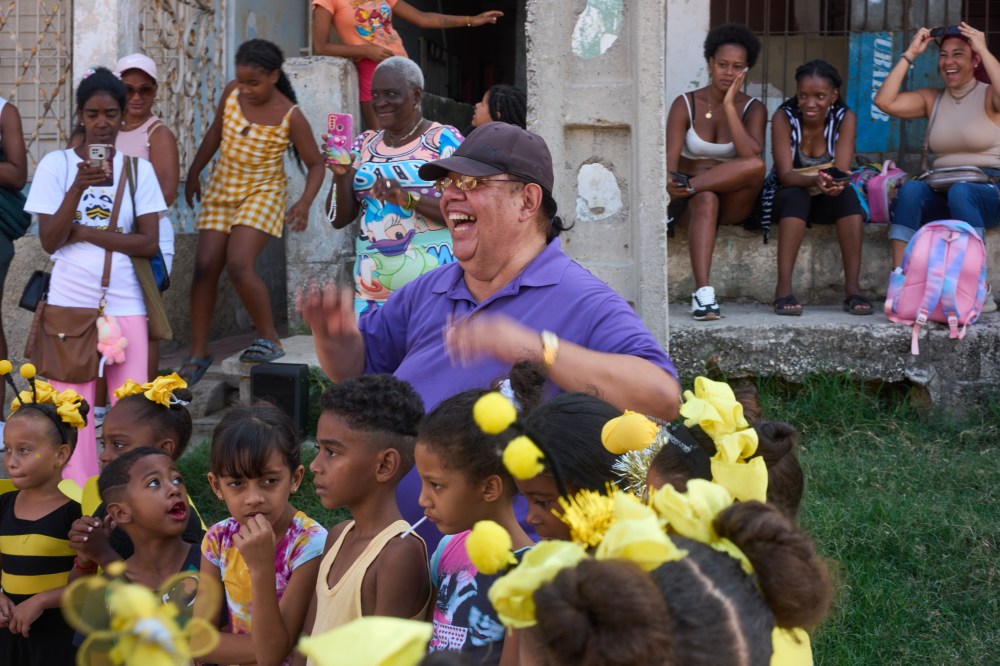
On a recent morning, water bottle in hand to ward off the heat, Mas walked six blocks to the lively Marianao district, where a crowd of 30 children and their mothers awaited his arrival.
The group suddenly transformed a street corner into a stage and for a full 90 minutes, the air filled with music as the little ones performed their songs and showed off their dance moves dressed as bees and other colorful characters.
Against all odds, Mas highlighted the importance of staying connected to his community.
“It’s about bringing the knowledge of art to these children and lifting them out of a reality defined by conflict,” he said.
___
Follow AP’s coverage of Latin America and the Caribbean at https://apnews.com/hub/latin-america