
Suspending defence board an obvious pressure tactic
Advertisement
Read this article for free:
or
Already have an account? Log in here »
We need your support!
Local journalism needs your support!
As we navigate through unprecedented times, our journalists are working harder than ever to bring you the latest local updates to keep you safe and informed.
Now, more than ever, we need your support.
Starting at $15.99 plus taxes every four weeks you can access your Brandon Sun online and full access to all content as it appears on our website.
Subscribe Nowor call circulation directly at (204) 727-0527.
Your pledge helps to ensure we provide the news that matters most to your community!
To continue reading, please subscribe:
Add Brandon Sun access to your Free Press subscription for only an additional
$1 for the first 4 weeks*
- Enjoy unlimited reading on brandonsun.com
- Read the Brandon Sun E-Edition, our digital replica newspaper
*Your next Free Press subscription payment will increase by $1.00 and you will be charged $20.95 plus GST for four weeks. After four weeks, your payment will increase to $24.95 plus GST every four weeks.
Read unlimited articles for free today:
or
Already have an account? Log in here »
“A strong Canada that prioritizes hard power over rhetoric benefits us all. Unfortunately, Canada has failed to make credible progress on its defence commitments.”
— U.S. Undersecretary of Defense for Policy Elbridge Colby
“This is the first time since the fall of the Berlin Wall that Canada has reached its NATO defence spending target … But Canada is acting. It’s clear. There’s no doubt about it.”
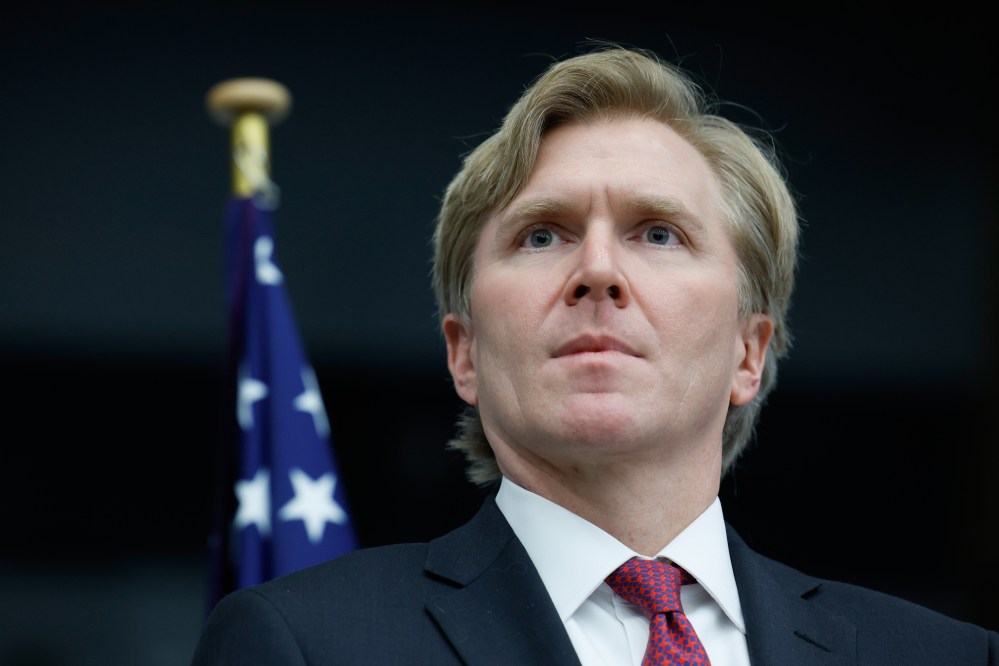
— Prime Minister Mark Carney
The Trump administration’s decision to pause its participation in the Permanent Joint Board on Defense with Canada this week should be seen for what it is — the latest naked pressure tactic intended to force Canada to direct more of its military procurement spending to American contractors.
In his announcement, made without a hint of diplomacy on Monday in a social media post on X, U.S. Undersecretary of Defense for Policy Elbridge Colby also suggested that the Pentagon will be reassessing how the PJBD “benefits shared North American defence.”
U.S. officials say the hardline measure is a necessary outcome of long-standing grievances over Canada’s over-reliance on the American security umbrella — and a similarly irritating underfunding of its own military.
While there is some truth to those concerns, the underlying argument doesn’t hold up very well these days if you consider that Canada has finally met its two per cent spending target and has already moved forward with plans to completely overhaul its military to bring it into the 21st century.
And that includes plans to update its equipment and vastly improve Canada’s defence capabilities.
Just this month, the Pentagon announced that it had secured a $1.1-billion contract with Lockheed Martin to manufacture M142 High Mobility Artillery Rocket Systems (HIMARS) for several allied countries, including Canada. Though it remains unclear at this point how many of these systems Canada has purchased, Canada had previously expressed interest in acquiring 26 HIMARS units.
In addition to the HIMARS, Canada’s procurement plan includes nearly 300 rocket pods for the HIMARS system and 64 M57 Army Tactical Missile System pods (ATACMS) that have a range of up to 300 kilometres.
The purchase of HIMARS addresses a critical capability gap for the Canadian Armed Forces, one that will also help bolster its commitments under NATO. And there have been several other infrastructure and tactical support announcements in the past year, including:
• $3 billion to modernize military installations in Nova Scotia and New Brunswick.
• More than $1 billion for power, heating and fire protection networks at CFB Halifax Dockyard and Stadacona.
• An $8-billion contract to build the first three River-class destroyers at Irving Shipbuilding in Halifax.
• The announcement of a $180-million facility to help integrate and train personnel for the Royal Canadian Navy’s upcoming River-class destroyers.
• More than $1 billion to overhaul Canada’s primary army training base at CFB Gagetown.
• A plan announced earlier this year to spend $84 million on 184 new residential housing units here at CFB Shilo to relieve local housing pressures.
And this is by no means a complete list.
There are also plans in the works to purchase Arctic Over-the-Horizon Radar from Australia, there’s a recently announced plan to co-produce military drones with Ukraine and share advanced drone technology, and a pending purchase decision on a next-generation submarine fleet for Canada, from either South Korean or German manufacturers.
As Prime Minister Mark Carney told reporters yesterday, by the end of the decade Canada will have invested more than $80 billion in the defence sector. To describe Canada as “not making credible progress” in improved military spending is simply unjustified.
What’s far more likely is that this particular shot across the bow is meant to send a message to Ottawa that not spending military procurement dollars with the United States will have future consequences.
Keep in mind that Canada has yet to publicly declare whether it will continue on with its order of 72 Lockheed Martin F-35 Lightning II stealth fighters — on top of the 16 it has already confirmed — or go with the alternative Saab JAS 39 Gripen E from Sweden, which would allow Canada to achieve greater industrial sovereignty. Saab has offered to build the aircraft on Canadian soil, which would establish domestic military jet production in this country and create thousands of jobs in the process.
The Trump administration has already made its position quite clear. In January, the U.S. said it would be forced to alter the NORAD continental defence pact — and threatened to “take over” Canadian airspace — if the Royal Canadian Air Force doesn’t purchase the U.S.-made F-35s.
But that threat did not stop Carney from announcing a new “Buy Canadian” policy in April, stating that “the days of our military sending 70 cents of every dollar to the United States are over.”
We already find ourselves in the middle of highly strained U.S.-Canada trade relations, in part created by the imposition of tariffs on Canadian steel and aluminum, among other products, and Donald Trump’s unwelcome rhetoric that Canada should become the “51st state.”
The U.S. is taking a rather hard gamble by walking out on the Permanent Joint Board on Defense. That joint U.S.-Canada co-operation has helped keep North America safe for generations.
All this decision does is further alienate a trusted U.S. ally, while potentially putting North Americans in harm’s way.
» Matt Goerzen, editor