
Top military commander Gen. Carignan nominated for senior advisory role in NATO
Advertisement
Read this article for free:
or
Already have an account? Log in here »
We need your support!
Local journalism needs your support!
As we navigate through unprecedented times, our journalists are working harder than ever to bring you the latest local updates to keep you safe and informed.
Now, more than ever, we need your support.
Starting at $15.99 plus taxes every four weeks you can access your Brandon Sun online and full access to all content as it appears on our website.
Subscribe Nowor call circulation directly at (204) 727-0527.
Your pledge helps to ensure we provide the news that matters most to your community!
To continue reading, please subscribe:
Add Brandon Sun access to your Free Press subscription for only an additional
$1 for the first 4 weeks*
- Enjoy unlimited reading on brandonsun.com
- Read the Brandon Sun E-Edition, our digital replica newspaper
*Your next Free Press subscription payment will increase by $1.00 and you will be charged $20.95 plus GST for four weeks. After four weeks, your payment will increase to $24.95 plus GST every four weeks.
Read unlimited articles for free today:
or
Already have an account? Log in here »
OTTAWA – The federal government is nominating Gen. Jennie Carignan, the head of Canada’s military, as a candidate for a top role in NATO.
Defence Minister David McGuinty announced Wednesday her candidacy for chair of the NATO Military Committee, the main military adviser to NATO’s Secretary-General Mark Rutte.
An election is set for September to choose a successor for outgoing chair Admiral Giuseppe Cavo Dragone of Italy, whose term ends next summer.
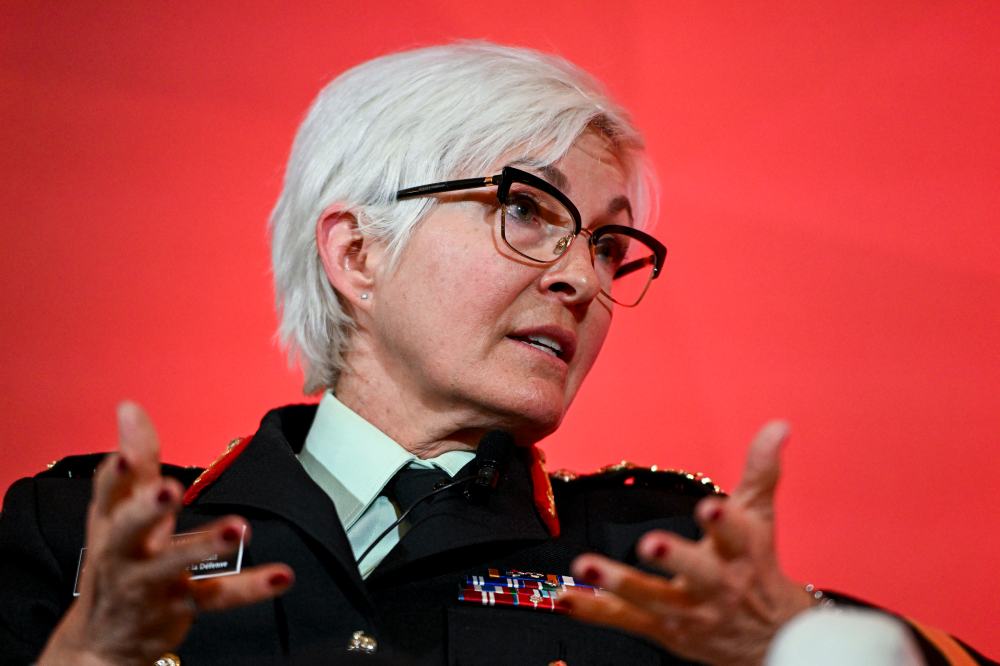
Carignan would have to step down as chief of the defence staff before taking on the new position. It’s also not a foregone conclusion she’ll get the job.
The senior role is highly coveted and the elections are hard-fought contests featuring intense lobbying.
Germany nominated its Chief of Defence Staff Gen. Carsten Breuer for the same position earlier this year.
Canada’s former ambassador to NATO Kerry Buck said that if Carignan’s bid is successful, she would become the first woman to chair the committee.
Buck said that while it would be good for Canada if Carignan got the job, she would not be representing Canada in the role and would act as a neutral party in the alliance.
“It would be fantastic if she got the job. But there’s going to be a lot of stiff competition,” Buck said.
“Even so, the fact that we’re putting forward is a pretty important signal to the council.”
Only three Canadians have ever served in the alliance’s top military role. The last Canadian who held the position was retired general Raymond Henault, who served as chair from 2005 to 2008 during the Afghanistan war.
Henault told The Canadian Press it’s an intense job that demands a lot of time and energy.
“The kind of talent that Jennie Carignan has shown as a chief of defence is ideally suited to a job like this one,” Henault said.
He described her as a leader with a great depth of operational experience who is “very active in soliciting advice and previous experience” to help inform decisions.
Carignan has served as chief of the defence staff since summer 2024, when she replaced now-retired general Wayne Eyre and became the first woman to helm the Canadian Armed Forces.
Carignan had a long career as a combat engineer and commander and has been deployed to Afghanistan, Iraq, Bosnia and Syria.
“Having a Canadian with the kind of expertise she’s shown … would serve NATO very well,” Henault said.
Carignan will continue to lead the Canadian military while the selection process for the NATO role takes place. The appointment is made by the alliance’s chiefs of defence.
Chiefs of the defence staff do not hold fixed terms but they tend to stay in the position for about three years.
The NATO vacancy comes at an especially challenging and tumultuous time for the alliance, as it grapples with the war in Ukraine, the rapid evolution of drone warfare and President Donald Trump’s repeated threats to withdraw U.S. support.
Trump also has initiated a troop drawdown from Europe, which risks undercutting deterrence and the cohesion of NATO’s policy toward Russia.
While NATO isn’t involved in the Iran war, that conflict would factor into internal alliance decision-making.
“It’s definitely a time of churn, a time of unpredictability, mostly caused by the U.S. but also caused by the current security environment,” Buck said.
“That makes decision making harder. Then the main challenge inside NATO is to keep the U.S. in the tent in as constructive a role as we can … So whoever is in that role, it’ll be hard.”
Rutte said at a press conference Wednesday the alliance is moving away from overreliance on the United States as the Americans slowly pivot their focus to other areas, namely Asia.
“Europe will take a bigger role together with Canada, a stronger Europe in a stronger NATO, taking more of the responsibility for the conventional defence,” Rutte told reporters at NATO Headquarters in Brussels.
Rutte’s four-year term ends in 2028, though it could be renewed for another term.
This report by The Canadian Press was first published May 20, 2026.