
Judge delivers manslaughter verdicts in gun sale that led to Edmonton police deaths
Advertisement
Read this article for free:
or
Already have an account? Log in here »
We need your support!
Local journalism needs your support!
As we navigate through unprecedented times, our journalists are working harder than ever to bring you the latest local updates to keep you safe and informed.
Now, more than ever, we need your support.
Starting at $15.99 plus taxes every four weeks you can access your Brandon Sun online and full access to all content as it appears on our website.
Subscribe Nowor call circulation directly at (204) 727-0527.
Your pledge helps to ensure we provide the news that matters most to your community!
To continue reading, please subscribe:
Add Brandon Sun access to your Free Press subscription for only an additional
$1 for the first 4 weeks*
- Enjoy unlimited reading on brandonsun.com
- Read the Brandon Sun E-Edition, our digital replica newspaper
*Your next Free Press subscription payment will increase by $1.00 and you will be charged $20.95 plus GST for four weeks. After four weeks, your payment will increase to $24.95 plus GST every four weeks.
Read unlimited articles for free today:
or
Already have an account? Log in here »
EDMONTON – A young man who sold a semi-automatic rifle later used to kill two Edmonton police officers has been found guilty of manslaughter in a rare case his lawyer argued would be used to expand criminal liability for gun violence across the country.
Dennis Okeymow sat still next to his lawyer, his hands in his lap, as he was convicted Tuesday on three counts of manslaughter. The 21-year-old was also convicted on three counts of criminal negligence causing death, two counts of unlawfully causing bodily harm and two counts of criminal negligence causing bodily harm.
Justice John Little said while Okeymow didn’t pull the trigger, by selling a semi-automatic rifle to 16-year-old Roman Shewchuk, the man knew or should have known something terrible could result.
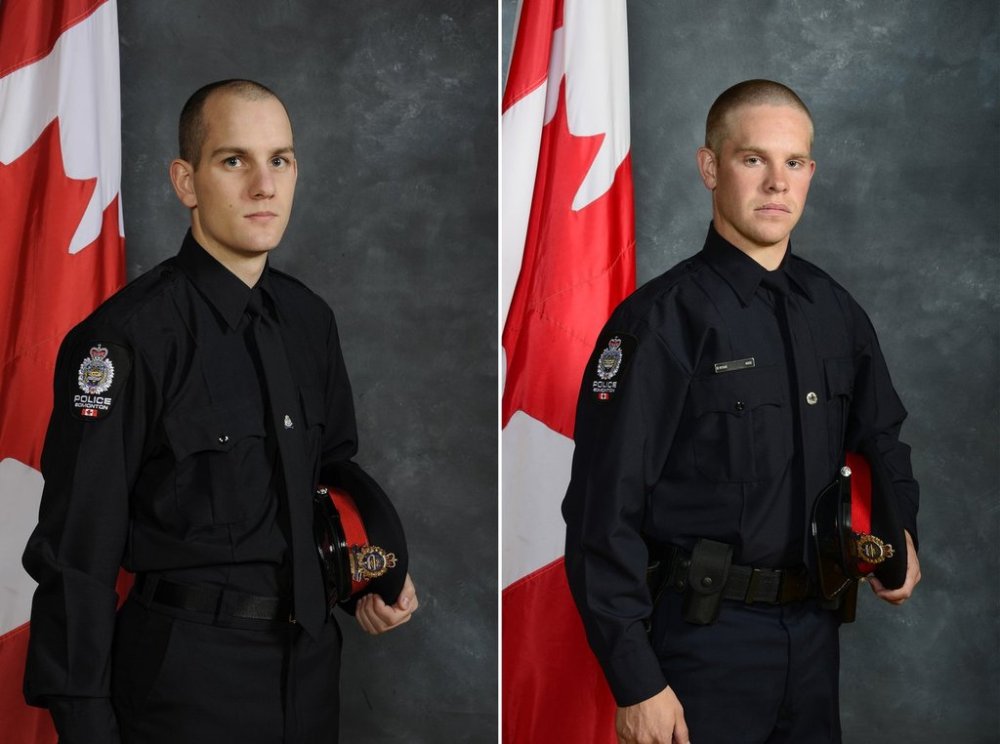
Okeymow was charged in the deaths of constables Travis Jordan and Brett Ryan, as well as the teen, on March 16, 2023.
The officers were responding to a domestic disturbance at an apartment building when they were ambushed and shot to death by Shewchuk.
The boy then killed himself.
The judge said there was “no intervening act to break the chain of causation” between the selling of the weapon about seven weeks before the officers were shot.
“It was not necessary that Mr. Okeymow foresee at the time of the rifle transaction the precise harm that Mr. Shewchuk would cause,” Little said.
“It was reasonably foreseeable the risk that the 16-year-old purchaser … would use the illegally obtained firearm and ammunition to cause harm to others.”
Crown prosecutor Adam Garrett had argued for the manslaughter verdicts, telling the judge there must be accountability for illegally selling a weapon to a minor knowing someone could be harmed.
He acknowledged that the case is among the few in Canada in which someone who sells a gun for monetary gain has faced homicide-related charges.
Okeymow’s lawyer, Jamil Sawani, argued his client was “an easy scapegoat” in a tragedy where “there is no other concrete person to blame.”
Okeymow earlier pleaded guilty to seven other offences related to selling drugs and the weapon to Shewchuk.
Court heard Okeymow sold the .22-calibre semi-automatic rifle and 80 rounds of ammunition to the teen. Shewchuk initially asked for a handgun, but Okeymow said he didn’t have one.
Shewchuk bought the rifle for $2,500, about three times its market value.
Six weeks later, the teen used the gun to shoot a man in the head in a pizza shop. Richard Albert, who didn’t know the boy, survived but suffered serious and permanent injuries.
Days later, Shewchuk strangled his mother until she lost consciousness. When she woke up, she ran to a nearby apartment building and called police.
Jordan and Ryan responded and were gunned down by the teen as they stood outside the family’s apartment. He also shot his mother but she survived. He then turned the gun on himself.
During earlier court arguments, Sawani stressed that his client was shouldering an unfair burden of blame.
He accused the Crown of hoping to use the case to expand criminal liability for gun violence, with prosecutors and law enforcement across the country “waiting with bated breath” on the outcome.
Sawani said a guilty verdict would open the “floodgates” for prosecutions and the law should not be tested in court with a disadvantaged Indigenous young man.
However, the judge found the sale of the rifle was a “significant contributing cause of the three deaths.”
“Defence counsel argues that a law respecting legal causation is intended to narrow responsibility to those who truly bear moral accountability for a death,” Little said.
“But there is no moral innocence in the unlawful act by Mr. Okeymow, (Shewchuk’s) drug dealer, to Mr. Shewchuk, his drug user, who then used it to kill and injure others.”
The judge said Okeymow was also prohibited from possessing a gun and sold the rifle to a teen who could not legally buy it.
Outside court, acting Insp. Eric Stewart said the effects of the officers’ deaths “cannot be overstated.”
“The investigation was not an easy task, but the dedication of our members and partners never wavered,” he said.
The Alberta Crown Prosecution Service called the decision significant but wouldn’t comment further as the matter remains before the court for sentencing. A date has yet to be set.
This report by The Canadian Press was first published May 26, 2026.