
By the numbers: Quebec’s struggles with social housing
Advertisement
Read this article for free:
or
Already have an account? Log in here »
We need your support!
Local journalism needs your support!
As we navigate through unprecedented times, our journalists are working harder than ever to bring you the latest local updates to keep you safe and informed.
Now, more than ever, we need your support.
Starting at $15.99 plus taxes every four weeks you can access your Brandon Sun online and full access to all content as it appears on our website.
Subscribe Nowor call circulation directly at (204) 727-0527.
Your pledge helps to ensure we provide the news that matters most to your community!
To continue reading, please subscribe:
Add Brandon Sun access to your Free Press subscription for only an additional
$1 for the first 4 weeks*
- Enjoy unlimited reading on brandonsun.com
- Read the Brandon Sun E-Edition, our digital replica newspaper
*Your next Free Press subscription payment will increase by $1.00 and you will be charged $20.95 plus GST for four weeks. After four weeks, your payment will increase to $24.95 plus GST every four weeks.
Read unlimited articles for free today:
or
Already have an account? Log in here »
MONTREAL – Nearly one-third of Quebec’s social housing units — roughly 21,500 homes — is in a state of disrepair. Advocates worry existing budgets will be inadequate because inflation is outpacing the pace of renovations.
Social housing is owned by the provincial government and sets rents at 25 per cent of the renters’ household income.
Here are some numbers on Quebec’s social housing stock:
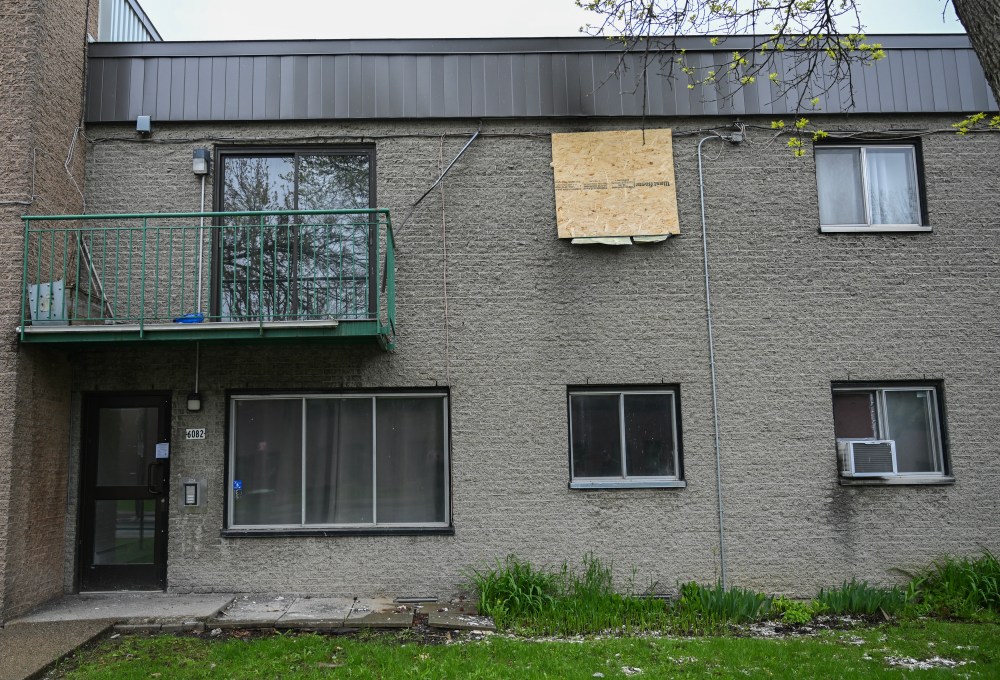
— Total of about 74,000 social housing units; 21,500 units need renovations.
— Quebec’s social housing complexes are graded on a scale from A to E. Units that receive a D or E grade are in very poor condition, with the cost to bring them up to code exceeding 15 per cent of the building’s replacement value.
— The provincial government says units with a D or E rating can be safe and habitable, as the grades are based on the estimated cost of work over five years.
— Social housing advocates say 43.9 per cent of units (26,922 homes) received a D or E grade in 2023. In 2026, that percentage was down to 34.2 per cent (21,457 units).
— The maintenance deficit rose by 25 per cent between 2023 and 2026. In 2023, the government estimated it needed more than $859.5 million to repair the 1,574 buildings in poor condition. In 2026, it needs more than $1.079 billion to renovate the remaining 1,445 buildings.
— Some units that received a grade between A and C deteriorated to a D between 2023 and 2026.
— More than half of Quebec’s social housing stock is in the Montreal area.
— In Montreal, the percentage of units with a D or E grade dropped from 76 per cent in 2023 to 53 per cent in 2026.
— In Laval, Montreal’s northern suburb, 85.7 per cent of its social housing units were in poor condition in 2023. Three years later, 82.2 per cent still need major renovations. Only 578 units in the city are considered in good condition.
— In Quebec’s regions, which have fewer social housing complexes than bigger cities, most of the stock is in good condition.
— In Montérégie, the Eastern Townships and Lanaudière, between 40 and 53 per cent of the housing stock is in serious need of renovations.
— The Quebec housing authority says nearly $3.6 billion has been set aside until 2028 to renovate the social housing stock, starting in 2023.
— According to the Quebec housing authority, about $1.3 billion of that $3.6 billion has already been allocated or spent.
This report by The Canadian Press was first published May 28, 2026.