
‘Just be amazed:’ Alberta is seeing a cyclical outbreak of caterpillars
Advertisement
Read this article for free:
or
Already have an account? Log in here »
We need your support!
Local journalism needs your support!
As we navigate through unprecedented times, our journalists are working harder than ever to bring you the latest local updates to keep you safe and informed.
Now, more than ever, we need your support.
Starting at $15.99 plus taxes every four weeks you can access your Brandon Sun online and full access to all content as it appears on our website.
Subscribe Nowor call circulation directly at (204) 727-0527.
Your pledge helps to ensure we provide the news that matters most to your community!
To continue reading, please subscribe:
Add Brandon Sun access to your Free Press subscription for only an additional
$1 for the first 4 weeks*
- Enjoy unlimited reading on brandonsun.com
- Read the Brandon Sun E-Edition, our digital replica newspaper
*Your next Free Press subscription payment will increase by $1.00 and you will be charged $20.95 plus GST for four weeks. After four weeks, your payment will increase to $24.95 plus GST every four weeks.
Read unlimited articles for free today:
or
Already have an account? Log in here »
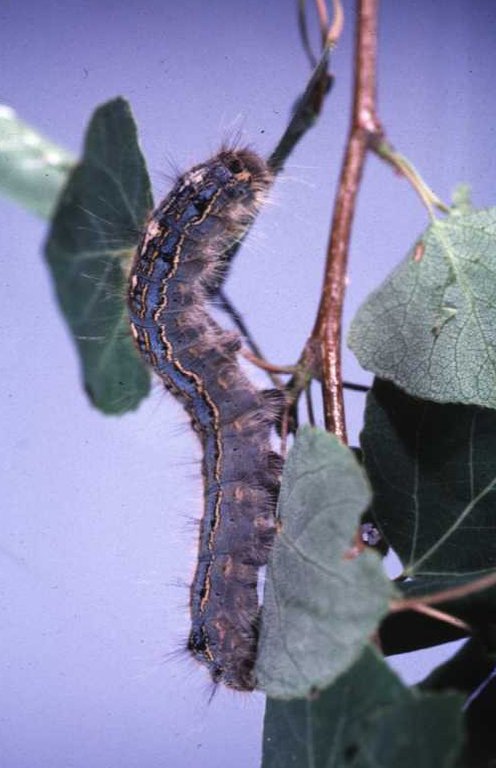
EDMONTON – Forest tent caterpillars are not entomologist Ken Fry’s favourite insect but the black-coloured critters with vibrant blue-and-yellow marks do have a soft spot in his heart.
They’re why his dad once let him break the house rule of not climbing the two poplar trees in their backyard, so Fry could clamber to the top of one and grab hundreds of caterpillar eggs before they hatched and destroyed leaves.
‘I was about seven-years-old … My dad said, ‘Ken, get up that tree, get after those caterpillar eggs,” said Fry, who is an instructor at Olds College of Agriculture & Technology in central Alberta.
“This particular species allowed me to climb our tree with wild abandon and absolute endorsement of my parents.”
Millions and millions of forest tent caterpillars, with fur that chokes hungry birds and makes beetles think twice about their next meal, are feasting on leaves in Alberta.
Fry said the outbreak of the caterpillars, voraciously feeding now across the province’s lush areas including Edmonton’s river valley, is a natural phenomenon that happens roughly every decade across northern areas in the Prairies with boreal forest.
“An unsavoury aspect of it is what goes in must come out so, if you are under a nice aspen tree on a picnic table and all of a sudden you think, ‘Hey, where’s all these droplets coming from?’ it’s not very nice,” Fry said with laugh.
“But that’s good fertilizer.”
It’s unclear what causes their population to explode cyclically. Fry said it has to do with the health of the caterpillars themselves, their natural enemies, and other factors such as the temperature, the moisture and how the trees are performing.
He said the caterpillars are native to Alberta. They typically appear in smaller numbers in spring and summer.
The City of Red Deer in central Alberta said residents may be noticing more caterpillars on trees, sidewalks and trails.
“Crews may physically remove or squish caterpillars where practical during regular work,” it said in a news release.
“At this time, the city is not conducting large-scale pesticide treatment for forest tent caterpillar.”
The town of Olds, also south of Edmonton, said the caterpillars are lurking on its poplar, aspen, ash and other deciduous trees. It said it understands seeing more bare trees in spring might seem dramatic but it’s a natural process.
“While mostly harmless, the small hairs on the caterpillars may cause skin irritation or mild allergic reactions in some individuals if handled, particularly for those with sensitivities,” the town said in a statement.
Fry said a moth can lay between 100 and 300 small black-coloured eggs on a tree’s canopy ahead of winter and during the year of the outbreak. The eggs, like most Canadians, withstand the cold.
They hatch in the spring and begin feasting on leaves. They move faster than slugs but slower than beetles. Roads running through forest might become slippery if the caterpillars are crawling on them.
“Then they’ll spin a silken cocoon and pupate either on the tree, your fence or on the side of your garage after four to five weeks of feeding,” Fry explained.
They have the word “tent” in their name because of their similarities with other species that spin silk to create a dome over their heads that protect them from predators.
Forest tent caterpillars don’t create a dome, Fry said, but spin silk to create a path connecting them from one branch to another.
Near the end of June, they transform into tan-coloured, furry moths that go on to lay more eggs.
Fry said Albertans can expect to see more moths hovering around porch lights until early July, when they perish.
Alberta Forestry found in 2025 that 70 per cent of all the defoliation in the province’s north to date was caused by forest tent caterpillars, Fry said, but added the destruction of trees is not a cause for concern.
“The caterpillars are doing the trees a service by taking out the weak and leaving only the strongest trees,” Fry said, adding they’re a vital part of a healthy forest and people should grab their binoculars and get a sight of them.
“Just be amazed at what you see because it doesn’t come around every year.”
This report by The Canadian Press was first published June 1, 2026.