
Canada needs a national trucking safety database
Advertisement
Read this article for free:
or
Already have an account? Log in here »
We need your support!
Local journalism needs your support!
As we navigate through unprecedented times, our journalists are working harder than ever to bring you the latest local updates to keep you safe and informed.
Now, more than ever, we need your support.
Starting at $15.99 plus taxes every four weeks you can access your Brandon Sun online and full access to all content as it appears on our website.
Subscribe Nowor call circulation directly at (204) 727-0527.
Your pledge helps to ensure we provide the news that matters most to your community!
To continue reading, please subscribe:
Add Brandon Sun access to your Free Press subscription for only an additional
$1 for the first 4 weeks*
- Enjoy unlimited reading on brandonsun.com
- Read the Brandon Sun E-Edition, our digital replica newspaper
*Your next Free Press subscription payment will increase by $1.00 and you will be charged $20.95 plus GST for four weeks. After four weeks, your payment will increase to $24.95 plus GST every four weeks.
Read unlimited articles for free today:
or
Already have an account? Log in here »
“The system was designed as a provincial system, and each provincial system was designed as such. It was not designed for people to exploit it the way that has been taking place, and it demonstrates that there are gaps in the system that need to be dealt with.”
— Manitoba Trucking Association executive director Aaron Dolyniuk
The fatal crash in Brandon last week should do more than simply prompt a police investigation. It should finally force governments across Canada to close a trucking loophole that has been tolerated for far too long.
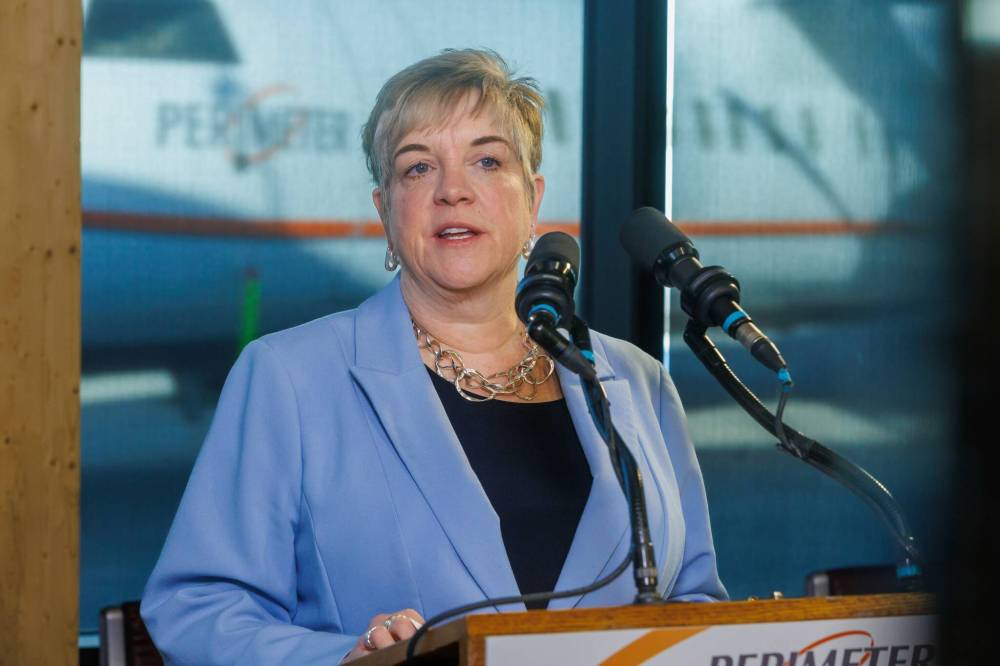
Transportation Minister Lisa Naylor is calling for national information sharing on trucking safety fitness records. (Mike Deal/Winnipeg Free Press files)
A 49-year-old woman is dead after a semi-truck connected to Conquer Transport Inc. allegedly blew through a stop sign at Highway 110 and Richmond Avenue East last Wednesday afternoon. Brandon police have charged the 35-year-old truck driver, Brijpal Panwar, with dangerous driving causing death.
The criminal case will proceed through the courts. But another issue demands urgent public attention — how a trucking company that lost its safety fitness certificate in Manitoba in 2021 was reportedly able to continue operating using documentation obtained in Alberta after changing its name.
That should trouble anyone who shares Canadian highways.
Manitoba says Conquer Transport lost its certificate because of ongoing deficiencies in safe operation and non-compliance with highway safety laws. Yet by early 2022, provincial officials learned the company was back on Manitoba roads using an Alberta-issued safety certificate and vehicle registration after a name change.
The practice is well known in the trucking industry.
Companies that shut down or lose operating authority in one jurisdiction sometimes reappear elsewhere under a new identity. They are commonly known as chameleon carriers.
Commercial trucking is essential to the Canadian economy. Thousands of carriers and drivers operate responsibly every day, moving goods safely across provincial borders and keeping supply chains functioning.
Most trucking companies invest heavily in safety, training and compliance because lives and livelihoods depend on it.
That is precisely why chameleon carriers are such a serious problem. They undermine reputable operators and expose the public to unacceptable risks.
If a carrier with a poor safety record or revoked operating authority can simply change its name and secure fresh documentation elsewhere, the regulatory system loses credibility. Worse, dangerous operators may remain on the road.
After all, it’s self-evident that Wednesday’s collision would not have occurred if the truck allegedly driven by Panwar had not been on that road that day; that is, if the trucking company that Panwar was driving for had not been able to obtain a safety certificate from another jurisdiction, allowing that company to continue conducting business in Manitoba.
The situation is not a new one. Industry representatives, transportation safety experts and regulators have been discussing this problem for years. The Canadian Council of Motor Transport Administrators is examining chameleon carriers and safety certification models after direction from transport ministers in 2024.
Manitoba and other provinces have been discussing improved data sharing. The Manitoba Trucking Association has pressed for stronger national co-ordination.
All of that work is worthwhile. But it is also moving too slowly.
The Brandon tragedy is a painful reminder that this cannot remain a long-term policy discussion without concrete results.
Transportation Minister Lisa Naylor and the Manitoba Trucking Association are right to renew calls for national information sharing on trucking safety fitness records. Manitoba has improved communication with other provinces when certificates are suspended or revoked. That is progress.
But partial reforms and bilateral communication are not enough when trucking is inherently national in scope. Commercial carriers move seamlessly across provincial boundaries. Safety oversight must do the same.
Canada needs a standardized, national trucking safety database that allows regulators in every jurisdiction to immediately identify carriers, owners, compliance officers and vehicles connected to previous safety violations or revoked operating authority.
That system should incorporate vehicle identification numbers and track ownership and management connections that might reveal attempts to evade oversight through corporate restructuring or name changes.
Such a database will not be simple to build. Provinces use different systems, different standards and different methods of recording data. And legacy systems do not always communicate easily with one another.
Achieving national uniformity is technically and politically challenging. But those challenges are not insurmountable.
No database or regulatory framework can prevent every collision. Human error, reckless decisions and criminal conduct will still occur. Still, public policy should aim to reduce preventable risk wherever possible.
The work has begun. Now governments must finish it.
» Winnipeg Free Press & The Brandon Sun