
NDP leader introduces bill that would require floor crossers to face voters first
Advertisement
Read this article for free:
or
Already have an account? Log in here »
We need your support!
Local journalism needs your support!
As we navigate through unprecedented times, our journalists are working harder than ever to bring you the latest local updates to keep you safe and informed.
Now, more than ever, we need your support.
Starting at $15.99 plus taxes every four weeks you can access your Brandon Sun online and full access to all content as it appears on our website.
Subscribe Nowor call circulation directly at (204) 727-0527.
Your pledge helps to ensure we provide the news that matters most to your community!
To continue reading, please subscribe:
Add Brandon Sun access to your Free Press subscription for only an additional
$1 for the first 4 weeks*
- Enjoy unlimited reading on brandonsun.com
- Read the Brandon Sun E-Edition, our digital replica newspaper
*Your next Free Press subscription payment will increase by $1.00 and you will be charged $20.95 plus GST for four weeks. After four weeks, your payment will increase to $24.95 plus GST every four weeks.
Read unlimited articles for free today:
or
Already have an account? Log in here »
OTTAWA – NDP parliamentary leader Don Davies has introduced a private member’s bill that would compel floor crossers to face their voters before switching parties.
Bill C-278 says no MP would be permitted to cross the floor without first sitting as an Independent and then contesting and winning a seat under the new party banner.
Davies said Prime Minister Mark Carney’s move to secure a majority government through floor crossings was undemocratic and made people question the legitimacy of democratic institutions.
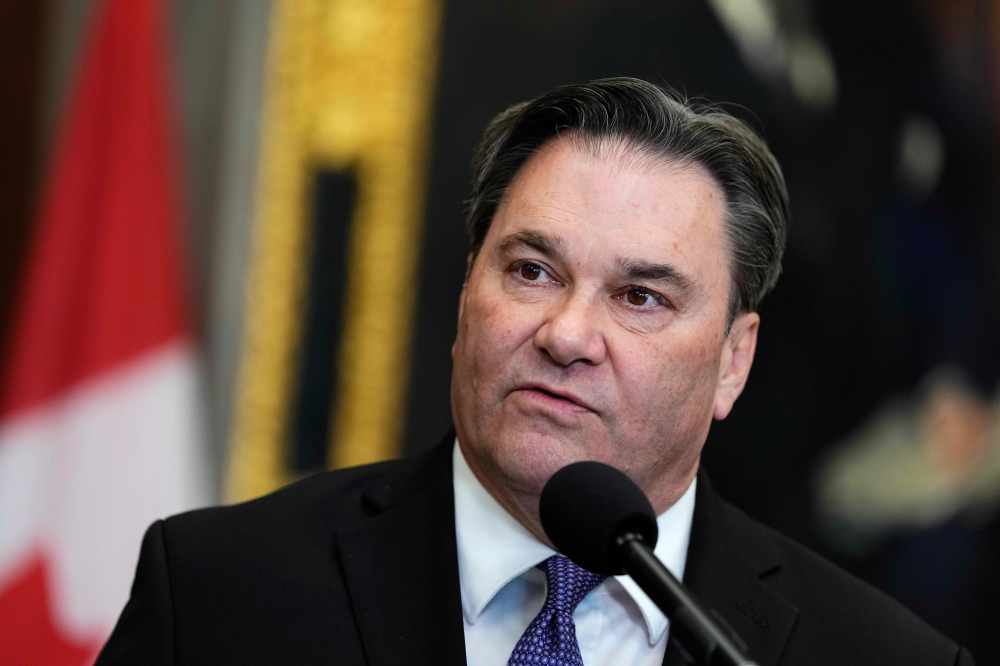
“The balance of power in this House was shifted not by voters in an election, but by political operatives in the backroom, holding private conversations hidden from the public,” he said.
“While that may not be illegal, it is inherently undemocratic.”
The Liberals won 169 seats in the 2025 election, three shy of a majority government, but five MPs crossed the floor between November and March, which, coupled with the Liberals winning three byelections to replace MPs who resigned, moved them to a slim majority of 174 seats.
The five floor crossers include former Conservatives Chris d’Entremont, Michael Ma, Matt Jeneroux and Marilyn Gladu, along with Nunavut MP Lori Idlout, who left the NDP for the Liberals in March.
Deputy Conservative leader Melissa Lantsman said Tuesday voters should have some means to hold floor crossers accountable, but she hasn’t had a chance yet to look at Davies’ bill.
“We’ll take a look at that legislation. We’ll look at a number of different options to make sure that voters have accountability for the members that they elected and the party that they elected them in,” Lantsman said.
The Conservatives have adopted floor crosses previously, including in 2006, when B.C. MP David Emerson was re-elected as a Liberal in the general election, but crossed to the Conservatives and was appointed to cabinet before the House of Commons began sitting under the new Parliament.
The NDP has an internal party policy barring it from accepting a floor crossing MP into its caucus, but neither the Liberals nor the Conservatives do.
D’Entremont, who was the first opposition MP to join Carney’s Liberals, said he and other MPs who crossed the floor did speak with their constituents before making their decisions.
“We did a lot of work over the summer talking to constituents, seeing what they thought. I mean, not coming out and saying, ‘Hey we’re going to cross the floor,’ but are you happy with the direction that this party or that party is going in,” he said Tuesday.
“There is a freedom of choice that a member has,” d’Entremont said, adding that Canadians elect individual MPs, “not parties, and it’s up to that member to make a decision of how to best represent their constituents when that time comes.”
D’Entremont said “probably 80 per cent” of the constituents he’s talked to are either happy with his move or at least understood his decision.
Laura Stephenson, a political-science professor at Western University, said while voters in federal elections choose individuals to represent their communities in Ottawa, party affiliation is a key factor in those decisions.
“So the idea behind this bill is an interesting one because it’s more speaking to the reality, which is that when voters go to the polls, they are in fact choosing the party as well,” Stephenson said.
In 2006, the Manitoba NDP provincial government passed a bill similar to what Davies’ proposes, and it remained in effect until 2018 when the Progress Conservative government at that time repealed it. It was challenged in court by an a former Tory MLA who was kicked out his party and was prevented from joining another caucus without resigning and winning a byelection first.
In June 2018 a Manitoba judge ruled the law was not a violation of the Charter of Rights and Freedoms.
Library of Parliament data shows 80 MPs have switched sides over the last 25 years.
Davies said while he’s not optimistic about the Liberal government passing this bill, he’s introduced similar legislation to every Parliament since he was first elected in 2008 and he hopes parliamentarians come together to help restore faith in the system.
He pointed to Gladu telling the Sarnia Observer that it seems government MPs get more for their ridings than those in the opposition benches.
“That’s U.S.-style, southern pork-barrel politics. And I don’t think Canadians support that,” Davies said.
“So that’s another reason I’m more concerned about this bill now than I used to be, because now you have MPs who cross the floor openly saying that they think they can get more government pork in their riding. That’s not the way government should work.”
This report by The Canadian Press was first published June 2, 2026.
— With files from Catherine Morrison.