
ITK president reflects on Mary Simon’s legacy as first Indigenous Governor General
Advertisement
Read this article for free:
or
Already have an account? Log in here »
We need your support!
Local journalism needs your support!
As we navigate through unprecedented times, our journalists are working harder than ever to bring you the latest local updates to keep you safe and informed.
Now, more than ever, we need your support.
Starting at $15.99 plus taxes every four weeks you can access your Brandon Sun online and full access to all content as it appears on our website.
Subscribe Nowor call circulation directly at (204) 727-0527.
Your pledge helps to ensure we provide the news that matters most to your community!
To continue reading, please subscribe:
Add Brandon Sun access to your Free Press subscription for only an additional
$1 for the first 4 weeks*
- Enjoy unlimited reading on brandonsun.com
- Read the Brandon Sun E-Edition, our digital replica newspaper
*Your next Free Press subscription payment will increase by $1.00 and you will be charged $20.95 plus GST for four weeks. After four weeks, your payment will increase to $24.95 plus GST every four weeks.
Read unlimited articles for free today:
or
Already have an account? Log in here »
OTTAWA – Inuit Tapiriit Kanatami president Natan Obed says he’s proud of how Gov. Gen. Mary Simon used her time in office to seek a balance between her dual identities as an Inuk woman and the Crown’s representative in Canada — roles that some Indigenous people felt were inherently in conflict.
“Self-determination also means that you get to decide whether or not to play any role within this country, and I think Mary was able to balance her indigeneity with her official function as head of state on behalf of the King for Canada,” he said.
“All throughout her role as Governor General, she has maintained just this down-to-earth attitude about the way that she interacts with and cares for people.”
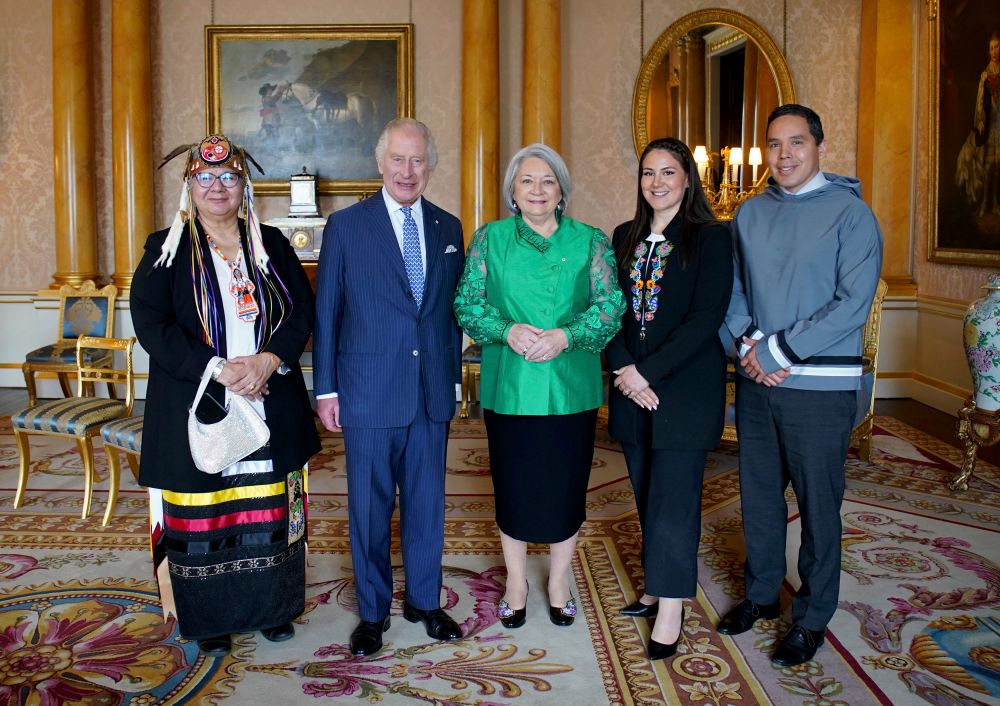
Simon, who has for years championed Canada’s reconciliation with Indigenous Peoples, has reached the end of her tenure, having served both Queen Elizabeth and her son King Charles. Louise Arbour, a former Supreme Court justice and United Nations high commissioner for human rights, is set to replace her on Monday.
Obed said he sees Simon as a kind of national grandmother figure — she loves children and loves seeing them succeed. She also has a way of making people from diverse backgrounds feel at ease in her presence.
He said he saw that side of her often when, during the many long flights they shared or official events they attended, Simon would lean over to tell him a joke or ask him about his family. It also shone through when she used her office to champion the accomplishments of Indigenous Peoples and Canadians.
“It’s made be think a little bit differently, and more positively, about the role of governor general,” he said.
Simon was uniquely suited to understand both the limitations and the powers of the job, Obed said, and Indigenous people, especially Inuit, looked on her with a degree of reverence.
“None of this happens, though, without her connection to community and her humility with taking on this role,” he said.
Obed has watched and stood alongside Simon as she fought for Inuit and Indigenous rights over the decades. She represented the people of Nunavik during the negotiations that led to the patriation of the Constitution in 1982.
Obed said Simon’s leadership was a factor in the talks that led to the inclusion in the Constitution of Section 35, which affirms the rights of Indigenous Peoples in Canada.
He said Simon never forgot where she came from and Indigenous people saw her as a symbol of success.
“And so then for that success to translate, to be recognized by the prime minister and be given this role, I think it really shone a light on how powerful it is to serve your community and your people,” Obed said.
That community connection was vividly displayed in Rideau Hall throughout Simon’s tenure. Sealskin draped the tables and Inuit artworks adorned the walls. The menus for the official receptions she hosted often featured both conventional fine dining and items of Indigenous cuisines that helped teach her international guests about the nature of Canada.
Those reminders of home, Obed said, served to make Rideau Hall a more welcoming place for all.
“I think that’s the epitome of a great leader,” he said.
“She has a great wit about her — and that wasn’t meant to be a pun for her partner Whit Fraser, but I also think of Whit as well.”
Whit Fraser and Obed go way back. Fraser hired Obed as director of socioeconomic development at ITK and Obed worked under him for almost two years. When he was the chair or the National Inuit Committee on Health, Obed would come to Ottawa and present to the ITK board when Simon was serving as its president.
Simon’s time at Rideau Hall wasn’t trouble-free. She faced early and sustained criticism over her inability to speak fluent French and a barrage of comments she called both racist and sexist.
Obed said her critics in the media and public life were too cavalier in their approach to her supposed deficiencies throughout her tenure.
“She is bilingual. If you know anything about Mary Simon, that’s the first thing you know,” he said, pointing out that she speaks fluent Inuktitut.
“The second thing is I guess she wasn’t colonized well enough so that she didn’t have French as well in her upbringing … Mary Simon grew up in that space where the government of Quebec wanted nothing to do with her, so the fact that she continues to serve Canadians and be proud for being Canadian is pretty remarkable.”
The criticisms notwithstanding, Obed said, Simon is someone who always looks forward.
“She’s not hung up on the fights of the present, or even the political spats between individuals. She’s more focused on, ‘What can we achieve in this moment?'” he said.
Obed said he’s keen to see what Simon does next. He said he’s hoping she’ll help ITK push forward with the creation of Inuit Nunangat University — an institution Simon championed as ITK president. Once the university opens in 2030, Inuit students will be able to obtain post-secondary degrees in their homelands for the first time ever.
He said he also hopes she sets aside time to unwind after an eventful few years.
“She loves to berry pick and she loves to be in Inuit Nunangat,” Obed said.
“So I hope that she’s able to relax a little bit.”
This report by The Canadian Press was first published June 7, 2026.