
Ancient squirrel feces a ‘time capsule,’ smelling as fresh as 700,000 years ago
Advertisement
Read this article for free:
or
Already have an account? Log in here »
We need your support!
Local journalism needs your support!
As we navigate through unprecedented times, our journalists are working harder than ever to bring you the latest local updates to keep you safe and informed.
Now, more than ever, we need your support.
Starting at $15.99 plus taxes every four weeks you can access your Brandon Sun online and full access to all content as it appears on our website.
Subscribe Nowor call circulation directly at (204) 727-0527.
Your pledge helps to ensure we provide the news that matters most to your community!
To continue reading, please subscribe:
Add Brandon Sun access to your Free Press subscription for only an additional
$1 for the first 4 weeks*
- Enjoy unlimited reading on brandonsun.com
- Read the Brandon Sun E-Edition, our digital replica newspaper
*Your next Free Press subscription payment will increase by $1.00 and you will be charged $20.95 plus GST for four weeks. After four weeks, your payment will increase to $24.95 plus GST every four weeks.
Read unlimited articles for free today:
or
Already have an account? Log in here »
The scent of ancient squirrel feces filled the laboratory where researcher Tyler Murchie was working to extract the genetic material it contained, revealing the scat can still smell just as fresh today as it did some 700,000 years ago.
The droppings collected from ancient ground squirrel burrows preserved by permafrost for millenniums didn’t smell like anything at first, but once Murchie inserted fluid to release the ancient DNA, he said there was an “overwhelming” smell.
“It hasn’t (undergone) mineral replacement like you’d find with dinosaur coprolites or paleofeces. In this case, it’s still organic,” he said.
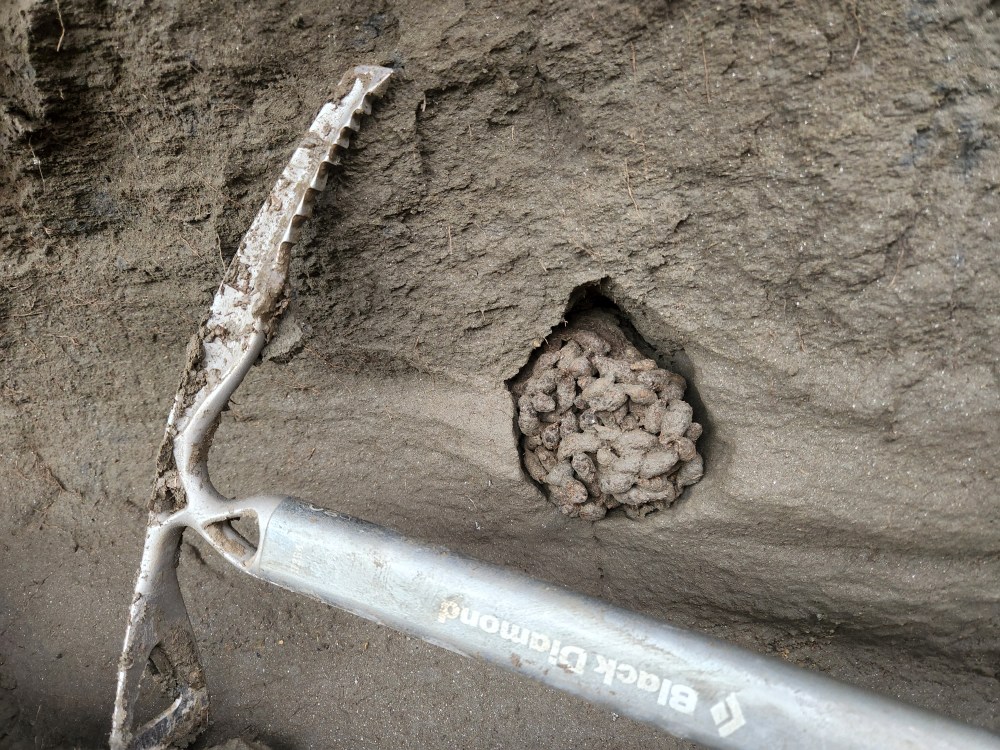
Murchie is the lead author of a peer-reviewed study released Tuesday that used the frozen feces pellets dating from between 17,000 and 700,000 years ago to identify an array of plant and animal life in Yukon’s Klondike region, including woolly mammoths.
The palaeogenomics researcher likened the pellets to “little frozen time capsules” providing a snapshot of the environment when the squirrels were alive.
“I would have thought the microbes in the digestive system would have destroyed the DNA, but it turns out in some cases DNA can be quite resistant to degradation,” said Murchie, a scientist with the British Columbia-based Hakai Institute.
“When you combine that with being frozen perpetually for all this time, you can have some really amazing preservation of these biomolecules.”
The paper, published in the journal Nature Communications, shows the ancient droppings contained the DNA of lemming, pika, caribou, wolf or coyote, snowshoe hare, among other animals, and an array of different plants.
The scat also revealed the squirrels were likely scavenging the carcasses of mammoths along with extinct species of bison and horse, Murchie said.
He said the findings paint a picture of the Pleistocene, commonly known as the last Ice Age, when mammoths and cheetahs roamed a landscape covered in grasses and flowering herbs, with some woody vegetation and very few trees.
The squirrels may not be as “charismatic” as the larger animals, but their droppings offer “huge” information potential, bolstered by the breadth of their diet, he said.
With modern humans, or Homo sapiens, emerging about 300,000 years ago, Murchie said the oldest sample used in the study is about twice as old as humanity.
The ancient squirrel burrows in the Yukon are particularly useful because they’ve been preserved in layers of volcanic ash, allowing researchers to establish more precise estimates of their ages than similar sites in Siberia, Murchie noted.
Murchie said studying the ancient squirrel feces has the potential to help researchers understand shifts between interglacial periods and offer insight into the current epoch, the Holocene, which began about 11,700 years ago.
“One of the areas that I’m most excited to get into is the last interglacial. So, this was about 115,000 thousand years ago, when it was warmer than it is today.”
Murchie said he hopes studying that period will help researchers understand how anomalous the Holocene is, particularly given human-caused climate change that is also melting the permafrost that has kept the ancient scat frozen in time.
“It might be that we’ve broken the glacial-interglacial cycling and that we may not enter another glacial period. And what that means, who knows.”
This report by The Canadian Press was first published June 9, 2026.