
At 356, the HBC charter is about to get a Manitoba Museum welcome
Advertisement
Read this article for free:
or
Already have an account? Log in here »
We need your support!
Local journalism needs your support!
As we navigate through unprecedented times, our journalists are working harder than ever to bring you the latest local updates to keep you safe and informed.
Now, more than ever, we need your support.
Starting at $15.99 plus taxes every four weeks you can access your Brandon Sun online and full access to all content as it appears on our website.
Subscribe Nowor call circulation directly at (204) 727-0527.
Your pledge helps to ensure we provide the news that matters most to your community!
To continue reading, please subscribe:
Add Brandon Sun access to your Free Press subscription for only an additional
$1 for the first 4 weeks*
- Enjoy unlimited reading on brandonsun.com
- Read the Brandon Sun E-Edition, our digital replica newspaper
*Your next Free Press subscription payment will increase by $1.00 and you will be charged $20.95 plus GST for four weeks. After four weeks, your payment will increase to $24.95 plus GST every four weeks.
Read unlimited articles for free today:
or
Already have an account? Log in here »
TORONTO – When Hudson’s Bay faltered last year, Manitoba Museum CEO Dorota Blumczynska didn’t even need to look at the institution’s bank accounts to know it couldn’t afford to buy the royal charter that formed Canada’s oldest business.
“Our acquisition budget as a museum has a balance of just over $4,000,” she said Monday. “Regrettably, it was nowhere in the realm of the possible.”
And yet later this week the Winnipeg institution will show off the 356-year-old document it now jointly owns in a welcoming ceremony expected to draw representatives from First Nations, Inuit and Métis governments, along with corporate supporters.
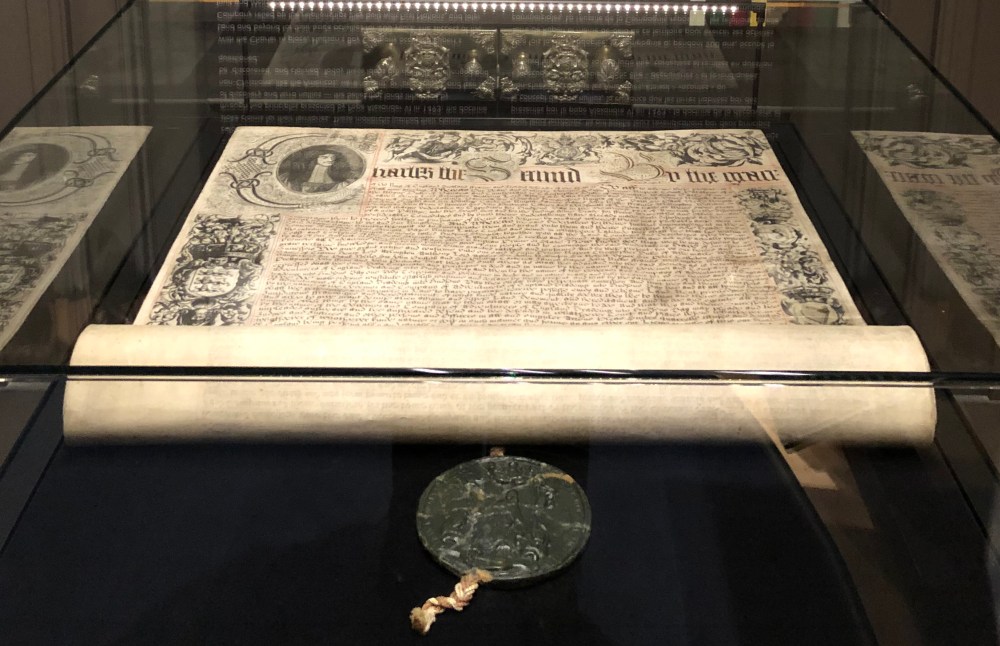
The Thursday ceremony will bring the charter home in some ways; the museum hosts 28,000 HBC artifacts donated in 1994 and Winnipeg is where the company opened its first department store in 1881.
The charter will be displayed during the ceremony before it’s sent back to storage in preparation for a one-year exhibition at the museum, likely in fall 2027.
The reception will mark a new chapter in the history of the 1670 charter, which gave HBC extraordinary control over Canadian land — and the Indigenous peoples who lived there — for decades before the country’s birth.
The artifact was sold to the Weston and Thomson families for $18 million after the fur-trading-company-turned-department-store’s collapse last year. Within 24 hours of the December purchase, they donated it to the Manitoba Museum, the Archives of Manitoba, the Canadian Museum of History in Gatineau, Que., and the Royal Ontario Museum in Toronto, Ont.
Blumczynska is still in disbelief that her museum was chosen not only to be the first to display the charter but also as one of its owners.
“I couldn’t have imagined it but here we are,” she said.
Since the quartet of institutions took ownership of the charter, Blumczynska said they’ve mostly been exploring how to work together.
“To the best of our knowledge, there has never existed this model of shared stewardship across four organizations spanning the country in a shared responsibility for one particular item,” she said.
Soon after the charter’s ownership was transferred to them, she said the artifact went through a thorough assessment from the Canadian Conservation Institute, a government agency that ensures historical items are preserved and accessible to Canadians.
The assessment was meant to get a sense of the charter’s condition, its conservation needs and how it could travel between the museums and any other institutions lends the document.
Blumczynska said what they found is that the charter “has generally held up very well,” despite its age and many moves.
The five-page vellum document with a red wax seal is notoriously fragile. Fluctuations in lighting, temperature and air quality can cause damage, as well as any movement or moisture.
When it travelled to the Manitoba Museum for its first and only public exhibition during the COVID-19 pandemic, the charter was transported on a private plane with a conservator specializing in paper documents and its own armed security team, who never took their eyes off the artifact.
It otherwise spent the last 52 years under glass in HBC’s Toronto head office, after centuries being shifted around HBC’s various England headquarters and a rural manor where it waited out the Second World War. (While it was for sale, it was stowed at a secret and secure storage facility.)
The challenge the Manitoba Museum and the charter’s other custodians now have is figuring out how to show the document to the public without compromising completely on its care.
“Absolute conservation might have it be in the dark, never moving, closed off from the public,” Blumczynska said.
“But then it doesn’t serve truth and reconciliation, it doesn’t serve our shared understanding of history and it doesn’t serve community connection and well-being.”
Over the next year, the new owners will decide whether the ROM or Canadian Museum of History will be next to host the charter.
They will also figure out how to balance all of the charter’s needs through a Weston and Thomson-ordered consultation with Indigenous groups, other museums, universities, archives, subject matter experts and the public.
They will be aided by $5 million the families donated to ensure the charter is preserved and shared with the public. Also at their disposal will be future support pledged by the Desmarais family and Power Corp. of Canada, along with the Hennick Family Foundation.
The plan is to find a way to preserve the charter but also let it visit public organizations from coast to coast.
Because not every community might have the right facilities and because the charter will likely need resting periods of perhaps five years, Blumczynska said high-end replicas are likely to be made.
Educational programs that integrate the charter into elementary and high school curriculum and teach adults about the document and HBC’s painful past will probably be in the mix, too.
Already, Blumczynska said seeing the document for herself has had an impact.
“It has shaped my understanding of my relationship with this country and that’s what I hope it offers others,” she said.
“I can’t say that it is a celebratory moment, but it is a transformative moment that will change, I hope, our collective understanding of who we are.”
This report by The Canadian Press was first published June 10, 2026.