
May the best team win… maybe
A gander of World Cup history reveals team destined to list trophy falls short
Advertisement
Read this article for free:
or
Already have an account? Log in here »
We need your support!
Local journalism needs your support!
As we navigate through unprecedented times, our journalists are working harder than ever to bring you the latest local updates to keep you safe and informed.
Now, more than ever, we need your support.
Starting at $15.99 plus taxes every four weeks you can access your Brandon Sun online and full access to all content as it appears on our website.
Subscribe Nowor call circulation directly at (204) 727-0527.
Your pledge helps to ensure we provide the news that matters most to your community!
To continue reading, please subscribe:
Add Brandon Sun access to your Free Press subscription for only an additional
$1 for the first 4 weeks*
- Enjoy unlimited reading on brandonsun.com
- Read the Brandon Sun E-Edition, our digital replica newspaper
*Your next Free Press subscription payment will increase by $1.00 and you will be charged $20.95 plus GST for four weeks. After four weeks, your payment will increase to $24.95 plus GST every four weeks.
Read unlimited articles for free today:
or
Already have an account? Log in here »
The best team doesn’t always win the World Cup.
The Netherlands knows this; Hungary, too. And Brazil, the only country with five stars on its shirt, might be forgiven for wanting seven.
Those are the most famous examples, and we’ll get to them. But a number of others deserve recognition as well — none of it detracting from the teams that actually lifted the trophy.
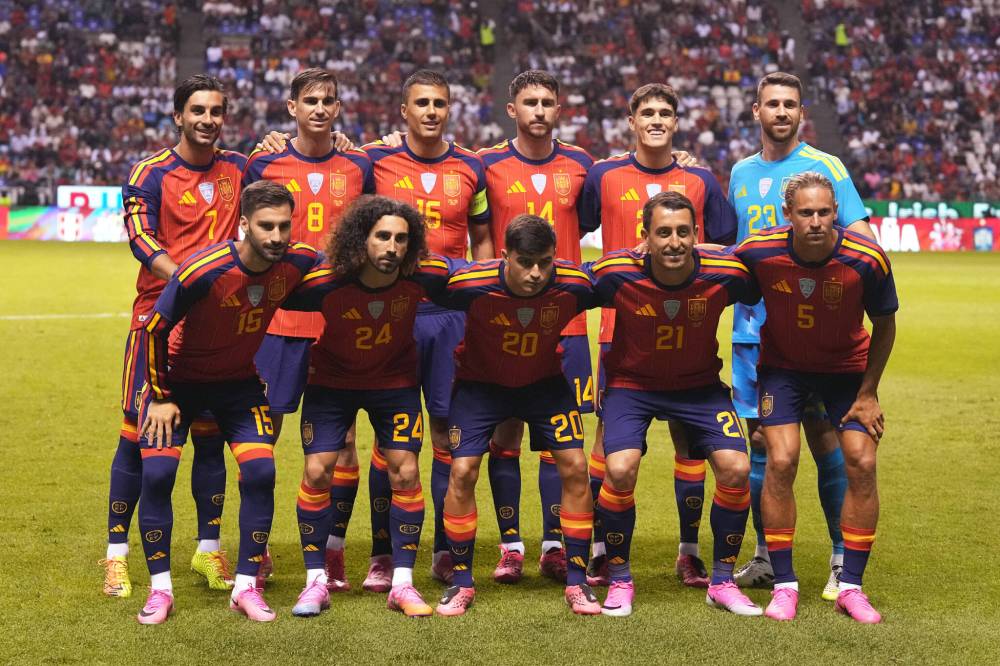
Moises Castillo / THE ASSOCIATED PRESS
Spain is one of the favourites to win the 2026 World Cup. But even if the team cruises to a Group H win, history tells a different tale about tourney juggernauts.
Thomas Padilla / THE ASSOCIATED PRESS
Head coach Didier Deschamps (right) looks to lead World Cup co-favourite Kylian Mbappé (left) and France to football’s promised land.
Like Austria, for example.
The Wunderteam of Hugo Meisl, one of European football’s great innovators, was a favourite to win the 1934 World Cup and, in other circumstances, probably would have.
That February, it had beaten Italy 4-2 in Turin and arrived at the tournament — also in Italy — without a loss in more than a year. It had also recently won the Central European championship, thanks in large part to a 2-1 defeat of Italy in Vienna.
In a fully knock-out tournament, Austria disposed of France and Hungary before facing the host in the semifinal.
Heavy rain had ruined the San Siro pitch, making Meisl’s tiki-taka precursor difficult to execute. Star striker Matthias Sindelar was also kicked, hacked and generally bullied to the point of ineffectiveness. The Azzurri prevailed 1-0 in front of Benito Mussolini.
Four years earlier, Argentina had arrived in neighbouring Uruguay at least half expecting to win the inaugural World Cup. And when it gazumped France, Mexico, Chile and the United States to the tune of 16-5, and then led Uruguay 2-1 at the break in the final, it seemed as though the Jules Rimet Trophy was bound for Buenos Aires.
That’s when things took a dark turn.
Some decades later, the granddaughter of Argentine superstar Luis Monti revealed that a number of Uruguayan heavies had entered the visitors’ dressing room and threatened to kill his mother and sister. The host came back to win 4-2.
Uruguay was also the unlikely winner of the 1950 World Cup, albeit in very different circumstances.
In the aftermath of the Second World War, depleted squads and early Cold War alliances saw numerous teams either refuse to participate or withdraw during qualification. Italy, meanwhile, was reeling from the Superga Air Disaster in which the entire Grande Torino squad had perished.
Argentina was one of the countries to pull out, so Uruguay qualified automatically as a result.
Brazil, hosting for the first time and powered by the brilliant Ademir, blazed through the group stage and dispatched Sweden and Spain in the final round by a combined score of 13-2. It also took the lead against Uruguay before losing the final match 2-1 in front of nearly 200,000 fans at the Maracanã. The loss remains known as “O Maracanaço,” The Maracanã Smash.
Glory eluded Brazil once again in 1982.
This was the famous Seleção of Socrates, Zico and Falcão, and for the better part of five matches it played some of the most mesmerizing football the sport has ever seen.
The Soviet Union, Scotland, New Zealand and Argentina were dissected in turn, and until the final quarter-hour against Italy the Brazilians seemed destined — and assumed, themselves, to be destined — for a semifinal versus Poland and the inevitable final thereafter. Well, it didn’t turn out that way.
Paolo Rossi’s hat trick and Claudio Gentile’s marking job on Zico sealed progression for the Azzurri. Socrates would later claim the July 5th match in Barcelona was the day football died.
The 1974 World Cup final featured a similar stylistic clash, as the flashy, total-footballing Netherlands side of Johan Cruyff, Johan Neeskens and Johnny Rep took on the calculated West Germany team of Franz Beckenbauer, Paul Breitner and Gerd Müller.
Unsurprisingly, the Dutch had blown the doors off the group stages with convincing wins over Brazil, East Germany, Argentina and Bulgaria. So no one was especially shocked when it took an early lead on the host nation in the final.

But the West Germans equalized on a 25th minute penalty, and shortly before the half-time whistle Müller scored what proved to be the winner.
Thirty-four years later, ex-FIFA president João Havelange told Folha de São Paulo — though without a shred of proof — that the governing body had sought to ease the path of the host, just as it had done in 1966 when England won the World Cup at Wembley.
Havelange was never a particularly trustworthy figure, so there’s no reason to take him at his word. But the fix was most certainly in at the 1978 tournament in Argentina, albeit orchestrated by the government.
Once again, the Netherlands was a heavy favourite to win a first World Cup and advanced to its second successive final after topping a second-phase group that also included Austria, Italy and West Germany. Brazil looked well-positioned to meet the Dutch at River Plate’s Monumental, but a curiously lopsided win over Peru vaulted the host country into a first World Cup final since 1930.
At the time there were, and there remain, believable reports that the military junta had pressured Peru into throwing the match, and it was under this cloud that Argentina beat the Netherlands in extra time.
Unfortunately for Mario Kempes, who was spectacular throughout the competition, the 1978 World Cup has been remembered more for the public crackdowns, threats and press intimidation than the football. (Sound familiar?)
If the Netherlands can be forgiven some bitterness at not winning a World Cup in the ’70s, Hungary can be pardoned its anger at being robbed in 1954.
Less than two years on from winning gold at the Helsinki Olympics, the Magical Magyars of Ferenc Puskás, Sándor Cocsis, Zoltán Czibor and other superstars was widely predicted to replicate its success in Switzerland. The previous November, it had even dismantled an England side led by Stanley Matthews at Wembley.
An 8-3 group stage drubbing of West Germany did nothing to temper expectations, nor did knock-out victories over Brazil and Uruguay. What was less anticipated was the rainstorm that greeted Hungary and West Germany for a rematch in the final.
The conditions were not the same for everyone. Prior to kickoff, the West Germans debuted a new Adidas boot equipped with special screws ideal for the waterlogged pitch. The officiating tilted things further.
West Germany’s second goal, an equalizer set up by a foul, probably shouldn’t have stood, and a late Puskás tally was denied by a dubious offside call. The 3-2 defeat was Hungary’s first loss in five years, and given that it was clearly the superior team the result did not go down well.
Now, each of these examples is at least 44 years old, and the separation of time allows us to examine them more objectively than they were in the moment. A couple of decades from now, less emotive analysis may permit re-examination of more recent tournaments. (1990 comes to mind).
Even so, it’s worth bearing in mind that while just a few national teams can realistically win the World Cup, the eventual champion often benefits from luck, the weather or other unforeseen circumstances.
The best team doesn’t necessarily win the World Cup, but the right one does — almost always, anyway.
winnipegfreepress.com/jerradpeters