
Saskatchewan’s safety agency not prepared for last year’s wildfires: report
Advertisement
Read this article for free:
or
Already have an account? Log in here »
We need your support!
Local journalism needs your support!
As we navigate through unprecedented times, our journalists are working harder than ever to bring you the latest local updates to keep you safe and informed.
Now, more than ever, we need your support.
Starting at $15.99 plus taxes every four weeks you can access your Brandon Sun online and full access to all content as it appears on our website.
Subscribe Nowor call circulation directly at (204) 727-0527.
Your pledge helps to ensure we provide the news that matters most to your community!
To continue reading, please subscribe:
Add Brandon Sun access to your Free Press subscription for only an additional
$1 for the first 4 weeks*
- Enjoy unlimited reading on brandonsun.com
- Read the Brandon Sun E-Edition, our digital replica newspaper
*Your next Free Press subscription payment will increase by $1.00 and you will be charged $20.95 plus GST for four weeks. After four weeks, your payment will increase to $24.95 plus GST every four weeks.
Read unlimited articles for free today:
or
Already have an account? Log in here »
REGINA – Saskatchewan’s community safety minister is promising to make improvements after an independent review found the province’s public safety agency was ill-prepared to fight last year’s wildfires.
“After reading this 107-page review, it is clear the Saskatchewan Public Safety Agency must do better,” Michael Weger told a news conference Friday in Saskatoon.
“I believe the Saskatchewan Public Safety Agency can and will do better and this will happen with the support of the government.”
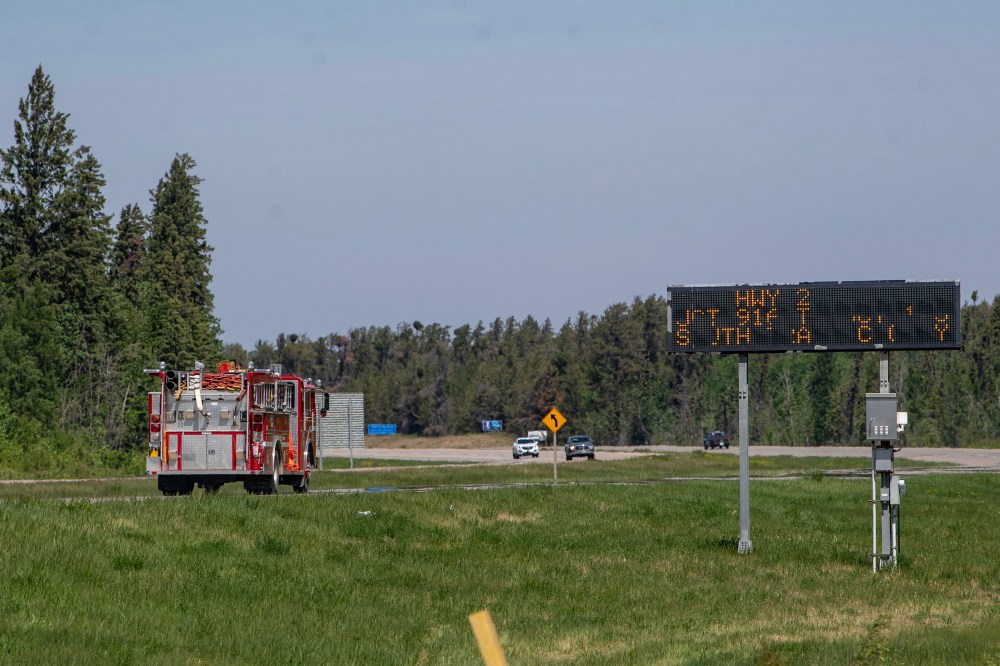
The report, released by accounting firm MNP, says the agency often operated in silos, resulting in uncertainty among staff about their roles and responsibilities.
It also says there was insufficient pre-season planning and delays in hiring, training and procuring equipment.
“While the (agency) had some foundational planning and structures, it was not fully prepared for a wildfire season of the scale and complexity seen in 2025,” the report says.
“Staffing shortages, recruitment challenges, and difficulty retaining both specialized and seasonal personnel further reduced preparedness levels.”
The 2025 fires were among the province’s worst on record. They forced more than 10,000 residents from their homes and burned 29,000 square kilometres of northern forest.
In Denare Beach, near the Manitoba boundary in northeast Saskatchewan, about 400 homes — half the village — were destroyed.
The report says while fire was encroaching on Denare Beach, firefighting staff were spread thin.
“(Agency) staff interviews noted there was insufficient personnel to deploy to support some communities to ensure adequate capacity to respond to this fire,” it says.
It also says the agency didn’t report on whether it ran modelling software each day to project the fire’s growth. It says modelling that was done didn’t account for a cold front that fanned the flames into Denare Beach.
It’s also unclear if previous “fuel management projects” near the village were effective, the report adds.
Karen Thomson, deputy mayor of Denare Beach, said village council hasn’t had the time yet to review the findings.
She said councillors spoke with Weger on Friday morning but they were not able to see the report before it was released publicly.
“I’m a little disappointed that we’re being privy to it at the same time as the general public, because I think Denare Beach had a major role to play in the inception of the report,” she said.
“As to the contents (of the report), I can’t say one way or another.”
Jennifer Hysert, a Denare Beach resident who lost her home and business in the fire, said the findings confirmed what she already knew — the agency lacked resources.
“The report indicates the need for a public inquiry, and it might be the last chance for Premier Scott Moe to redeem himself,” she said in an interview.
“We deserve the right to be heard and we deserve to have all levels of government present to hear, see and feel how their lack of response affected us all.”
Hugh Gordon, the NDP’s public safety critic, told reporters the public has a right to question the management of the safety agency.
“It’s a damning report,” Gordon said. “I think we’ve got some really serious questions about the competence and capability and skill set of this government to deliver.”
Others issues flagged by the review found the agency didn’t go through hypothetical emergency scenarios before wildfire season began.
It says the agency’s spring outlook that year put Saskatchewan at a moderate drought risk, with the northeast being even drier.
On evacuations, the report says there was confusion around who was in charge. Emergency alerts were also inconsistent and delayed, with some host communities receiving little notice of incoming evacuees.
“These breakdowns in coordination, combined with unclear roles between the (agency) and partner agencies, created uncertainty, strained local capacity, and weakened confidence in the (agency’s) ability to provide timely, consistent evacuation leadership,” the report says.
In April, Saskatchewan’s ombudsman released a report finding the agency was slow to respond to evacuees, leaving some without supports to get food or shelter.
Marlo Pritchard, the president of the agency, told reporters Friday he takes full responsibility for issues outlined in the report.
“I have committed to my board and to my minister that we can do better. We now have a road map to follow,” he said.
The agency is also working to provide money to evacuees in the future through e-transfers, he added.
The report outlines 11 recommendations, which Weger said the government would immediately begin implementing.
The recommendations include a review of the safety agency’s structure and enhancing communication.
Weger said Saskatchewan would also be providing grants to communities to mitigate against future wildfires and training a new tier of “reservist” firefighters based in communities.
“I have the support of the premier and cabinet as we move forward with these actions,” Weger said.
“We know that the wildfires are becoming more unpredictable and in some cases like last year, more dangerous than ever. We need to learn from every season going forward and be tracking that.”
The report says climate change is putting further stressors on public safety agencies, as extreme fire seasons are expected to become more frequent in the future.
This report by The Canadian Press was first published June 12, 2026.