
Middleton adds the write stuff to karate path
Advertisement
Read this article for free:
or
Already have an account? Log in here »
We need your support!
Local journalism needs your support!
As we navigate through unprecedented times, our journalists are working harder than ever to bring you the latest local updates to keep you safe and informed.
Now, more than ever, we need your support.
Starting at $15.99 plus taxes every four weeks you can access your Brandon Sun online and full access to all content as it appears on our website.
Subscribe Nowor call circulation directly at (204) 727-0527.
Your pledge helps to ensure we provide the news that matters most to your community!
To continue reading, please subscribe:
Add Brandon Sun access to your Free Press subscription for only an additional
$1 for the first 4 weeks*
- Enjoy unlimited reading on brandonsun.com
- Read the Brandon Sun E-Edition, our digital replica newspaper
*Your next Free Press subscription payment will increase by $1.00 and you will be charged $20.95 plus GST for four weeks. After four weeks, your payment will increase to $24.95 plus GST every four weeks.
Read unlimited articles for free today:
or
Already have an account? Log in here »
When one of Manitoba’s original karate practitioners Philip Dingman died in 2023, Scott Middleton was bereft.
The Brandonite had been Dingman’s student, and after his sensei’s death, he hoped to take solace in the bread crumbs Dingman had left in his writings. When Middleton discovered there were no words to read and that all of his influential teacher’s knowledge was gone, he was determined not to follow the same path.
After all, he could read an edition of Shotokan Karate Magazine and dissect the words of someone who was long dead.
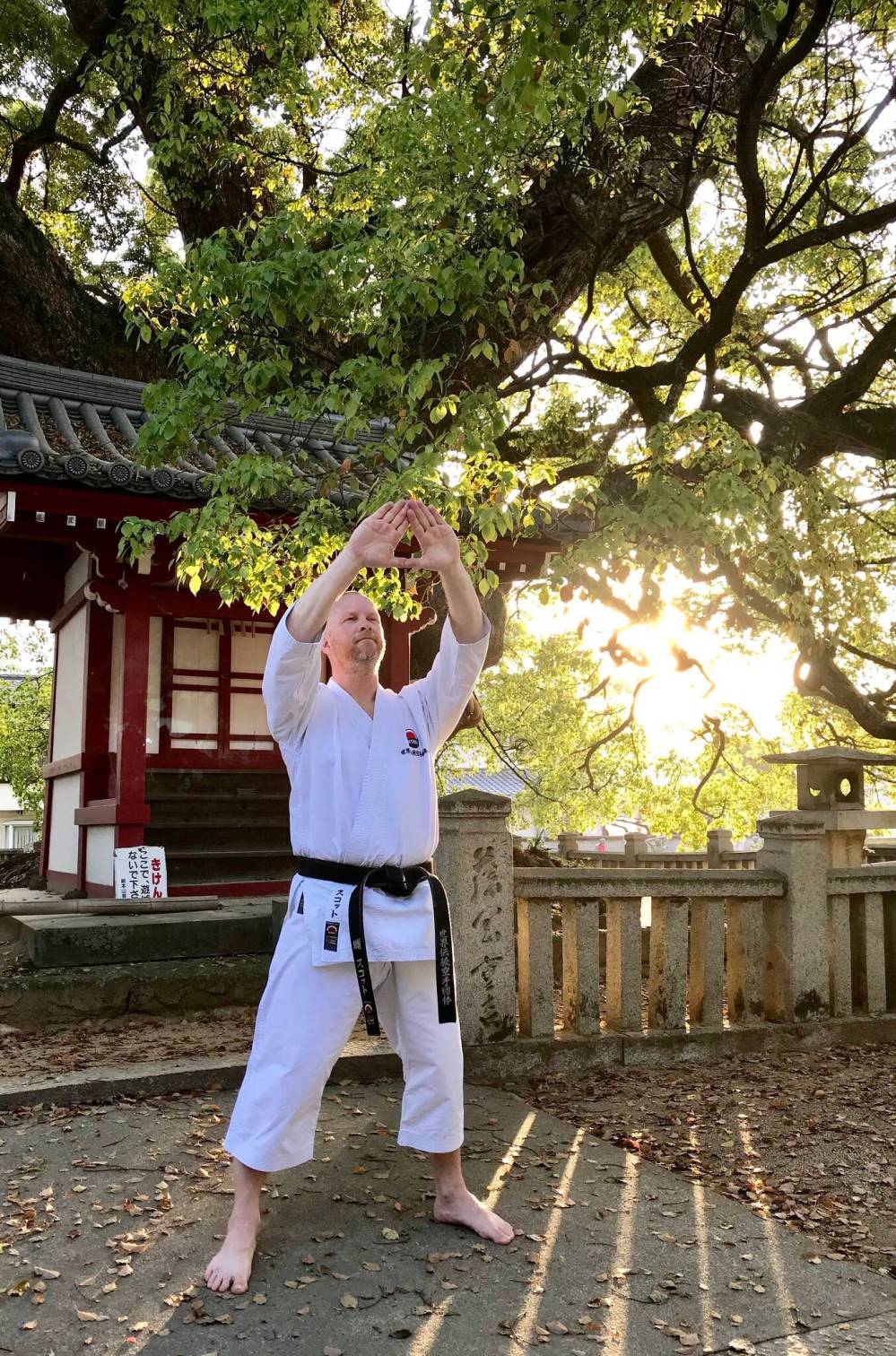
“You’ll have people who were interviewed in the magazine 35 years ago and I’ll be like ‘OK, what did they say about this?’ and go back to it,” said Middleton, who is one of fewer than 10 seventh-degree black belts in Canada. “Those words echo past the time when you’re gone. It’s like your legacy will continue, even though you’re gone.
“I felt obliged to a certain degree. That was the catalyst to make me want to write my memoirs.”
The epiphany actually happened when he was teaching Sweden, and he told his wife when he got back that he had to go visit his other formative influence, Yutaka Yaguchi, in Denver. Within a few months, Yaguchi also died.
That was the final push needed by Middleton, who turns 54 in August and has been in karate for 40 years.
“As soon as I started, wow, what a process,” said Middleton, noting it’s not unheard of for someone of his status in the karate world to write a memoir. “I’ve never written anything before besides a couple of articles. I think I’m fairly articulate and can describe knowledgeably what I’m talking about, but I had no idea how to start a book. I had never thought of the process.
“My wife gave me some really good advice when she said ‘Just start. Just start writing, all the silly jokes and silly stories you’ve been telling me from all those years and it will come together,’ and she was totally right.”
He’s now 80,000 words into what’s become a three-year project. He’s in the editing stage, and after contacting a publishing company, guesses he is six months out from having a book in his hands.
Along the way, he decided to split the book into three volumes, covering the periods of 1986 to 1999, 1999 to 2003 and 2003 to present. Each period has a special significance in his journey.
“There was no way to do my life in karate justice in one book,” Middleton said. “This sounds ambitious before I’ve written one but this is the first of three.”
The first words he wrote actually came a few years ago.
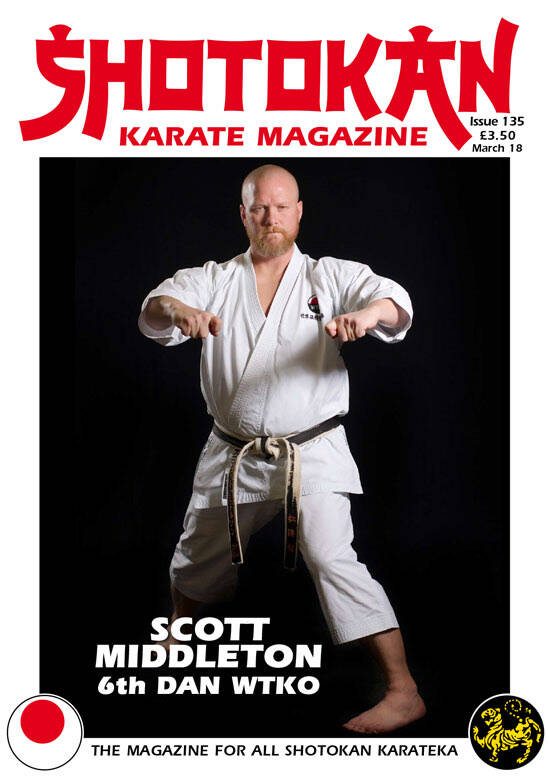
In March 2018, Middleton appeared on the cover of Shotokan Karate Magazine, becoming the first and only Canadian featured on the front in its 42-year history.
That was an incredible moment for him, because the magazine was of profound importance to him when he grew up and devoured each of their four issues every year.
“I used to look at that as a teenager and go ‘Wow, these people are the gods of karate,’” Middleton said. “When the opportunity came up, one of the proudest moments of my karate journey so far was being on the cover.”
He later submitted a couple of articles to the magazine, and after they were published, he discovered he liked the process of writing and the ability to express the techniques in words.
EARLY PATH
Middleton began taking lessons at the YMCA in early 1986 for a good reason: His younger brother was being bullied in school so their parents thought it wouldn’t hurt.
It just happened to be just after the movie The Karate Kid came out in 1984, and the 13 year old was interested anyway.
“To me it was just magical, and for a lot of kids my age,” Middleton said. “I had that image in my head that I wanted to try karate, and when the chance came up, I did.”
Five years later, he earned his first degree black belt, and by September 1992, he founded Traditional Karate of Brandon, with the first lessons offered in the Oval Room at the Sportsplex.
He continued to earn higher black belts, including second degree in 1994, third in 1996, fourth in 2000, fifth in 2008, sixth in 2013, and finally his seventh on May 1, 2022.
In the very beginning, the external validation of moving up the ranking system was important to him because it was motivational and provided short-term goals. At some point, however, that fell away.
“After 40 years of training, it becomes less and less and less important,” Middleton said. “It’s more of a by-product of what you put into it.”
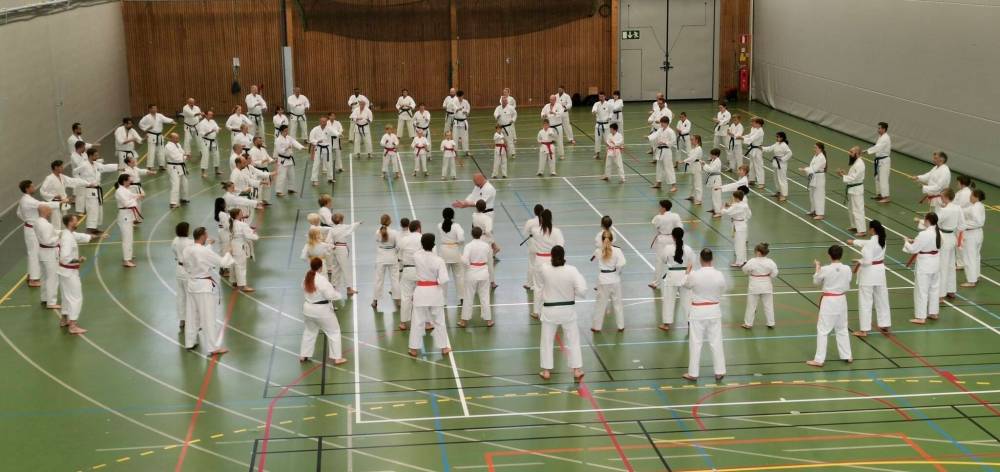
He’s now at the stage when other higher belts have to invite him to test for the next belt: He can’t ask for an opportunity. Instead, others will notice when he’s ready.
“It’s recognized in you, your maturity and growth,” Middleton said. “It’s time when it’s time.”
He’s now at the point where he doesn’t have instruction from senior belts very often, but he does seek out opinion and direction.
THE GLUE
With any sport, there’s an inevitable churn of participants as people try it and don’t last long for whatever reason. But Middleton was different. In his decades in the sport he has taught around the world, and he was asked in Norway by a student who is also a psychologist what keeps him motivated.
It wasn’t something Middleton had a ready answer for, so he reflected on it.
“Karate is a lot of hard work,” Middleton said. “You rarely see progress but the Japanese call it ‘soo ne,’ which means daily habits. It’s like brushing your teeth and having your shower. It’s something that you don’t think of, but if you don’t do, you miss. Karate for me has just engrained itself into my life and it’s something that I do every day and it’s always in my thoughts.
“I filter pretty much my entire life through karate, how I am as a parent, how I am as a man. It’s very, very difficult to separate that now.”
He gets up at 5:20 every day for his first workout in his personal dojo, goes to work, teaches and trains some more.
Middleton has at least 500 personal sessions a year and teaches another 400 classes.
In a journey that long, there are bound to be plateaus and even dips. Middleton chooses instead to focus on the tiniest details, using the example of bowing.
Hundreds of years ago, Japanese samurai were the only people allowed to carry short and long swords, and by law were allowed to test their blade at any time.
The custom of bowing began when citizens literally offered their heads to the samurai, obviously hoping they would be spared from the sword.
Middleton said understanding the real meaning behind a bow allowed him to grow as a practitioner.
To the uninitiated, karate may seem like a mixed martial art that fits into the combat sport realm. To the practitioners, however, it’s an endless string of katas, the detailed and highly structured patterns of movement. They encourage a quest for perfection as people flow from one position to another while trying to maintain ideal form.
“A lot of people just see the exterior, see the punching, see the kicking, see the kiais,” Middleton said. “They don’t see what really goes into it. It makes all the challenges of life, the stress at work and relationships, raising children, it makes everything easier. If you can go through the difficulties of the dojo, by comparison everything else is fairly easy.”
THE TEACHER
Middleton began to travel for karate in 2012, with his first trip to New York City. In the ensuing 14 years, he’s been all across Canada and the United States, Brazil, England, Scotland, Ireland, Switzerland, Germany, Portugal, Iceland, Norway, Sweden and soon Japan too.
A normal trip might take a week.
He is able to accommodate his travel within his time off from the city, where he’s worked for 37 years.
Middleton said another senior belt once told him that it’s one thing to be invited once, but another to repeatedly be brought back, because that shows people find value in his teaching. He’s been to Norway 10 times.
While he takes pride in that and is honoured by their interest, he’s always examining his motivation to ensure it’s not for money or ego fulfilment, but instead for the joy of sharing his knowledge.
“I know how important my instructors and my training were to me,” Middleton said. “I’m really positively influencing not just my students in Brandon, but people abroad. It’s very self satisfying and very self fulfilling.”
It’s no secret that we live in an increasingly less formal and arguably less disciplined world than ever before, which would seem like the polar opposite of what karate offers.
Middleton said that’s become part of its appeal. When he was a youngster and taken to church, he intuitively realized it was not somewhere to fool around and he needed to be respectful to the environment.
“When students come into my dojo, I think they understand,” Middleton said. “I start that education process right away that for me this is a very serious place. It’s not serious like we can’t have fun, but this is not something that is just for play, this is not something that’s just for show.”
That appeals to parents, who may not see their children getting those life lessons anywhere else.
As a result, he seldom advertises his classes because he doesn’t need to: Instead, people find him.
“For me it’s not a business,” Middleton said. “Just because it’s bigger doesn’t mean it’s better. I’d rather have it more intimate.”
While the movie The Karate Kid may have started a wave in 1984, the sport of mixed martial arts sparked another one in the 2000s with the dawning and increasing popularity of the UFC. Middleton rented the videotapes in the early days of MMA, and while he found that version of the sport quite sloppy, he noted the sport’s evolution in skill has made it more educational for him in terms of things like their training.
“I’m a fan of it, even though I would never pursue it myself or never put my children in it,” said Middleton, who represented Manitoba many times over the years at national sparring events. “I was already a second-degree black belt before I even heard of the UFC. It opened up a lot of people’s eyes but it also put people in certain segments.”
He said that meant some people became more invested in their martial art, while others dabbled in many.
“It was ‘OK, then I need to train in everything,’ he said. “No you don’t. You pursue one thing to the depth of its core and then see where that goes.”
He noted that nearly 400 years ago, Japanese swordsman Miyamoto Musashi suggested in The Book of Five Rings that if you fully know one thing, you know most things.
That would suggest Middleton knows a lot.
He soaked up the teachings from his instructors at an early age that karate was a righteous path, and he’s stuck to it. While he admits some days are better than others and his knees ache at times, he remains committed to the art form.
After all, his personal mantra is “Karate, the endless journey.”
“True karate is doing it for your lifetime,” Middleton said. “There’s no end to it.”
» pbergson@brandonsun.com