
Researchers take stock of storm
Advertisement
Read this article for free:
or
Already have an account? Log in here »
We need your support!
Local journalism needs your support!
As we navigate through unprecedented times, our journalists are working harder than ever to bring you the latest local updates to keep you safe and informed.
Now, more than ever, we need your support.
Starting at $15.99 plus taxes every four weeks you can access your Brandon Sun online and full access to all content as it appears on our website.
Subscribe Nowor call circulation directly at (204) 727-0527.
Your pledge helps to ensure we provide the news that matters most to your community!
To continue reading, please subscribe:
Add Brandon Sun access to your Free Press subscription for only an additional
$1 for the first 4 weeks*
- Enjoy unlimited reading on brandonsun.com
- Read the Brandon Sun E-Edition, our digital replica newspaper
*Your next Free Press subscription payment will increase by $1.00 and you will be charged $20.95 plus GST for four weeks. After four weeks, your payment will increase to $24.95 plus GST every four weeks.
Read unlimited articles for free today:
or
Already have an account? Log in here »
WINNIPEG — Researchers have collected eight-centimetre hailstones and surveyed homes damaged by hail from storms that slammed southern Manitoba this month to better understand their predictability and impact on insurance.
Jack Hamilton, a researcher with the Canadian Severe Storms Laboratory, and his team have been gathering evidence and data from the June 9 storm that brought record rainfall to Winnipeg and surrounding communities, downed trees and power lines and resulted in basement and overland flooding. Two minor tornadoes were confirmed, in Ste. Anne and Dufrost.
“In terms of severity, it was quite severe,” Hamilton said.
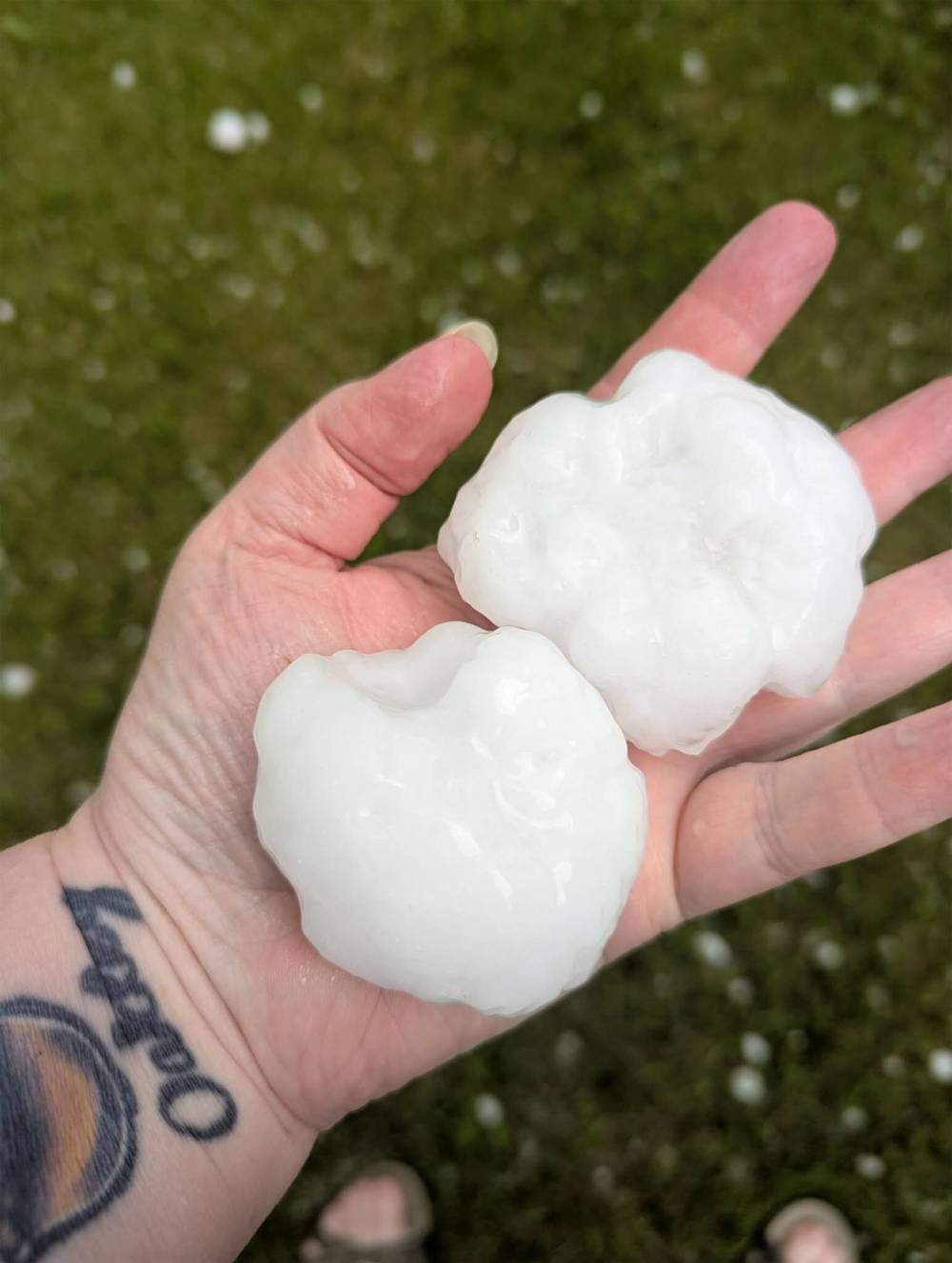
Susan Oakley holds two large hailstones that fell in Sanford on June 9. (Susan Oakley photo)
Hamilton has been working with the Northern Hail Project, which researches hailstorms to better detect them and predict their size. Hamilton and his team went to homes that had siding panels full of holes from hail that travelled at 94 kilometres per hour, or about as fast as the speed of an average Major League Baseball fastball.
Ahead of the June storm, the team had predicted the thunderstorms, but didn’t expect the system to have so much force.
“We were expecting some intense thunderstorms, and in terms of tornadoes, there were two tornadoes from that event, which is pretty high,” Hamilton said.
In the following days, the lab had three teams in Manitoba to assess the damage, a record for the most number of survey teams out on one day. They collected an eight-centimetre hailstone from East Kildonan, but believe there were larger projectiles elsewhere in the city.
On Thursday, Hamilton and a group from the lab were in Winnipeg to demonstrate some of the damaging effects of hail. The team rigged up a “hail cannon” that shot a 4.8-centimetre hailstone through a piece of siding typically found on the outside of a home at about 100 km/h. It left a gaping hole.
Researchers are trying to understand the causes of increasingly frequent storms, including the effect of climate change.
“Part of the reason that our research is so important, is that we need these big complete datasets to totally say for certain whether or not climate change is impacting it,” Hamilton said.
A Statistics Canada study released June 16 said extreme weather, exacerbated by climate change, is becoming more frequent, severe and costly. The study said insurers have paid out $9 billion for flooding across the country in the last 10 years.
A hailstorm in Calgary in 2024 was the second costliest natural disaster in Canadian history. It caused $3.29 billion in hail damage, Hamilton said.
Stonewall received 250 mm of rain on June 9. A weather station in the town has recorded 351 mm of rain since May 25, said Environment Canada meteorologist Kyle Ziolkowski.
Near the town of Clandeboye in the Interlake, weather stations have recorded 271 millimetres of rain in the last month.
While the precipitation did not set records because the area doesn’t keep climate records, Ziolkowski said the numbers are significant.
“Those are amounts that you’d see in a typical rainy season, and not in just a short period of time like a month,” he said Thursday. “For a lot of people, it’s definitely one to remember.”
With severe weather sticking around, municipalities must adapt, said Greg Kopp, director of the lab.
Kopp’s focus is to call for policy changes to building codes so residents can better protect their homes and insurance rates can stay affordable.
He advised homeowners to install backwater valves to prevent water from backing up through sinks and toilets.
Research shows tornadoes seem to be shifting eastward across Canada, so homeowners should install hurricane straps, which are metal fasteners that connect roof trusses or rafters to wall frames.
“Every one of these events, we’re always talking about billions of dollars (in damage). Now that affects insurance rates. It’s kind of like death by 1,000 cuts,” Kopp said. “If we can do some really simple measures that don’t cost too much, it can take that away.”
Manitoba has recorded five tornadoes so far this year, the lab said.
Many homeowners affected by the June 9 storm, and another storm that flooded hundreds of homes in western Manitoba on June 6, weren’t covered by insurance. The Manitoba government has made disaster aid widely available as a result. The provincial program now includes insurable damage, which is normally not the case.
Rural Municipality of Rockwood Reeve Wes Taplin said residents are frustrated money isn’t being handed out faster. In his municipality north of Winnipeg, hundreds of residents are dealing with the aftermath of flooding and many have had insurance claims rejected.
“The ones that don’t have insurance, how do they start to rebuild or repair if they have no money to do it with?” Taplin said.
The RM applied for disaster assistance to repair roads and highways that were washed out, but that money could take up to a year to be paid out, Taplin said.
A provincial spokesperson wouldn’t say how many applications it had received for disaster aid for storm coverage.
The City of Winnipeg, along with the province and other municipalities, offered a subsidy for sump pumps and backwater valves from 2011 to 2014. Owners of 3,142 homes in Winnipeg and 281 homes in rural communities used the program.
Kopp said the more proactive residents and governments can be, the less money it will cost in the long run.
“Sometimes you think, ‘oh, nothing happened, so it was a waste of money,’ but no, it’s not that. It’s when we do this all as a community, there’s a huge benefit to all of us,” he said.
» Winnipeg Free Press