
China imposing 73.5 per cent anti-dumping tariffs on Canadian pea starch
Advertisement
Read this article for free:
or
Already have an account? Log in here »
We need your support!
Local journalism needs your support!
As we navigate through unprecedented times, our journalists are working harder than ever to bring you the latest local updates to keep you safe and informed.
Now, more than ever, we need your support.
Starting at $15.99 plus taxes every four weeks you can access your Brandon Sun online and full access to all content as it appears on our website.
Subscribe Nowor call circulation directly at (204) 727-0527.
Your pledge helps to ensure we provide the news that matters most to your community!
To continue reading, please subscribe:
Add Brandon Sun access to your Free Press subscription for only an additional
$1 for the first 4 weeks*
- Enjoy unlimited reading on brandonsun.com
- Read the Brandon Sun E-Edition, our digital replica newspaper
*Your next Free Press subscription payment will increase by $1.00 and you will be charged $20.95 plus GST for four weeks. After four weeks, your payment will increase to $24.95 plus GST every four weeks.
Read unlimited articles for free today:
or
Already have an account? Log in here »
OTTAWA – China is imposing a 73.5 per cent tariff on pea starch from Canada starting Wednesday.
The Chinese commerce ministry says the levy is the result of an anti-dumping investigation it launched in August last year that found Canadian products were dumped in China.
Pea starch is commonly used as a thickener and stabilizer in food products, animal feed and medication.
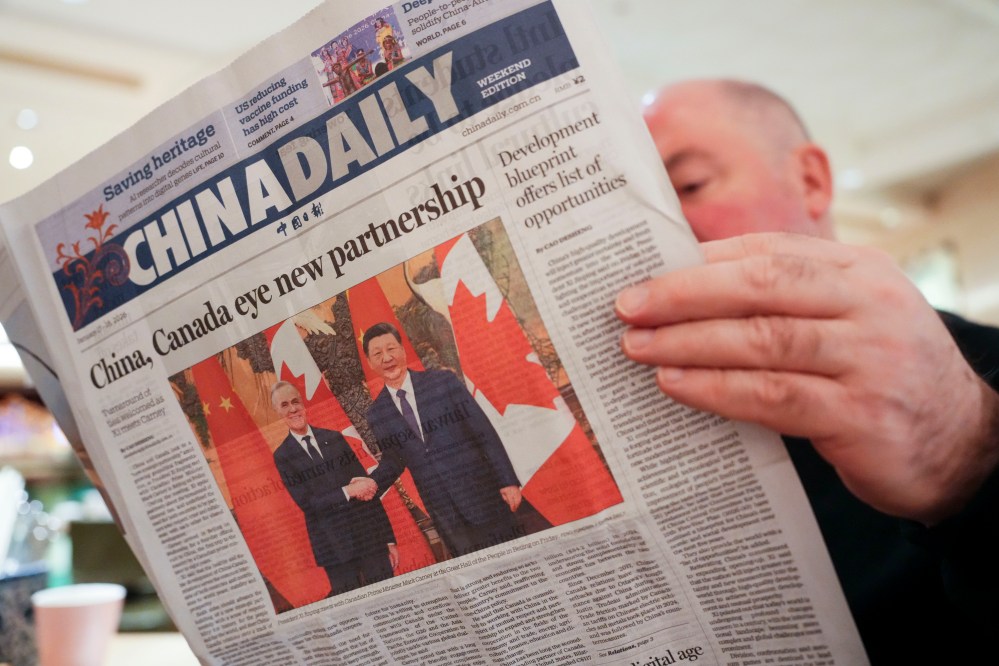
Tensions between Canada and China eased after Prime Minister Mark Carney visited Beijing in January and struck a new strategic partnership with Chinese President Xi Jinping on trade irritants.
Xi’s office characterized the meeting as a “turning point” in relations between the two countries, which had been sour since 2018.
In return for lower levies on Canadian canola seed and meal, seafood and peas, the Canadian government agreed to allow up to 49,000 Chinese electric vehicles into the country at a low tariff rate.
Canada had imposed a 100 per cent tariff on Chinese EVs, as well as batteries, solar panels and critical minerals, in 2024. In response, the Chinese imposed 100 per cent tariffs on canola products and peas from Canada, as well as 25 per cent levies on lobster, crab and pork.
Canada has remained concerned about Chinese dumping of steel products in light of U.S. tariffs. The Canada Border Services Agency announced in April it was launching an anti-dumping investigation into steel racks from China after a complaint by a group of Canadian producers. At the time CBSA said it was set to make preliminary decisions by July 20.
The Conservatives said the new tariff on pea starch “proves the Liberals’ trade strategy is a complete disaster.” In a statement signed by their agriculture critic John Barlow, international trade critic Stephanie Kusie and foreign affairs critic Eric Duncan, the Conservatives said the strategic partnership with China was reckless.
“As Conservatives warned, there was no guarantee these trade barriers would be permanently, immediately or completely eliminated,” the statement said.
“While our pea starch processors face more uncertainty, Canadian agricultural and seafood exporters continue to suffer under persistent Chinese trade barriers on pork, canola, peas and seafood this Liberal government left completely unresolved.”
Following his trip to China in late January, Carney told the House of Commons that pork producers would also soon see relief from punishing Chinese tariffs. They remain in place, along with a 100 per cent tariff on Canadian canola.
Canada is aiming to increase exports to China by 50 per cent by 2030, the same year the Carney government said it wants to double non-U.S. exports worldwide.
This report by The Canadian Press was first published June 30, 2026.