
Changing climate brings ‘new normal’
Advertisement
Read this article for free:
or
Already have an account? Log in here »
We need your support!
Local journalism needs your support!
As we navigate through unprecedented times, our journalists are working harder than ever to bring you the latest local updates to keep you safe and informed.
Now, more than ever, we need your support.
Starting at $15.99 plus taxes every four weeks you can access your Brandon Sun online and full access to all content as it appears on our website.
Subscribe Nowor call circulation directly at (204) 727-0527.
Your pledge helps to ensure we provide the news that matters most to your community!
To continue reading, please subscribe:
Add Brandon Sun access to your Free Press subscription for only an additional
$1 for the first 4 weeks*
- Enjoy unlimited reading on brandonsun.com
- Read the Brandon Sun E-Edition, our digital replica newspaper
*Your next Free Press subscription payment will increase by $1.00 and you will be charged $20.95 plus GST for four weeks. After four weeks, your payment will increase to $24.95 plus GST every four weeks.
Read unlimited articles for free today:
or
Already have an account? Log in here »
“That was probably the most intense night of severe storms I’ve seen in my 30-year career. It was wild.”
— Dan Fulton, a meteorologist with Environment and Climate Change Canada (EC) to CTV, regarding a series of storms that hit southern Manitoba, June 10.
“It just looks like a giant tornado tore up what used to be a field of grass, and it’s now a ravine. There’s like just this huge amount of earth missing, and it was just sucked out by the floodwater.”
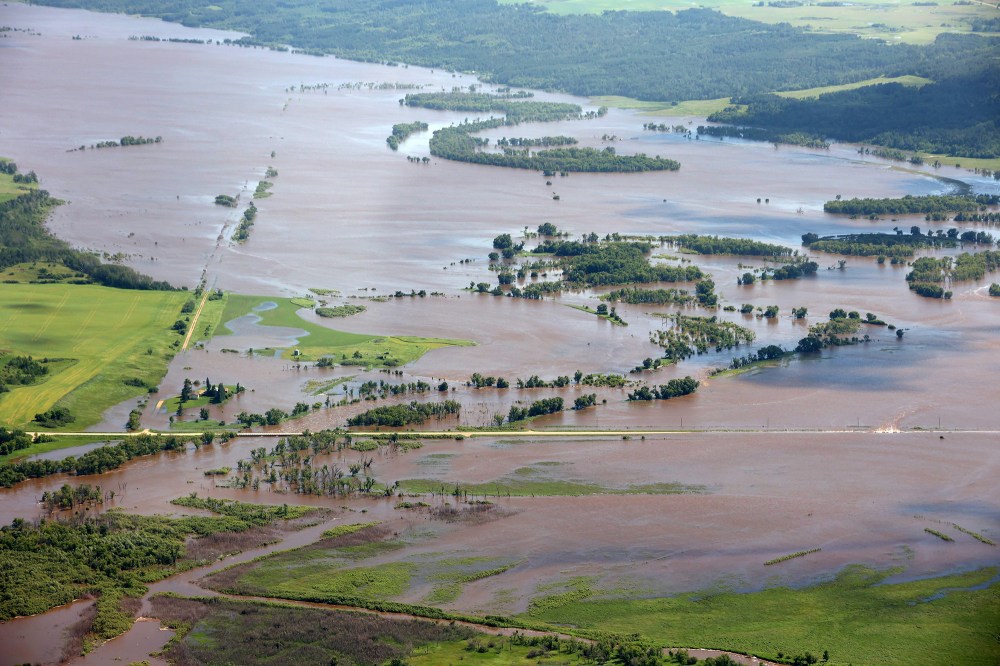
— Manitoba Premier Wab Kinew describing a piece of land near Minitonas, June 10.
“I’ve been doing this for 40 years, I’ve never seen anything like it.”
— Rossburn fire Chief Kelly Slon on June 29, after a tornado ripped through two farm properties near the community.
“In my lifetime, there’s been four or five major floods. This is probably — from a city point of view — as bad as I’ve ever seen it in the city of Dauphin.”
— Dauphin Mayor David Bosiak to CBC News, July 1.
“I’m 82 years old and I haven’t seen (a storm) like this ever like that. I can’t remember ever being a storm that’s so intense. There was a terrible wind with it and a lot of rain.”
— Killarney resident Gwen Sutton, July 6.
Residents in the Whiteshell and northwestern Ontario were cleaning up from a severe storm that destroyed trees and flooded roads in the region on Monday.
Communities around the Parkland areas continue to deal with storm damage, overland flooding and high water from the Assiniboine and Little Saskatchewan rivers that has gradually been making its way south through the watershed.
On Monday, a violent hailstorm tore through Swift Current, Sask., with heavy rain temporarily flooding streets, even as investigators with the Northern Tornadoes Project were looking into reports that a tornado touched down in the Battlefords area the Friday before.
And heavy rain and hail pounded southern Alberta this weekend, severely damaging crops in several areas of the province — much like what happened on Sunday evening between Boissevain, Killarney and Wawanesa.
This has been a month of incredibly wild weather that has left Prairie provinces reeling in the aftermath. In Manitoba alone, at least 37 municipalities have declared a local state of emergency, with the latest being the City of Brandon on Saturday, and the Municipality of Oakland-Wawanesa on Monday.
Add to that at least four First Nations, including Sioux Valley and Waywayseecappo, that have also declared states of local emergencies.
As of last Friday, dozens of highways in the western half of the province remained closed due to flooding. And though the province is attempting to take stock of the situation, needed repairs that will come as a result of all the washouts and flood damage to our roadways will be both extensive and expensive.
Yet we can be thankful as a province that — in spite of all of the damage to our communities, homes and infrastructure throughout the region — authorities have not reported any serious injuries as a result.
For most of us, it feels like we’re stumbling from one storm to another, watching videos and seeing images of flooding and disaster on our screens that doesn’t seem real. And yet not so long ago, Manitoba was in the middle of a difficult drought season, with our lakes and rivers experiencing substantial drops in water levels.
While Ontario, Manitoba and the rest of the Prairies have always experienced volatile summer storm seasons, data suggests that the frequency and intensity of floods and droughts is intensifying.
A paper from the Prairie Climate Centre on Manitoba and climate change suggests that the combination of wetter springs and drier summers means that southern regions “may have to cope with flooding and drought in the same year.”
As a province, we will have to adapt to the changing climate conditions as we move forward — deeper, longer droughts and more intense storms and flooding. And so we will.
But it’s quite clear that the “new normal” that climate scientists anticipated is coming to pass, characterized by a breakdown of the previous norms of seasonal predictability.
» Matt Goerzen, editor