
City’s 150th a chance to envision its future
Advertisement
Read this article for free:
or
Already have an account? Log in here »
We need your support!
Local journalism needs your support!
As we navigate through unprecedented times, our journalists are working harder than ever to bring you the latest local updates to keep you safe and informed.
Now, more than ever, we need your support.
Starting at $15.99 plus taxes every four weeks you can access your Brandon Sun online and full access to all content as it appears on our website.
Subscribe Nowor call circulation directly at (204) 727-0527.
Your pledge helps to ensure we provide the news that matters most to your community!
To continue reading, please subscribe:
Add Brandon Sun access to your Free Press subscription for only an additional
$1 for the first 4 weeks*
- Enjoy unlimited reading on brandonsun.com
- Read the Brandon Sun E-Edition, our digital replica newspaper
*Your next Free Press subscription payment will increase by $1.00 and you will be charged $20.95 plus GST for four weeks. After four weeks, your payment will increase to $24.95 plus GST every four weeks.
Read unlimited articles for free today:
or
Already have an account? Log in here »
In a little under six years from now, Brandon will mark its 150th anniversary as a city.
And for Manitoba’s second-largest community, 2032 will be an interesting milestone. From a booming small city of 3,000 people to a generally prosperous burg with an estimated population of north of 61,000, Brandon has shown both resilience and a fair amount of civic engagement over the years.
Its citizens wanted Brandon to succeed, from the very start. As the Daly House Museum notes, Brandon’s first mayor, Thomas Mayne Daly, took office upon the city’s incorporation in July 1882. And during his two terms of office, he actively promoted civic development. It was Daly who raised $150,000 through municipal debentures to fund public works and rapid early expansion.
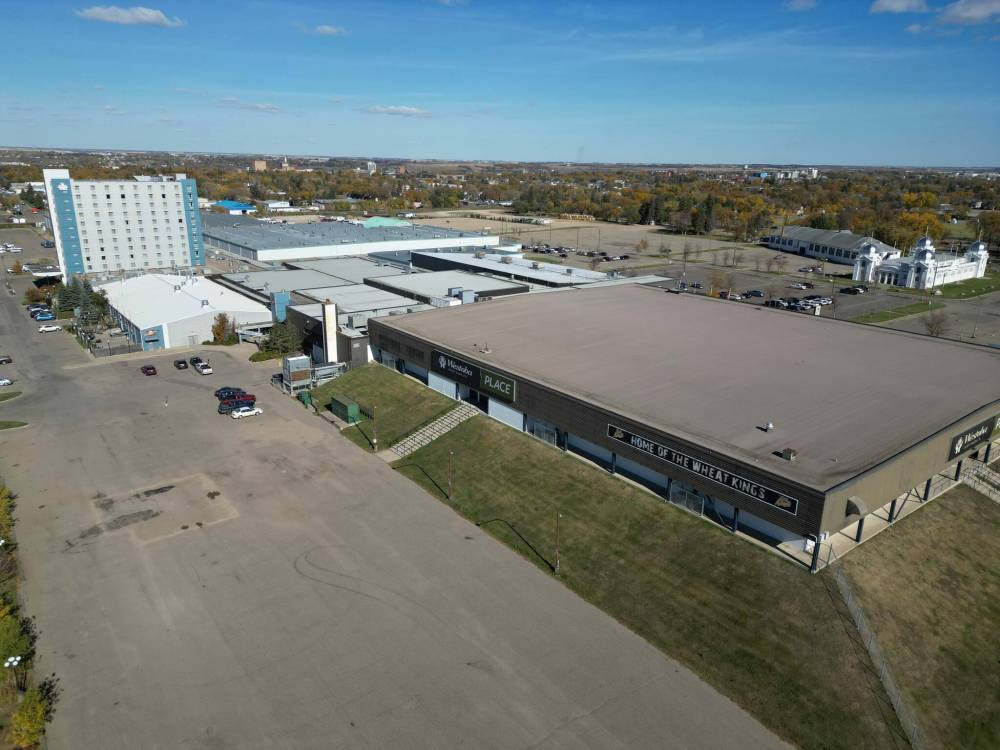
A good example of forward thinking has been the recently published details regarding the Keystone Centre, and its multi-year plan to revamp its ground space with an outdoor rink, camping area and interpretive trails. (Tim Smith/The Brandon Sun files)
Note that it was also Daly who coined the city’s nickname “the Wheat City,” during the city’s first council meeting on July 3, 1882.
Since those heady early days of its history, Brandon has not enjoyed the same level of growth. As former mayor Ken Burgess noted at Brandon’s centennial celebration in 1982, its growth has not been spectacular, but “steady.”
In recent years, the city budget has been fiercely stretched and local taxes increased significantly as our councillors and mayor look to expand the city’s growth on the south end of the community. These moves have garnered a great deal of public discussion, and likely a whole lot of private decisions — both around the council table and around the kitchen tables of this community.
As the next municipal election approaches, and our 2032 milestone approaches, it’s worth taking note of what our mayoral candidates would like Brandon to become.
“Our goal is to grow our population to 80,000 by 2040,” Brandon Mayor Jeff Fawcett told the Sun in April. “This is part of building economic sovereignty. This is part of getting the critical population we need to have the services and identity (that) Brandonites want.”
Although Mayor Fawcett has never really offered an official “guiding vision” for Brandon and its future, this particular statement does go some distance to provide one. That’s not surprising really — he made it during his State of the City address this past spring, the same day that he announced his intention to seek re-election.
In announcing his candidacy, Mayor Fawcett listed financial stability and stronger regional partnerships as the defining achievements of his first term.
And what would a second term look like for Mayor Fawcett? His pitch to voters, as we reported it last spring, centres on continuity, building on financial reforms, deepening partnerships and advancing major projects already underway.
So, more of the same.
His opponent in the race for the mayor’s chain of office, Len Isleifson, has been holding a few fireside chats with some small groups in the city. Isleifson told the Sun in May 2025 when he announced his candidacy that running for mayor had been part of his long-term goals going back to 2009, when he first ran for council.
When asked, Isleifson has told media that his campaign will focus on three key pillars — enhancing public safety, promoting sustainable economic growth and improving access to community services. In 2025, Isleifson also expressed interest in boosting Brandon’s economic potential.
“There’s a market out there. People are interested in what Brandon has to offer, and we need to be more aggressive in going after those opportunities,” he said at the time.
So, more of the same — but better.
Quite frankly, it is difficult to get charged up about these kinds of mediocre election campaigns — I might also suggest the word “underwhelming.”
The next mayor and council that are elected to office will spend a great deal of time doing the regular things that are expected of municipal officials — making sure the buses run on time, making sure residents pay their taxes and trimming budgets, and establishing zoning and land use for development.
Or — as in this month’s case — managing the flow of yet another major flood.
The both practical and thankless aspects of making municipal decisions are not in dispute — they form the bulk of the work elected officials must handle. Nevertheless, the men and women around the council table will also be responsible for setting the tone for the next four years. And there should be more to leadership of a city than merely keeping the buses running on schedule.
Why not set in motion a few long-term goals that voters and residents can get behind to mark Brandon’s 150th?
A good example of that kind of thinking has been the recently published details regarding the Keystone Centre, and its multi-year plan to revamp its ground space with an outdoor rink, camping area and interpretive trails. While that development plan requires a great deal of “costing out” to see if any or all of it will come to fruition, the public now has an idea of what the goal is.
What the future of Brandon will be in the next century is anybody’s guess. Much depends on the people we elect to help make those decisions. If and when they show up at your door asking for your vote, make sure to ask candidates for mayor — and council, too — what they would like Brandon to become.
Six years from now, and beyond.
» Matt Goerzen, editor