
First Sabres team blazed rugby path
Advertisement
Read this article for free:
or
Already have an account? Log in here »
We need your support!
Local journalism needs your support!
As we navigate through unprecedented times, our journalists are working harder than ever to bring you the latest local updates to keep you safe and informed.
Now, more than ever, we need your support.
Starting at $15.99 plus taxes every four weeks you can access your Brandon Sun online and full access to all content as it appears on our website.
Subscribe Nowor call circulation directly at (204) 727-0527.
Your pledge helps to ensure we provide the news that matters most to your community!
To continue reading, please subscribe:
Add Brandon Sun access to your Free Press subscription for only an additional
$1 for the first 4 weeks*
- Enjoy unlimited reading on brandonsun.com
- Read the Brandon Sun E-Edition, our digital replica newspaper
*Your next Free Press subscription payment will increase by $1.00 and you will be charged $20.95 plus GST for four weeks. After four weeks, your payment will increase to $24.95 plus GST every four weeks.
Read unlimited articles for free today:
or
Already have an account? Log in here »
Every journey begins with a single step, and for the 25-year-old Souris Sabres rugby program, it was a path into the unknown in the fall of 2001.
New teacher Brian Yon was encouraged to form girls’ and boys’ rugby teams in a community that had no background in the sport, and faced the challenge with characteristic enthusiasm.
Jill Early (nee Harvey), Lynn Cliplef (nee Spratt) and Renee Turner (nee Woods) were all part of that team and in attendance at the community hall in Souris on Saturday as the program celebrated its 25th anniversary.
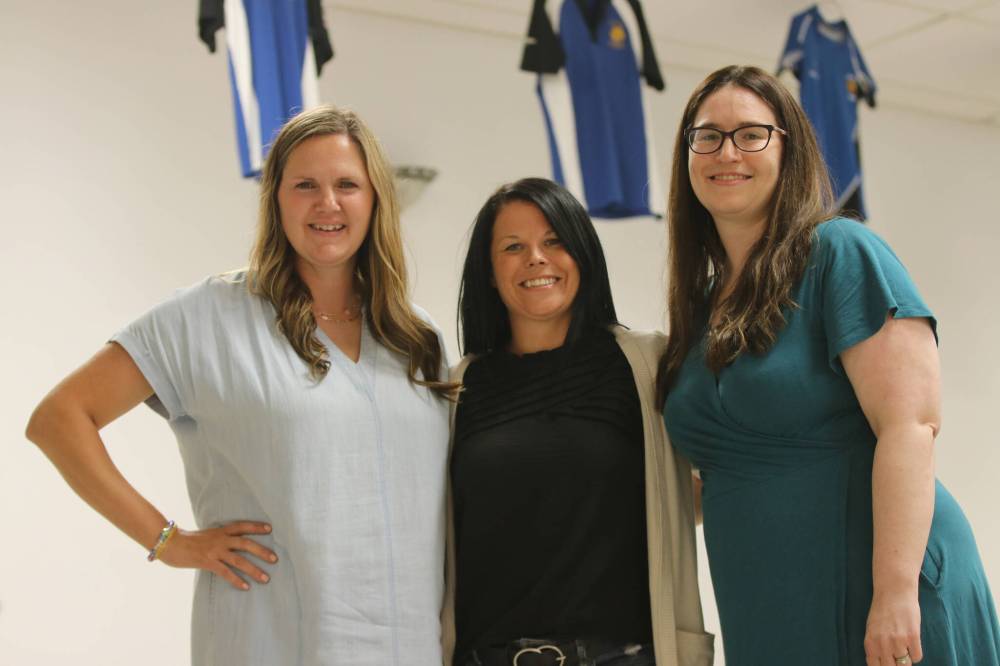
Jill Early, Renee Turner and Lynn Cliplef were part of the first Souris Sabres girls' rugby team back in 2001-02. The program celebrated its 25th anniversary on Saturday in Souris. (Perry Bergson/The Brandon Sun)
While the trio laugh about the sight of the fiery Yon throwing clipboards in disbelief on the sideline, they acknowledge all he’s done for the sport in Souris.
“I feel that his passion and drive for the sport personally kind of carried over into us,” Cliplef said. “We caught that vibe from him and we produced passion too. It made it really exciting for us, and he really poured that into us as kids.
“He was excited about it and that made you excited about it, and made it a super good community sport, which was unheard of in a small town.”
Early and Turner started in Grade 8 and played until Grade 12, although Turner missed her Grade 9 season with a broken leg suffered outside rugby. Cliplef picked it up in Grade 11 and played two seasons.
The three friends all remember their initial contact to the idea of the new sport starting up at Souris School.
“He announced it in class,” Early said.
“He kept coming around, making sure we knew it was going to start and we were going to try it,” Turner added, with the three friends and former teammates laughing and finishing each other’s sentences.
Cliplef’s story was a little different.
She was already a varsity athlete, and Yon apparently saw promise in her.
“I was playing high school varsity basketball and Yon was the teacher-volunteer who travelled with our team,” Cliplef said. “I got fouled out of a basketball game and I was upset and passionate. Yon came and sat down beside me and said ‘Hi Lynn, I’m starting a rugby team. I think you would like it.’
“And I signed up.”
That first day, the recruits watched some rugby videos, had a meeting, went to the gym and then ate pizza. They quickly spotted the appeal of rugby.
“It was a sport for everyone,” Early said.
“Anybody, any person who wasn’t athletic could come out and play,” Turner added. “That was the best part about it. Girls from Hartney and from our town who never played sports found a place and actually became really good in their spots.”
Even so, this was a cohort of athletes who had never even seen a rugby ball in person. While it’s a physical sport, it’s also a delicate balance of 15 people playing offence and defence together as a single unit.
Turner chuckled the biggest problem was remembering to pass the ball backward but to run forward.
“In our first game, we literally had no idea what we were doing,” Early said. “Until you saw it and ran through all the motions, then you kind of understood it better.”
The good news was that everybody understood how new the sport was, and there was a concerted effort to educate.
“Not just our whole team, but it was all the teams we would play against,” Cliplef said. “The refs would actually stop and teach a lot. It was a very teaching situation, which is interesting for high-school students. You see it more in younger kids’ sports.
“They would actually pause and say ‘Do you guys know what happened?’ ‘No.’ ‘And then they would do a little bit of teaching. I’m sure Yon was in on the teaching but I remember the refs doing it, especially in that 2001-02 year.”
Turner added Yon was terrific in that first season as the team beat Vincent Massey, Minnedosa and Shaftesbury and lost to Dakota and Minnedosa for a record of 3-2.
“He had a lot of patience with us, starting as people who knew nothing,” Turner said. “He really taught us what to do. He never got mad at us, he was patient. I remember thinking ‘God, he must be frustrated with us, we have no idea what we’re doing.’”
Early said it took a full season for the sport to start to make sense and then everything began to fall into place. Of course not everybody received that education.
“Our parents have no idea and probably still don’t understand it,” Turner said as her friends laughed. “They just watched and ran up and down the sidelines. They were our biggest fans as we got crushed or crushed people.”
Just as importantly, Yon’s players were learning about themselves.
“One thing that comes to mind when I think about playing is getting hit hard to the ground and I got up and Yon looked at me and said ‘You’re mad, go get even then, use that strength and go and get even,’” Turner said. “’Let’s go back, let’s hit them harder.’ He was ‘OK, we’re down, let’s keep going.’
“He taught us to never give up, and that’s a huge thing in life. You carry that through in your whole life if you’re lucky.”
By the second season, Cliplef wanted to play more and was excited to be begin rugby training in March.
The new Westman High School Rugby league formed in time for the 2002-03 season, and the early lessons by Yon paid off, with the Sabres winning the first five girls’ titles and seven of the first eight.
While winning is nice, Yon’s impact went well beyond the pitch because the life lessons kept coming.
“Yon meant a lot to me as a coach,” Early said. “I learned a lot from him as a human. The program certainly wouldn’t be here 25 years later. Even looking at the league, the same coaches aren’t in charge of any of the other WHSR teams. Wawanesa doesn’t have a team anymore, and they were one of our big teams back when we started.”
“I feel like it taught me how to be a team player,” Early added. “I was a captain for a few years and it teaches you how to be a team player, how to work with others, how to play well with others. In my career today, you work as a team.”
Cliplef agreed.
“I was also a captain for one year,” Cliplef said. “Leadership, working with a team, friendship, and there is something to be learned from playing a physical sport too with your strength that you didn’t get from playing volleyball. I think that brings confidence.”
While the 25-year-old memories of the time actually spent on the pitch playing are now hazy, the off-field recollections remain sharp.
“People who normally didn’t play sports came out and played sports and it was a way to meet new people and get to know them,” Turner said. “They actually found a sport they excelled at and it was really neat to be with a different group and different people and work all together.
“That was the best part, all body types, all athleticisms could find a spot in rugby.
“That was major in a small town.”
» pbergson@brandonsun.com