
Fact File: Chemical smell from wildfire smoke is not evidence of spraying
Advertisement
Read this article for free:
or
Already have an account? Log in here »
We need your support!
Local journalism needs your support!
As we navigate through unprecedented times, our journalists are working harder than ever to bring you the latest local updates to keep you safe and informed.
Now, more than ever, we need your support.
Starting at $15.99 plus taxes every four weeks you can access your Brandon Sun online and full access to all content as it appears on our website.
Subscribe Nowor call circulation directly at (204) 727-0527.
Your pledge helps to ensure we provide the news that matters most to your community!
To continue reading, please subscribe:
Add Brandon Sun access to your Free Press subscription for only an additional
$1 for the first 4 weeks*
- Enjoy unlimited reading on brandonsun.com
- Read the Brandon Sun E-Edition, our digital replica newspaper
*Your next Free Press subscription payment will increase by $1.00 and you will be charged $20.95 plus GST for four weeks. After four weeks, your payment will increase to $24.95 plus GST every four weeks.
Read unlimited articles for free today:
or
Already have an account? Log in here »
Several online videos claimed a chemical smell in Canadian wildfire smoke was deliberately created rather than a natural phenomenon. Wildfire smoke naturally contains volatile organic compounds, and its smell varies depending on how those compounds interact in the atmosphere. Different fuels release different volatile organic compounds, producing distinct odours, and while human-caused pollution can interact with wildfire smoke, there is no evidence of human meddling causing the chemical smell.
THE CLAIM
Hundreds of wildfires are burning across Canada and the United States, triggering air quality warnings as smoke blankets parts of both countries.
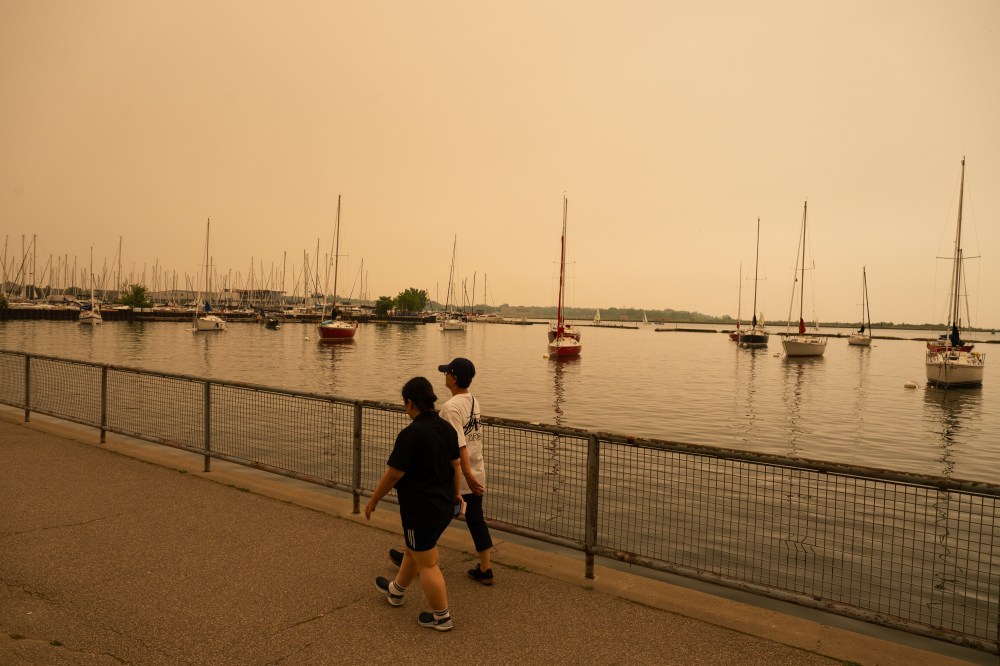
The smoky skies have also sparked social media speculation ranging from suspicion to conspiracy theories over the smoke’s origin.
“There is NO way- this is smoke from the forests fire,” reads the caption of a TikTok video from July 15, when smoke from wildfires in northern Ontario settled over much of the province.
In the video, a woman stands outdoors and points to the hazy sky, noting a chemical smell. “Whatever they have just sprayed is not good,” she says.
In another video posted to TikTok with around 2.4 million views, a man responds to a clip of a news anchor explaining why Canadian wildfire smoke may smell like chemicals. “Never once has a wildfire smelled like (chemicals),” the man says.
Some of the top comments on that video referred to a chemical attack or chemical warfare, suggesting the smoke’s chemical smell was the result of deliberate human intervention.
In a video posted to Instagram, a man claimed the chemical smell of Canadian wildfire smoke is a new phenomenon,
“It’s never smelled like that before,” he says.
THE FACTS
Wildfire smoke is made up of particles, water vapour and gases, and it includes a mix of chemicals called volatile organic compounds.
The B.C. Centre for Disease Control notes that volatile organic compounds evaporate quickly and can give wildfire smoke its typical campfire or burning wood smell. The centre says a number of factors — the weather, what’s burning, the temperature of the fire and how far the smoke has travelled — can affect the smoke’s composition.
“Wildfire smoke is a very complex form of air pollution,” Sarah Henderson, scientific director of environmental health services at the centre, said in an interview last week.
She added that different volatile organic compounds can give off different odours.
The amount of volatile organic compounds can vary depending on how hot the fire is burning and what’s fuelling it, Henderson said. A burning pine tree smells different from a burning maple, for example.
“When a wildfire is burning homes or cars, those fuels are obviously really different from the wildland biomass fuels, and the smoke from those fuels is going to smell quite different because there’s going to be different volatile organics that are created from those fuels,” she said.
The chemical smell of wildfire is the result of complex chemical reactions in the atmosphere, said Michael Jerrett, a professor in the department of environmental health sciences at the UCLA Fielding School of Public Health.
As smoke travels and ages, its chemical makeup changes. The smoke can produce enhanced levels of the volatile organic compounds benzene and formaldehyde, which can result in a plastic or rubber-like smell, he said in an interview Wednesday.
The chemical smell from distant wildfires “has nothing to do with humans intentionally adding other chemicals to forests,” said John Liggio, a senior research scientist with Environment Canada who studies air quality.
“It has everything to do with the fact that we’re a thousand kilometres or more away, and chemistry occurs all along the way from the source to the receptor, being your nose,” he said in an interview Wednesday. “It smells different because the chemicals are different. Not that they’ve been added, they have been formed during transport. So it is a natural phenomenon.”
Burning plastics or other man-made materials also might give off a chemical smell when burned, Jerrett added.
“The fires that are at the urban fringe or burning structures, they’re a very complex mixture of volatile organic compounds because you’ve got a lot of plastics and other types of consumer products that are often imbued with metals (and) flame retardants,” he said.
The frequency and intensity of wildfires, as well as the increased chemical smells some people are noticing from wildfire smoke are the result of a variety of factors, Jerrett said.
They include climate change, improper forest management and the increase in wildland-urban interfaces — areas where communities exist next to forested areas.
But there is no evidence to support the idea that the wildfire smoke is the result of deliberate meddling, Jerrett added. “It’s just an unfortunate result of these interlinked environmental problems.”
This report by The Canadian Press was first published Aug. 6, 2026.