
Congo’s fastest-growing Ebola outbreak reaches a sixth province
Advertisement
Read this article for free:
or
Already have an account? Log in here »
We need your support!
Local journalism needs your support!
As we navigate through unprecedented times, our journalists are working harder than ever to bring you the latest local updates to keep you safe and informed.
Now, more than ever, we need your support.
Starting at $15.99 plus taxes every four weeks you can access your Brandon Sun online and full access to all content as it appears on our website.
Subscribe Nowor call circulation directly at (204) 727-0527.
Your pledge helps to ensure we provide the news that matters most to your community!
To continue reading, please subscribe:
Add Brandon Sun access to your Free Press subscription for only an additional
$1 for the first 4 weeks*
- Enjoy unlimited reading on brandonsun.com
- Read the Brandon Sun E-Edition, our digital replica newspaper
*Your next Free Press subscription payment will increase by $1.00 and you will be charged $20.95 plus GST for four weeks. After four weeks, your payment will increase to $24.95 plus GST every four weeks.
Read unlimited articles for free today:
or
Already have an account? Log in here »
KINSHASA, Congo (AP) — Congo’s Ebola outbreak has spread to a sixth province after a death was recorded in the previously unaffected Bas-Uele province, the head of Africa’s CDC said Thursday.
The man died in Buta, the capital of Bas-Uele, after traveling there from Isiro in Haut-Uele province, said Jean Kaseya, director general of Africa Centres for Disease Control and Prevention.
The outbreak in eastern Congo, considered the fastest-growing one yet, is on track to surpass the deadliest one in history, which erupted over a decade ago and killed over 11,000 people, the World Health Organization said Wednesday. There are no approved vaccines or treatments for the rare Bundibugyo virus responsible for the current outbreak.
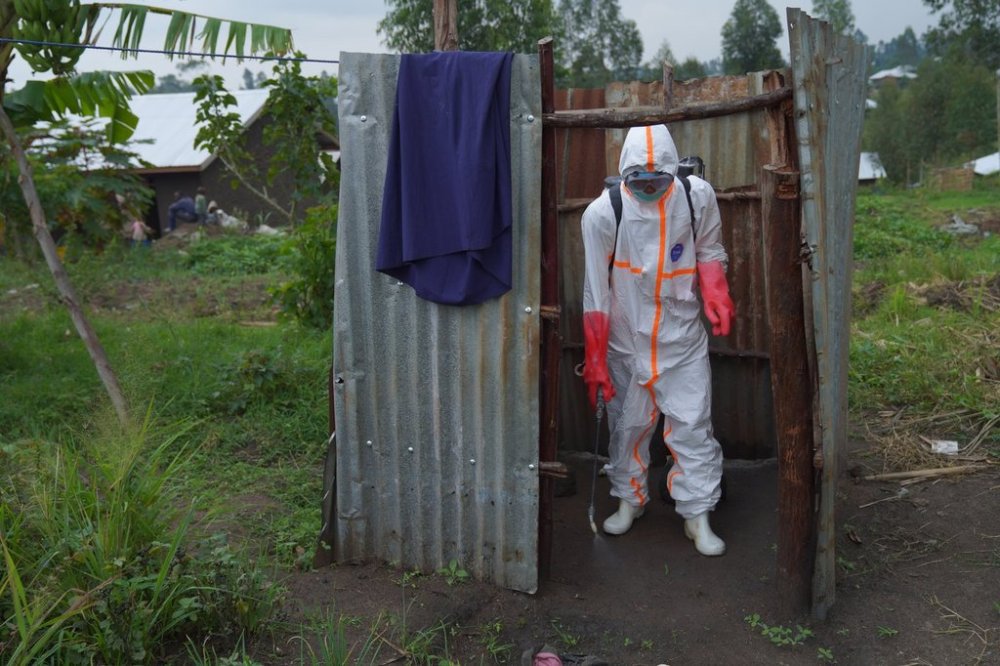
It has killed over 2,100 people out of more than 4,500 cases, according to the latest government figures. This death toll has been reached almost three times faster than in the 2014-16 Ebola outbreak in West Africa — the worst in history.
The outbreak is unfolding in some of the most challenging conditions imaginable, with strikes by some unpaid health workers, threats by rebel groups, anger from long-traumatized communities and misinformation asserting that Ebola isn’t real.
Bas-Uele is a vast province in northeastern Congo that borders the Central African Republic, where there is recurring armed violence that has forced thousands to flee and take refuge in the province. Access can be difficult due to bad and poorly connected roads as well as limited communication networks, and there are frequent population movements related to gold mining and displacement from conflict.
As of Thursday, six out of 26 of Congo’s provinces have been impacted. About 90% of all cases and 80% of deaths are concentrated in Ituri province, the WHO said Wednesday.
Mercy Corps, an aid group, warned Thursday that Ebola cases have been reported along a major travel route about 35 kilometers (22 miles) from Congo’s border with South Sudan, expressing concern over the outbreak’s “widening footprint.” No cases have been confirmed in South Sudan so far.
Unpaid health workers strikes and low contact tracing hamper response
Meanwhile, health workers at the Nizi Treatment Center in Ituri province, one of the most affected in the area, went on strike Thursday, leading to the temporary closure of the center after they said they have not been paid for three months.
Kaseya on Thursday called on the Congolese government to pay the outstanding salaries.
“We need to pay health workers,” he told reporters. “This is the responsibility of the government, not partners. And they told us that money is available.”
The real scope of the outbreak remains unknown. It was declared on May 15, but the WHO now says sequencing showed it began months earlier, in February.
Health authorities have said between 60% and 70% of new cases are recorded outside contacts being monitored, and that the disease is spreading at an “alarming” rate. Contact tracing helps break chains of transmission by finding exposed people early and reacting quickly if they show symptoms.
“We are chasing the virus; the virus is ahead of us,” the WHO regional director for Africa, Dr. Mohamed Yakub Janabi, said this week.
On Thursday, Kaseya from Africa CDC said “the concept of contact tracing in DRC has become useless.”
Trials for treatments and vaccines are underway
Ebola is rare but highly contagious and can be contracted from bodily fluids such as vomit, blood or semen, and from contaminated surfaces and materials such as bedding and clothing. The disease it causes is severe and often fatal.
Clinical trials of two possible treatments for this type of Ebola began last month in Ituri, the most affected of the five provinces in Congo where cases have been reported.
Two vaccines developed specifically for the Bundibugyo virus are now being tested in people for the first time, the WHO said Wednesday.
WHO also plans to test whether an existing Ebola vaccine could protect people against the virus after studies in animals showed promising results.
Kaseya said on Thursday that Africa CDC supports the use of Ervebo, a vaccine authorized against the Zaire Ebola strain in provinces impacted by Bundibugyo virus. He said some studies show some cross-protection from the available vaccines.
“We are in a gray area,” he said. “And when you are in a gray area, you have to make strong decisions to stop seeing people dying.”
——-
Associated Press reporters Constant Same Bagalwa in Bunia, Congo and Justin Kabumba in Goma, Congo contributed.