
Tennessee and Oklahoma put men to death as US states schedule 3 executions for the same day
Advertisement
Read this article for free:
or
Already have an account? Log in here »
We need your support!
Local journalism needs your support!
As we navigate through unprecedented times, our journalists are working harder than ever to bring you the latest local updates to keep you safe and informed.
Now, more than ever, we need your support.
Starting at $15.99 plus taxes every four weeks you can access your Brandon Sun online and full access to all content as it appears on our website.
Subscribe Nowor call circulation directly at (204) 727-0527.
Your pledge helps to ensure we provide the news that matters most to your community!
To continue reading, please subscribe:
Add Brandon Sun access to your Free Press subscription for only an additional
$1 for the first 4 weeks*
- Enjoy unlimited reading on brandonsun.com
- Read the Brandon Sun E-Edition, our digital replica newspaper
*Your next Free Press subscription payment will increase by $1.00 and you will be charged $20.95 plus GST for four weeks. After four weeks, your payment will increase to $24.95 plus GST every four weeks.
Read unlimited articles for free today:
or
Already have an account? Log in here »
Tennessee and Oklahoma put inmates to death within 30 minutes of each other Thursday as U.S. states scheduled three lethal injection executions in one day.
The Tennessee man was executed for killing a maid at a motel in 1985 and the Oklahoma man for killing his girlfriend in 2003. In Alabama, a man is scheduled to die later for killing of a 5-year-old girl he paid her mother to abuse.
The last time three executions were held on the same day was Jan. 7, 2010, when Louisiana, Ohio and Texas put inmates to death. Three executions were scheduled on the same day in 2018, but only one went forward after a Texas man was granted a reprieve and prison officials in Alabama had problems with the IV line.
Florida executed two men on the same day in July and has put 31 prisoners to death since the start of 2025.
Oklahoma prisoner said he regretted 2003 killing of girlfriend
Carlos Cuesta-Rodriguez, 70, died by lethal injection at the state’s penitentiary in rural McAlester, Oklahoma. He was the third person put to death this year in Oklahoma and the 20th under Republican Gov. Kevin Stitt, who leaves office in January after eight years.
Cuesta-Rodriguez turned his head to look at his two relatives who attended and mouthed “I love you” but said he had no last words.
His breathing was labored for several minutes before he was pronounced dead at 10:13 a.m. CDT.
Convicted of fatally shooting his girlfriend at their Oklahoma City home in 2003, Cuesta-Rodriguez had said he regretted killing Olimpia Fisher and told a board he didn’t want clemency.
Fisher, 43, planned to leave Cuesta-Rodriguez when he shot her in one eye and then waited about eight minutes as she screamed for help before firing the fatal shot into her other eye.
Fisher’s daughters, Cinthya Allen and Katya Wallis, said they hope the execution brings awareness to preventing domestic violence and they honor their mother by “raising our families to reflect the love and faith in God that she taught us.”
“Our faith in Jesus has allowed us to forgive,” they said a statement. They did not attend the execution.
Last month, the Oklahoma Pardon and Parole Board voted 3-1 against recommending clemency for Cuesta-Rodriguez. His attorneys had asked the board to recommend he serve life in prison, saying he had a difficult childhood in Cuba and suffered from brain damage, post-traumatic stress disorder and major depression with psychotic episodes.
Tennessee man challenged execution after previous one was halted
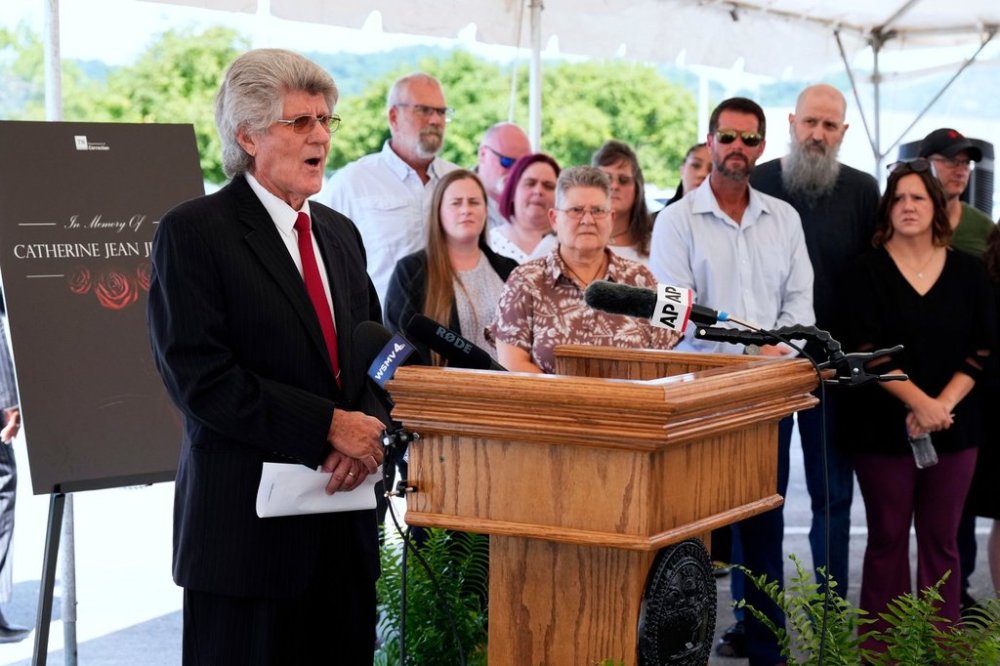
Anthony Darrell Hines was executed by lethal injection in Tennessee for the 1985 murder of Catherine Jean Jenkins. He was pronounced dead at 10:43 a.m. CDT.
Hines stabbed Jenkins to death while the 54-year-old was working as a motel maid in Kingston Springs.
Hines said “not right now, thank you” when first asked if he had final words, then said, “Tell my son hello” before he died. Hines’ son witnessed the execution. He reconnected with his father four days ago after not seeing him since he was 3 years old.
About four minutes after the curtain to the death chamber opened, Hines asked his spiritual adviser: “How long do I have?” Not long afterward, witnesses heard groans and heavy breathing as the spiritual adviser put her hands on his shoulders and prayed over him.
After the execution, Jenkins’ son detailed how his mother was killed to reporters with only a plastic spray bottle to defend against the knife attacks.
“I hope he did suffer. I hope he felt severe pain because what he did to my mother is nothing compared to what he may have just gone through,” Dennis Jenkins said.
Hines’ execution comes just three months after the attempted lethal injection of another man was called off because of a problem inserting an IV. Hines’ arms and hands were covered by a sheet.
Hines, 66, appealed unsuccessfully to the governor and the courts, saying that the doctor who oversaw a May execution that was stopped as medical staff couldn’t establish a backup IV line for more than an hour was unqualified and likely to botch his execution as well.
The state had declined to say whether the same doctor would preside over Hines’ execution. Regardless, the Tennessee Supreme Court ruled Hines had not proven the doctor was unqualified and suggested the problems were an isolated mishap.
Alabama inmate pleaded guilty to rape and killing of girl
Alabama is scheduled to execute Jeremy Williams by lethal injection for the 2021 rape and murder of a 5-year-old Georgia girl.
Williams, who pleaded guilty to killing Kamarie Holland, declined to appeal and asked for his death sentence to be carried out.
Williams, 42, raped and strangled Holland after offering her mother $2,500 for the child to perform a sex act, prosecutors said.
Williams filmed his attack on the girl and kept her body to continue to abuse, prosecutors said.
“To see on video what he did to this baby, what a grown man could do to a child, it’s shocking, it’s horrible, it’s disgusting,” Russell County District Attorney Richard Chancey said. “It’s just a level of evil.”
Williams also was a suspect in the 2005 death of his infant daughter in Alaska but charges were not filed until 2022.
Corey Holland, Kamarie’s father, said his daughter was an exuberant 5-year-old who loved princesses and made people laugh.
“She loved playing dress-up, all her little Halloween costumes and her princess stuff I got her. She liked anything girly,” Corey Holland said.
It will be Alabama’s first execution of the year if it goes forward. A nitrogen gas execution was halted in June after a federal judge ruled the method unconstitutional.
The girl’s mother is serving a 20-year prison sentence after pleading guilty to sex trafficking.
___
Associated Press writer Jeffrey Collins contributed.