
Brandon soccer growth a product of immigration
Advertisement
Read this article for free:
or
Already have an account? Log in here »
We need your support!
Local journalism needs your support!
As we navigate through unprecedented times, our journalists are working harder than ever to bring you the latest local updates to keep you safe and informed.
Now, more than ever, we need your support.
Starting at $15.99 plus taxes every four weeks you can access your Brandon Sun online and full access to all content as it appears on our website.
Subscribe Nowor call circulation directly at (204) 727-0527.
Your pledge helps to ensure we provide the news that matters most to your community!
To continue reading, please subscribe:
Add Brandon Sun access to your Free Press subscription for only an additional
$1 for the first 4 weeks*
- Enjoy unlimited reading on brandonsun.com
- Read the Brandon Sun E-Edition, our digital replica newspaper
*Your next Free Press subscription payment will increase by $1.00 and you will be charged $20.95 plus GST for four weeks. After four weeks, your payment will increase to $24.95 plus GST every four weeks.
Read unlimited articles for free today:
or
Already have an account? Log in here »
Diego Rodriguez moved to Brandon from Colombia to change the lives of his family. Little did he know, he would play a massive role in reshaping a community through his love of soccer.
Rodriguez had spent the better part of his adult life working for a wholesaler he compares to Costco in Canada, while also playing semi-professional soccer.
When he moved to Brandon nearly 20 years ago, he quickly found a youth soccer coaching position and was surprised to see the lack of popularity for the sport.
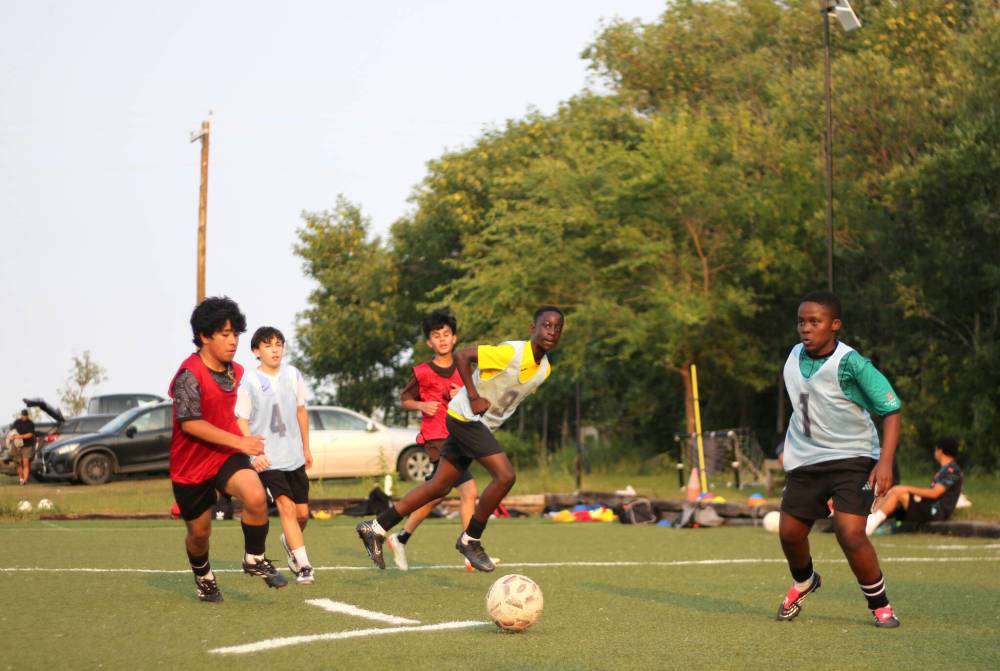
Westman FC under-13 boys practise at coach Taso Spiropolous's home field on Tuesday. The team is made up of athletes from myriad nationalities. (Thomas Friesen/The Brandon Sun)
“It was really weird for me,” Rodriguez said. “Most of the time here in Brandon, it was just kids going to play and nobody telling them exactly what to do, how to control the ball, ‘just go have fun.’”
Working with Rainer Schira, he helped kickstart the growth of Westman FC.
“Their first year was terrible, was really bad. We’d play against Winnipeg teams and they’d come in and spend most of the time in our net,” Rodriguez said.
“I made a meeting with the parents and said, ‘Be patient, it’s part of the process.’”
A couple of years later, his teams figured out how to win, coming home from Winnipeg with a Golden Boy tournament title and showing signs of life in a sport not many took seriously in the region.
That growth isn’t entirely a result of Rodriguez’s efforts, but it’s impossible to ignore the impact of the pathway he took.
• • •
Back in Colombia, Rodriguez saw an ad for Maple Leaf Foods — now Canada Packers — looking for 400 people to become temporary foreign workers.
He said 1,000 people applied when he did, and he found out he just met the minimum age requirement of 35, while also checking the boxes of being married and having children.
These requirements, many understand, are in place to increase the likelihood of temporary workers settling down and staying in a job upon gaining permanent residency, since moving again will be more difficult with a family. In theory, someone with a family to take care of is more likely to head home, as has been the case for thousands of current Westman residents, to bring their family back with them.
When Rodriguez applied, that was definitely his plan.
“Canada is a really nice place to live. It’s safe, compared to Colombia. I was looking for a better future for my boys,” Rodriguez said.
Rodriguez remarked that one week’s pay when he started at Maple Leaf was the equivalent of a month back home.
But he had to spend a couple of years away from his wife and children.
He said it was hard to be away from family. Thankfully, he found a sliver of home in the Latino Soccer League.
However, just six weeks into joining, he had his collarbone broken during a game, leaving him unable to work in his deboning role at the pork production plant.
He said he hadn’t been there long enough to collect employment insurance, and the injury occurring outside of the workplace meant there was no other compensation.
“At work I remember people saying, ‘Oh buddy, you broke your collarbone, Maple Leaf going to send you back.’ I stayed quiet and kept working and doing my best,” Rodriguez said.
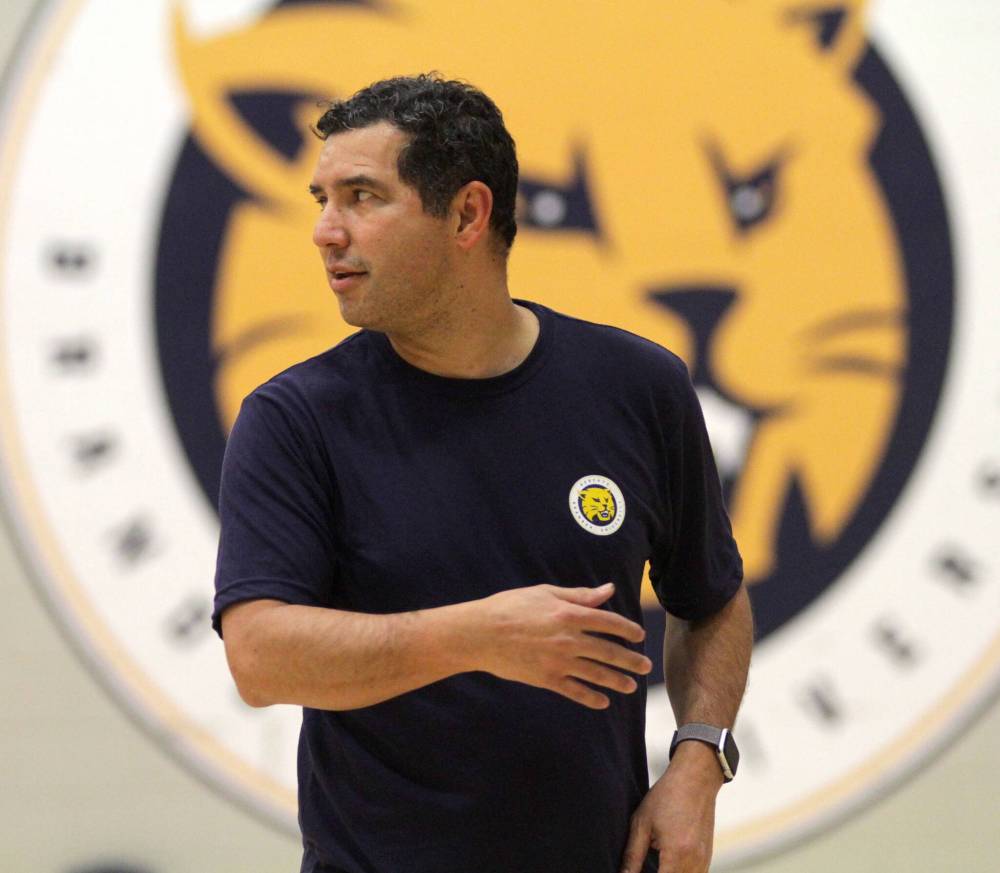
Diego Rodriguez moved to Brandon to work for Maple Leaf Foods — now Canada Packers — nearly two decades ago, and has made a massive impact on the local soccer community through coaching at various levels. (Thomas Friesen/The Brandon Sun)
“Honestly, I am so lucky, even with that. I appreciate the company, Maple Leaf, for how they bring us and give us the opportunity.”
Rodriguez added that the company didn’t just bring him and others in and leave them to fend for themselves, but spent a week bringing them up to speed on things like public transit, clothing to handle harsh winter and laws they may not be aware of.
He has since changed roles a few times, most recently becoming a supervisor in the sanitation department.
After he settled in, he helped build both the Brandon University and Assiniboine College soccer programs. When his sons, Diego Jr. and Camilo, graduated high school, they both went on to win Manitoba Colleges Athletic Conference MVP awards with the Bobcats.
And most recently, Rodriguez Sr., has head coached the women to three straight MCAC titles and trips to Canadian Collegiate Athletic Association nationals.
“Right now, I am so proud of how soccer is growing in this community,” Rodriguez said.
• • •
That growth is certainly evident to guys who’ve been around longer, like Taso Spiropolous.
He noted that when he started playing soccer in Brandon in the mid-1990s, very few guys saw it as their first sport.
“A lot of guys played soccer in the summers to stay in shape for hockey in the winter,” Spiropolous said. “Once immigration ramped up … you saw a big switch.”
Spiropolous played in the Latino league with Inspire FC for three years, before it moved over to the Manitoba Major Soccer League and climbed the ranks to compete against some of the province’s top senior men’s clubs.
He now coaches the club in local competition, while also leading Westman FC youth teams.
In the same way Canada has become a “melting pot,” he has watched players from around the world bring unique styles of play to Brandon.
“I found the Honduran teams were very organized as a group, they had a very clear-cut way of how they attacked another team,” Spiropolous said.
“The El Salvadorian teams, I found, were strong as a group as well, but there’s more of an individualistic strength.
“The Colombian teams passed well, they shot well, but played a lot faster, more direct way.
“That’s the great thing about the game, there’s not one right answer.”
• • •
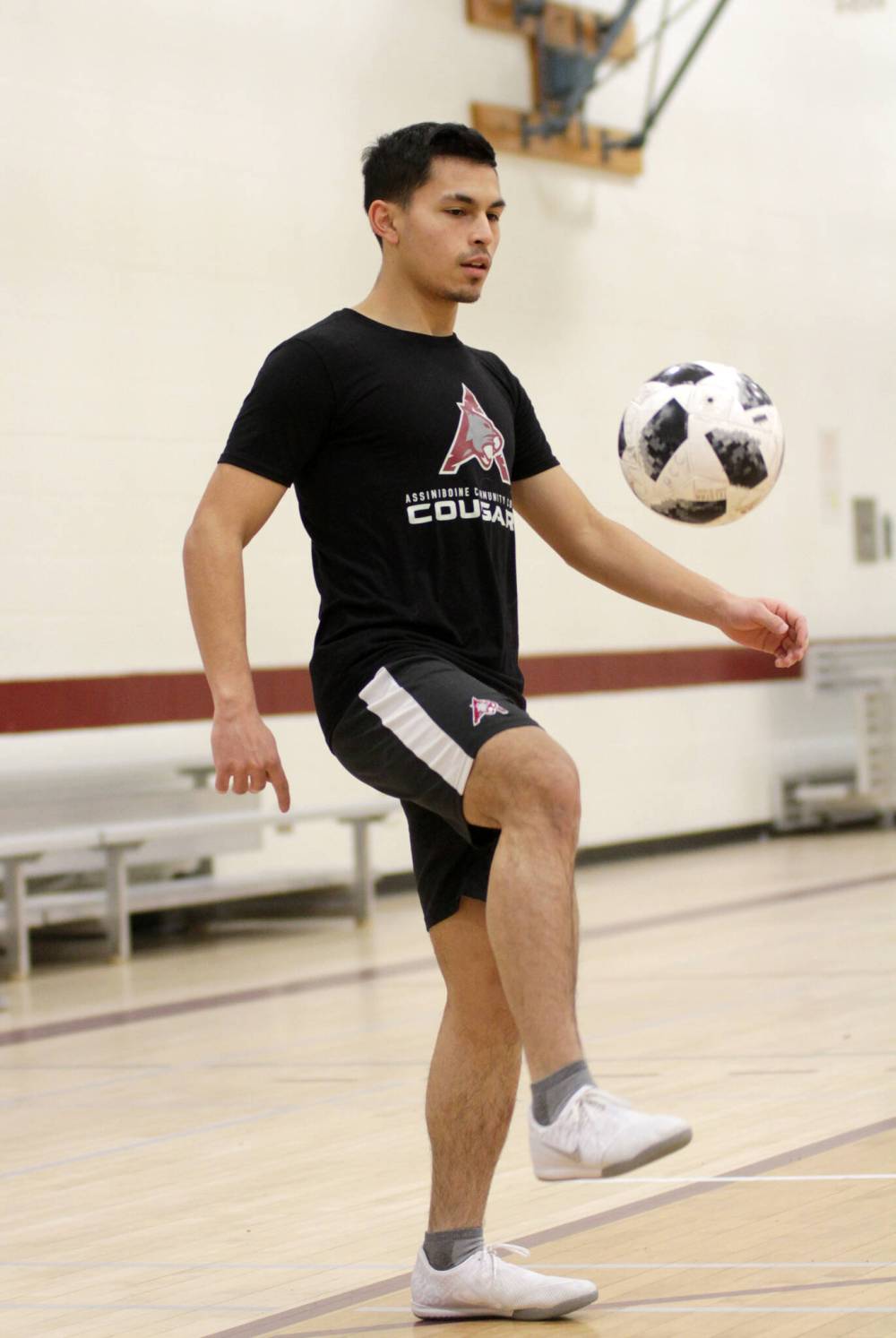
Diego Nomesque was just 11 years old when he moved to Canada as a result of his father earning permanent residency after an initial move through the temporary foreign worker program. (Thomas Friesen/The Brandon Sun)
While many men have moved to Brandon and other Westman communities as temporary foreign workers, those they leave behind during that time are faced with unique challenges.
Diego Nomesque was about nine years old when his father left Colombia.
“There’s a little uncertainty,” Nomesque said. “My parents weren’t on the best terms but they weren’t leaving each other … just regular family tension. When he left, there was a lot more doubt of ‘Will he be leaving us?’”
Nomesque said he tried not to worry about it, but did cross the days off on a calendar as he waited to reconnect.
His father came home after a year, leaving a laptop for them to communicate more frequently.
Nomesque moved two years later in July and attended New Era for a few years before heading to Vincent Massey in Grade 9.
Interestingly, he never played soccer back home but picked it up in high school as he made friends with a few El Salvadorians — another hot spot for Canada Packers hiring sprees.
“I was terrible. I was really bad at it, but because they were doing it, I didn’t care about that,” Nomesque said. “I’m a person to get obsessed with something if I want to improve.”
Looking back, he realizes Canada was probably a great place to start the game later in life, as the country still lags behind many in terms of soccer development.
Still, Nomesque had a lot of pride and didn’t want to fail in front of others, so he practised at home as much as possible.
He ended up playing for Assiniboine College under Rodriguez Sr., earning the team’s most-improved award following the 2019-20 soccer and futsal seasons.
“Diego is a confident and enthusiastic soccer player. It was a pleasure to coach him this year as he is always willing to learn,” Rodriguez said in a release in 2020. “It was very rewarding as a coach to see his development throughout the season and I am very proud to present this award to him.”
Nomesque still plays soccer today. He said he’s “on loan” from Inspire FC with SalMex, which includes a handful of the Salvadorans he played with in last month’s Brandon World Cup.
His parents got married in Canada, and while his father left Canada Packers as soon as he could and has worked a few different jobs since then, his mother joined the company and still works there.
• • •
While Brandon is now home to a $19 million-plus soccer facility, the Canada Packers Sports Complex, the best soccer battles in town don’t happen on its state-of-the-art turf field.
They take place a few nights a week on a remarkable makeshift field Spiropolous built at his house.
He acquired second-hand turf from a company in Markham, Ont., and built nets and light posts with hardware from Home Depot, with netting and lights from Amazon.
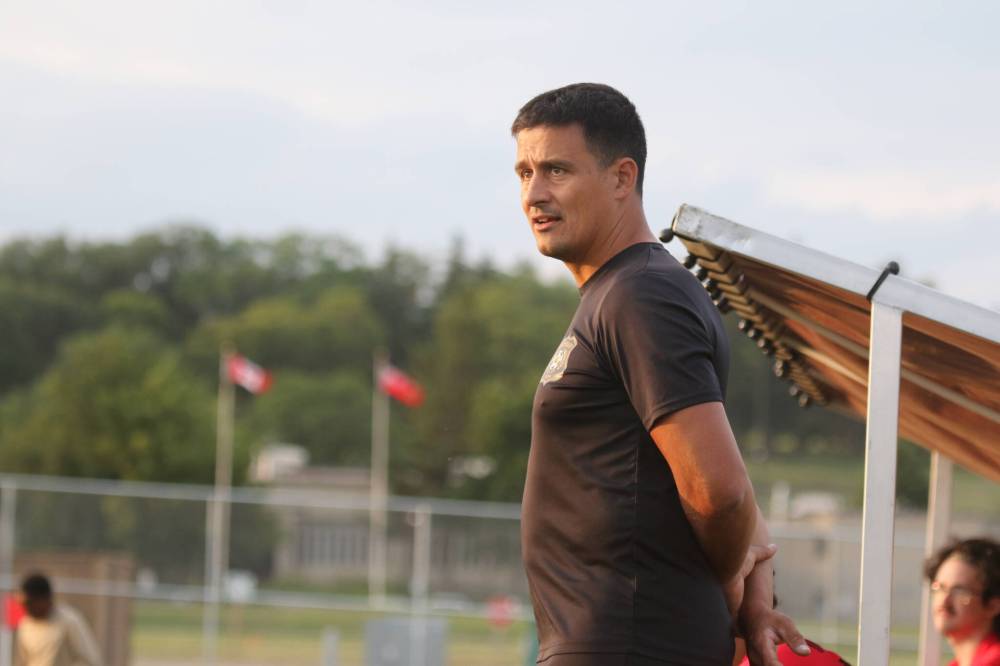
Taso Spiropolous coaches the Inspire FC men during their game against Minnedosa last week. (Thomas Friesen/The Brandon Sun)
Spiropolous contracted Tasmanian Gravel to level the foundation for the 100-by-130-foot pitch, exchanging olive oil from his family’s farm in Greece for use of a tractor.
“If it wasn’t for Tasmanian Gravel, it would have been very, very hard to get this done,” Spiropolous said.
Now, a few evenings a week throughout the summer, his Westman FC U13 premier 1 boys will train before his Inspire FC club and a few other players show up, make teams and play their own version of “King’s court.”
For some, it’s the highlight of the week.
“This is the only thing that gives me motivation, really,” said Carlos Torres. “Just get off work and it’s either go home and play video games or come here and get some exercise.
“I love coming here after work.”
Torres moved to Brandon from El Salvador 19 years ago at age nine, and was disappointed at the level of soccer in the area.
When he arrives at the field and catches the tail end of Westman FC scrimmages, he sees major differences.
For one, this youth club is made up of Greek, Irish, Nigerian, South African, Ukrainian, El Salvadorian, Colombian, Paraguayan, North American Indigenous athletes and more.
And they’re simply light-years ahead in skill.
“The fundamentals, I think, were lacking before these guys,” Torres said of coaches like Spiropolous and Rodriguez. “Now all these kids have really good fundamentals and that’s why it’s improved so much.
“I wish soccer would have been like this when I came.”
Like the Canadian men’s national team, which reached the round of 16 at the World Cup last month on the backs of stars from all around the world, the game is in a better place because of immigrants who moved here for a better future and chose to give back and inspire others.
» tfriesen@brandonsun.com