
Trade war with U.S. won’t be easy fight
Advertisement
Read this article for free:
or
Already have an account? Log in here »
We need your support!
Local journalism needs your support!
As we navigate through unprecedented times, our journalists are working harder than ever to bring you the latest local updates to keep you safe and informed.
Now, more than ever, we need your support.
Starting at $15.99 plus taxes every four weeks you can access your Brandon Sun online and full access to all content as it appears on our website.
Subscribe Nowor call circulation directly at (204) 727-0527.
Your pledge helps to ensure we provide the news that matters most to your community!
To continue reading, please subscribe:
Add Brandon Sun access to your Free Press subscription for only an additional
$1 for the first 4 weeks*
- Enjoy unlimited reading on brandonsun.com
- Read the Brandon Sun E-Edition, our digital replica newspaper
*Your next Free Press subscription payment will increase by $1.00 and you will be charged $20.95 plus GST for four weeks. After four weeks, your payment will increase to $24.95 plus GST every four weeks.
Read unlimited articles for free today:
or
Already have an account? Log in here »
“We’ve recognized from the start that America has changed. We recognize that sometimes its signature is written in pencil.”
— Prime Minister Mark Carney
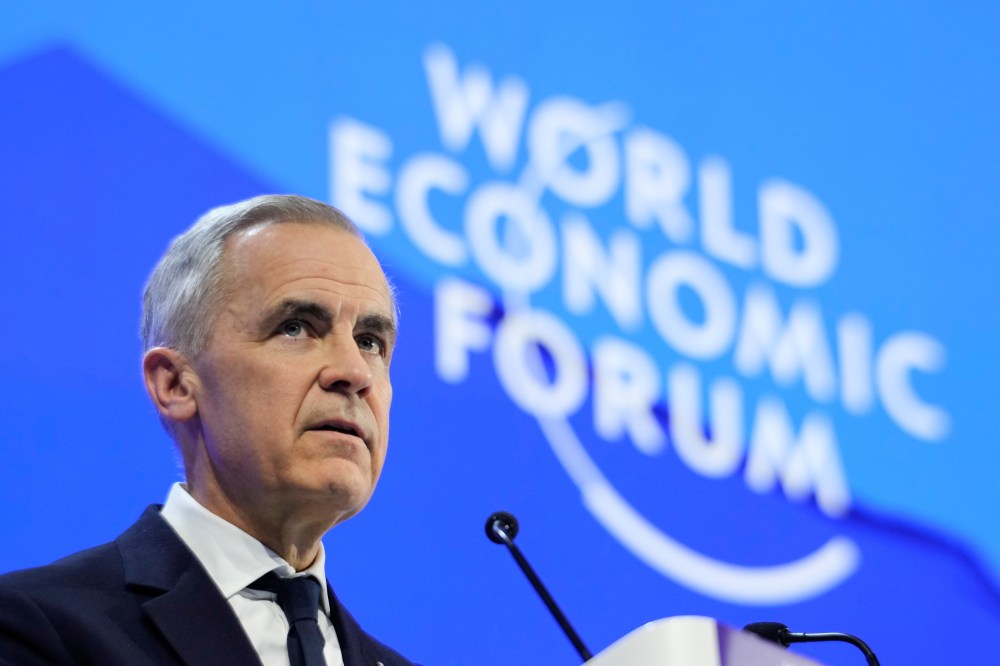
It has been seven months since Mark Carney rose to the podium in Davos, Switzerland, and bluntly declared that the traditional U.S.-led rules-based international order is over, and that it had been replaced by an era of great power rivalries and economic coercion.
The prime minister’s January speech, which talked of a “rupture” in global dynamics, intimated that countries like the United States were weaponizing economic integration to force smaller economies to their will.
It served as an extraordinary call to arms for middle powers to band together and build coalitions and cross-continental partnerships with like-minded governments instead. Carney also advised countries to insulate their economies and build domestic resilience. In effect, he was exhorting world leaders to build a counterweight to superpower dominance.
“When the rules no longer protect you, you must protect yourself,” he said.
It was an extraordinary address, one that had reverberations around the world in the weeks that followed. But it was only in the last few days that we have fully seen the realization of Carney’s “value-based realism” in his decision to end trade negotiations with the United States late Friday night, and take Canada to war.
An economic war, certainly, but one that has no less real-world consequences when it comes to our fiscal and political resolve. “Dollar-for-dollar” retaliatory measures by Canada are expected to be announced in the coming days.
Even as provincial premiers from across Canada have publicly supported Carney’s decision at the dawn of this trade war, this will not be an easy fight, and the fiscal punishment that it will inflict on our economy will take a toll — not the least of which on national unity — in the months ahead.
But from what details have been made public, it appears Canada had little choice in the matter.
During a Saturday press conference, Carney outlined three major actions that the U.S. negotiating team attempted to take at the 11th hour. They included restrictions on tariff relief and an unfair alteration to the scope of tariffs on Canadian auto content; an attempt to limit Canada’s independent ability to form other trade agreements with non-U.S. countries; and agreement wording that would have served to weaken Canada’s protections regarding language, culture and our national sovereignty.
Accepting these terms would have meant surrendering Canadian sovereignty, effectively turning the country into a vassal state of the Trump administration. It also would have undermined Carney’s Davos promise: to safeguard Canada’s independence and expand global trade as a shield against a volatile American hegemony.
As a result of Carney’s decision to walk away, Trump’s 50 per cent tariffs on scores of Canadian imports kicked in on Saturday, with the new levies expected to affect about five per cent of Canada’s exports to the U.S. — roughly $20 billion in goods ranging from honey and hockey sticks to clothing and furniture.
The tariffs will also apply to some products that were previously protected under the Canada-United States-Mexico Agreement, which is an important point to ponder. Trump’s willingness to bypass his own negotiated trade agreement with Canada by invoking Depression-era tariff legislation in an attempt to force economic compliance is doing the United States no favours.
Make no mistake, the international community has taken notice of the developing trade war between Canada and the United States, and world leaders will be watching how the fallout will impact the economies of both of our nations in the weeks and months to come. Further, those countries that accepted reduced U.S. tariffs in their respective trade negotiations with the Trump administration are now anxiously looking at what they signed up for.
Carney’s public warning that American agreements are “written in pencil” serves as a sharp lesson to world leaders in the altered nature of U.S. policies, and highlights the difficulties of negotiating with the unreliable trade partner that the United States has become.
Long-term U.S. partners have clear evidence that American commitments can be completely rewritten on a political whim or by executive decree. This unreliability will severely damage its remaining diplomatic “soft power,” making foreign governments hesitate to enter into complex, multi-year agreements with Washington.
It’s certainly possible — if not likely — that the United States will outlast Canada’s resolve and win this trade battle before cooler, smarter heads prevail. We should be under no illusions that this will be easy. But the Trump administration is doing far more harm to its own economic interests than the damage it has caused Canada-U.S. relations as it tries to subsume us.
If other countries in Europe and Asia follow Carney’s lead, the U.S. may find itself losing a far larger economic war that leaves Washington isolated in an economic landscape of its own making.
» Matt Goerzen, editor