
Saskatchewan’s Premier Moe announces 50% retaliatory tax on U.S. booze amid trade war
Advertisement
Read this article for free:
or
Already have an account? Log in here »
We need your support!
Local journalism needs your support!
As we navigate through unprecedented times, our journalists are working harder than ever to bring you the latest local updates to keep you safe and informed.
Now, more than ever, we need your support.
Starting at $15.99 plus taxes every four weeks you can access your Brandon Sun online and full access to all content as it appears on our website.
Subscribe Nowor call circulation directly at (204) 727-0527.
Your pledge helps to ensure we provide the news that matters most to your community!
To continue reading, please subscribe:
Add Brandon Sun access to your Free Press subscription for only an additional
$1 for the first 4 weeks*
- Enjoy unlimited reading on brandonsun.com
- Read the Brandon Sun E-Edition, our digital replica newspaper
*Your next Free Press subscription payment will increase by $1.00 and you will be charged $20.95 plus GST for four weeks. After four weeks, your payment will increase to $24.95 plus GST every four weeks.
Read unlimited articles for free today:
or
Already have an account? Log in here »
PRINCE ALBERT – As Canada’s trade war with the United States escalates, Saskatchewan is hitting back with a reciprocal tax on American alcohol.
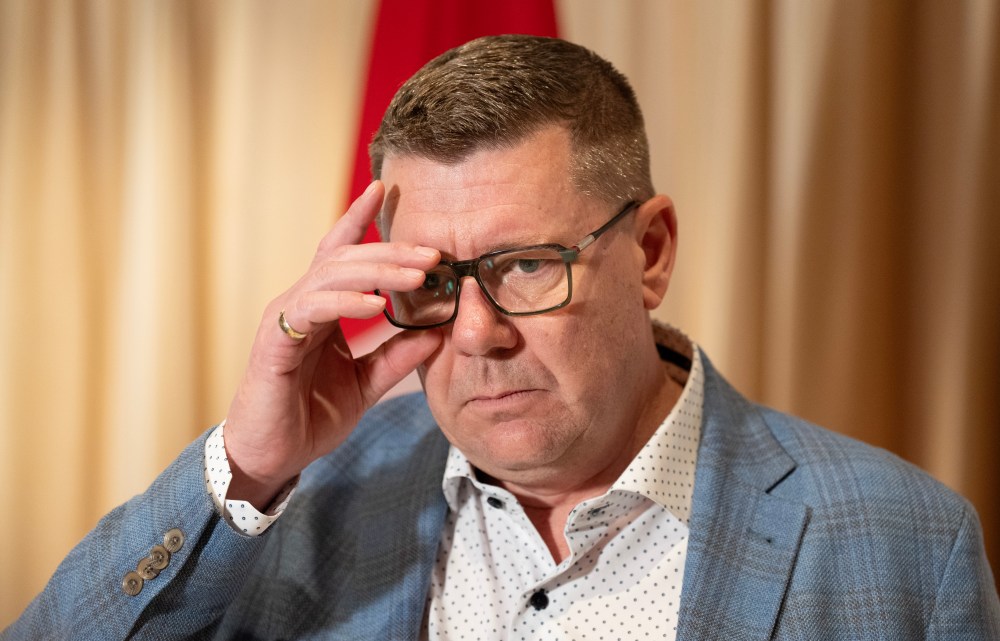
Saskatchewan Premier Scott Moe announced Wednesday that starting Sept. 8, Saskatchewan will impose the 50 per cent fee.
“It will be good for our Saskatchewan producers with domestic and local sales,” he told reporters Wednesday in Prince Albert, Sask.
The move comes after trade talks recently broke down between Canada and the United States.
U.S. President Donald Trump has implemented a 50 per cent tariff on Canadian alcohol products and a range of other goods. In return, Prime Minister Mark Carney has promised to hit back with dollar-for-dollar retaliatory tariffs starting Sept. 8.
Unlike other provinces, Saskatchewan and Alberta do not currently have a ban on American booze.
Moe said the goal of any countermeasures should be to get Americans back to the negotiating table. But he also said Canada – and Saskatchewan – must protect itself.
“I know there’s been many that have been asking if Saskatchewan is going to make changes with respect to American alcohol that is being made available in this province,” he said.
U.S. liquor will remain on store shelves because the province doesn’t want to limit the public’s ability to choose, Moe said.
“That is a very important core value for this government,” he said.
He added residents have been showing support for Canadian products with their wallets, as American booze sales in the province are down by about 40 per cent.
“I think that actually sends a much stronger message than any government-ordered ban,” Moe said. “The sale of Saskatchewan-made products has increased at the very same time.”
Moe said he supports Canada’s countermeasures against the United States, but he hopes both countries can get back to the negotiating table and reach a fair deal.
A last-minute proposal by the U.S. administration to limit Canada’s ability to trade with other countries was “totally unacceptable,” he said.
The U.S. tariffs affect six per cent of Saskatchewan’s economy, Moe said, while the remainder continues to have free access.
He said Canada’s countermeasures affect 11 per cent of the province’s imports from south of the border, or about $1.6 billion in goods.
“We may see those (tariffs) escalate in the days ahead,” Moe said.
Premiers have weighed in on what Canada should do against the United States as leverage.
Ontario Premier Doug Ford has proposed Alberta block oil shipments to the United States, while B.C. Premier David Eby has suggested Ottawa review U.S. exports of thermal coal through British Columbia.
Both Moe and Alberta Premier Danielle Smith are opposed to applying export taxes on oil.
Moe also said applying an export fee on potash – a key mineral in fertilizer – is also a non-starter.
“That would be a tremendous economic hit to our province and to our nation,” he said. “First, Canadians would lose jobs. Second, farmers on both sides of the border would pay more for that crucial fertilizer.”
If potash was blocked, he said, the United States would also start buying from other countries, like Belarus, which is an ally of Russia.
“This would be a tremendously flawed policy on behalf of Canadians,” he said.
Moe repeated his calls for Canada to get more pipelines built in the country, while also calling for policy changes that would make it easier to ship more Prairie products out of the Port of Vancouver.
He cited past federal decisions that have made it difficult to get pipelines built.
“We certainly have given up some energy security, which is becoming evident today, and ultimately (is) putting at risk our very sovereignty,” he said. “We should not make that mistake or any of those mistakes again in the future. We need to do better.”
This report by The Canadian Press was first published Aug. 26, 2026.