
Sixth-generation Manitoba ranch earns recognition for stewardship
Advertisement
Read this article for free:
or
Already have an account? Log in here »
We need your support!
Local journalism needs your support!
As we navigate through unprecedented times, our journalists are working harder than ever to bring you the latest local updates to keep you safe and informed.
Now, more than ever, we need your support.
Starting at $15.99 plus taxes every four weeks you can access your Brandon Sun online and full access to all content as it appears on our website.
Subscribe Nowor call circulation directly at (204) 727-0527.
Your pledge helps to ensure we provide the news that matters most to your community!
To continue reading, please subscribe:
Add Brandon Sun access to your Free Press subscription for only an additional
$1 for the first 4 weeks*
- Enjoy unlimited reading on brandonsun.com
- Read the Brandon Sun E-Edition, our digital replica newspaper
*Your next Free Press subscription payment will increase by $1.00 and you will be charged $20.95 plus GST for four weeks. After four weeks, your payment will increase to $24.95 plus GST every four weeks.
Read unlimited articles for free today:
or
Already have an account? Log in here »
For the English family, regenerative agriculture has been about continually asking how the land, cattle and business can work better together.
That approach has earned Connor and Kyla English, along with Brian and Leanne English, the 2026 Manitoba Environmental Stewardship Award.
The sixth-generation family ranch near Bradwardine manages about 320 breeding cows across nearly 1,100 acres of owned and rented pasture and forage land. Over the past decade, the family has steadily changed how it manages its grasslands, livestock and water systems, with the goal of building a ranch that remains productive for generations to come.
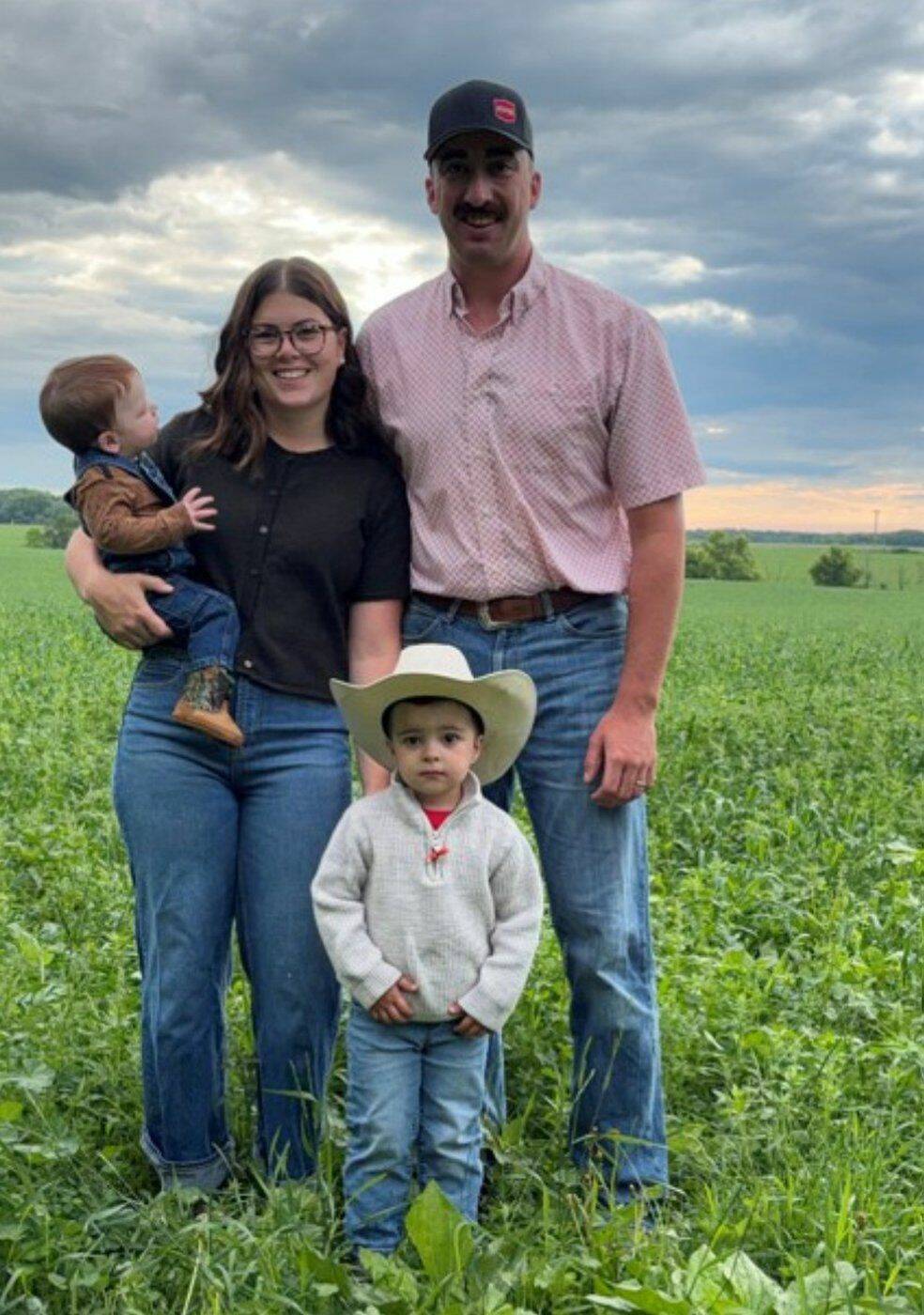
The sixth-generation English family near Bradwardine has been recognized with the 2026 Manitoba Environmental Stewardship Award for its regenerative grazing practices and commitment to protecting soil, water and biodiversity. (Courtesy Connor English)
Connor English said the changes have come with plenty of trial and error.
“There’s been many, many ups and downs in the journey,” he said. “In the agriculture world, we try new things and see what works and see what doesn’t and learn from our failures.”
For the English family, one of the biggest changes has been a shift toward perennial forages.
Since 2022, the family has transitioned its ranch acres so that about 95 per cent are now in perennial forage. That shift has required a major investment in fencing and water infrastructure to make rotational grazing possible and allow the family to better manage where and when cattle graze.
The ranch uses a total grazing approach, moving cattle through smaller paddocks and allowing forage time to recover before it is grazed again.
The result, English said, has been improvements in both the quality and quantity of forage available to the herd, while infrastructure has made some management practices less labour-intensive.
“It’s starting to see some results on quality and the quantity that we’re able to achieve with our grazing system,” he said.
The work has also become increasingly important as the family has expanded its herd.
Since 2022, the number of cows on the ranch has nearly tripled, putting additional pressure on the operation’s water systems.
Water has long been one of the family’s biggest challenges, particularly during winter. The ranch has developed several winter watering sites to provide cattle with reliable access to water while allowing them to remain on pasture as much as possible.
During the summer, much of the ranch’s water is delivered through underground, shallow-buried pipelines to troughs throughout the grazing areas.
That infrastructure has allowed the family to provide water to parts of the ranch where natural sources aren’t available, giving them more flexibility in managing grazing.
The family’s three creeks are fenced off from cattle to protect riparian areas. Instead, livestock receive water through the pipeline and trough system.
The ranch’s grazing system is divided into three management zones, including productive grazing areas, buffer areas that provide flexibility during dry or wet years, and stockpiled forage that is generally held for the following spring and calving season.
Conservation and agricultural programs have helped the family develop cross fencing, pipelines and other infrastructure.
English said the process has involved plenty of long days and projects that did not always produce the expected results.
But he said those setbacks are an important part of making progress.
“If you’re not willing to have some downfalls, you’re not gonna make any positive changes at the end of the day,” he said.
The family has also benefited from connecting with other producers who are experimenting with similar approaches.
English said he regularly talks with previous Manitoba Environmental Stewardship Award recipients through a group chat, allowing producers to share ideas and experiences.
Being recognized alongside those producers has made the award particularly meaningful, he said.
“It’s an honour to be recognized with folks like that, that calibre,” English said.
The ranch has also become a place where others can see regenerative practices in action. School groups, neighbours and international visitors have toured the operation to learn about the family’s grazing system.
Brian English also participates in the Loop program, which diverts surplus grocery produce that might otherwise end up in landfills and uses it as livestock feed.
The family plans to continue making changes. Future projects include expanding water storage, improving winter watering systems and establishing additional shelterbelts to protect soil, capture snow and provide livestock shelter.
English is also interested in the potential of virtual fencing, which could eventually give the family another tool for managing grazing areas.
But he cautions other producers against chasing every new idea simply because it is being promoted as the next big thing.
Instead, he said producers need to understand why they are making a change and how it fits into the larger goals of their operation.
“You can get carried away,” he said. “You hear of a new thing and you go wholehearted down the path and you make it to the end of the year and think, really, what did we achieve? Are we any further ahead than we were when we started?”
Understanding that “why,” he said, is something that can take years.
For the English family, environmental stewardship also has to make economic sense.
English said ranchers need to balance ecological health with the financial sustainability required to keep agricultural operations operating for future generations.
“I think we need to really focus on doing a good job of both of them to have businesses moving forward into the future for further generations,” he said.
Maintaining the family’s sixth-generation ranch, he added, doesn’t necessarily mean doing things exactly as previous generations did.
“Keeping the legacy alive would be very cool,” English said. “But if change needs to happen, I hope we can acknowledge that it may need to.”
He said the goal is to give future generations the opportunity to make their own decisions while ensuring the land and business remain in a position to support them.
And while the family has been recognized for its environmental work, English said consumers also have a role to play in supporting Canadian cattle producers.
“Just eat beef,” he said.
English said beef producers across the country are working to improve their operations and protect the land they depend on.
For the English family, the award is a recognition of that ongoing work but not a signal that the work is finished.
The next generation of the ranch will inherit land shaped by six generations of farming and ranching, but English believes its future will depend on continuing to adapt.
The challenge, he said, is finding ways to make the ranch economically sustainable while maintaining healthy soil, water and ecosystems for the generations that follow.
» Winnipeg Sun