
Letter to the Editor — Transit improvements benefit everyone — so who pays for it?
Advertisement
Read this article for free:
or
Already have an account? Log in here »
We need your support!
Local journalism needs your support!
As we navigate through unprecedented times, our journalists are working harder than ever to bring you the latest local updates to keep you safe and informed.
Now, more than ever, we need your support.
Starting at $15.99 plus taxes every four weeks you can access your Brandon Sun online and full access to all content as it appears on our website.
Subscribe Nowor call circulation directly at (204) 727-0527.
Your pledge helps to ensure we provide the news that matters most to your community!
To continue reading, please subscribe:
Add Brandon Sun access to your Free Press subscription for only an additional
$1 for the first 4 weeks*
- Enjoy unlimited reading on brandonsun.com
- Read the Brandon Sun E-Edition, our digital replica newspaper
*Your next Free Press subscription payment will increase by $1.00 and you will be charged $20.95 plus GST for four weeks. After four weeks, your payment will increase to $24.95 plus GST every four weeks.
Read unlimited articles for free today:
or
Already have an account? Log in here »
I am writing in response to the op-ed published on Sept. 9, 2026, entitled “One way to reduce our carbon footprint,” in which the author calls on transit systems across Manitoba to provide bus service free of charge. The author argues that, along with increased safety measures and improved accessibility accommodations, transit would be a more viable option for more people, greatly reducing the need for cars on the road and thus decreasing Manitobans’ transportation-related emissions. This is a strong point, and it is supported by the City of Brandon’s Climate Change Action Plan, which aims to rethink transportation in our city by making bus travel more reliable and convenient. I agree with the author of the previous letter that safety is also an issue that should be included in any transit improvement plans for Brandon.
Over the past few years, Brandon Transit has conducted research and public engagement to produce a Transit Master Plan. This document compares Brandon to other cities of our size in Canada and suggests the best way to make our system more efficient, accessible and convenient without raising fares too much (Brandon transit fares are currently among the lowest in the country, and are far below what similar jurisdictions charge).
This Master Plan would modernize bus service in Brandon, improving on the hub-and-spoke model where each bus returns to a single terminal every half hour (which is becoming impossible with increased traffic and more riders getting on and off), expanding service hours on evenings and weekends and restructuring routes so that buses run both ways along major thoroughfares. The first phase of this plan was set to roll out this fall, but I haven’t heard anything about this actually happening. As always, it likely comes down to funding. Who will pay for these improvements?
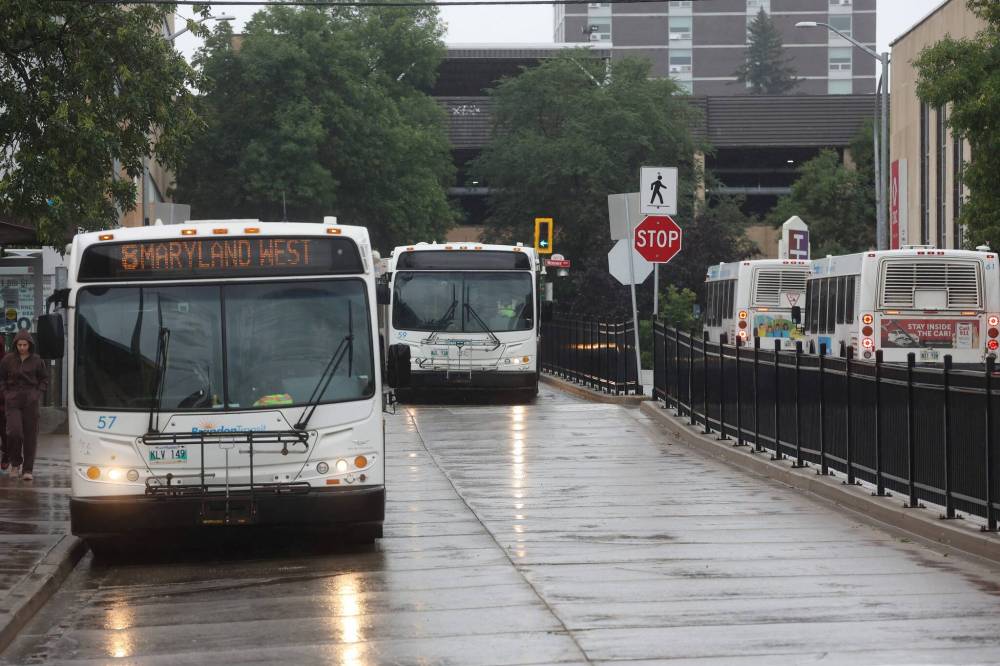
Brandon Transit buses cue at the downtown terminal. (Tim Smith/The Brandon Sun files)
Earlier this year, the provincial government offered up to $10 million to provide youth riders with free transit across Manitoba. The City of Brandon has taken them up on that, and free transit ‘Smart!’ cards are being distributed to all Brandon School Division students and youth under 18 this week (with parental permission). This is a huge step toward creating a culture of transit use in young people, and checks off a box on the city’s Action Plan on the province’s dime — a win-win!
But what happens when more young people start riding the bus during peak times, when the bus is already running up to half an hour late? At what point do buses start to fill up and pass people by at bus stops, as is often seen in Winnipeg? Getting more kids on the bus is fantastic, but only if the bus system can handle the additional load. Most of Brandon’s buses are due for refurbishment or replacement, and breakdowns are a consideration as well. More buses means more operator hours, more maintenance and more fuel. The city’s transit budget is currently stretched to its limit, and the additional $3 million per year in operating expenses estimated by the Transit Master Plan would have to come from somewhere else — but where?
Enter the ongoing provincial campaign calling on the province to bring back the “50-50 model” of matching funds that was scrapped by the PC government in 2017. Since that funding was frozen, transit systems across the province have seen huge reductions in service and fare increases. Paying more for worse service isn’t appealing for many; even free transit isn’t much better when that free bus never comes, or comes late and too full to board!
The province’s offer to pay for youth transit seems generous, until you realize that the $10 million is only to cover lost fare revenue. The municipalities are left holding the bag for the accompanying increases in operating costs, addition of new buses and infrastructure, etc. When campaigning for office, now-Premier Wab Kinew called for a return to the 50-50 funding model. This year, in response to increasing pressure to keep his word, he has denounced this model as outdated, pointing to the free youth passes as today’s solution. For many transit riders (and potential transit riders) across the province, this is not enough.
I encourage the author of the previous op-ed, and anyone who read that letter and agreed, to join the coalition calling for the restoration of provincial matching funds to drastically improve Manitoba’s transit systems — safety, efficiency, accessibility, reliability and sustainability — without the transit rider having to pay the price. More information on this campaign and how to get involved can be found on Climate Action Team Manitoba’s website.
KAT HUNKIN
Brandon