
Roll with the changes on Brandon Transit
Advertisement
Read this article for free:
or
Already have an account? Log in here »
We need your support!
Local journalism needs your support!
As we navigate through unprecedented times, our journalists are working harder than ever to bring you the latest local updates to keep you safe and informed.
Now, more than ever, we need your support.
Starting at $15.99 plus taxes every four weeks you can access your Brandon Sun online and full access to all content as it appears on our website.
Subscribe Nowor call circulation directly at (204) 727-0527.
Your pledge helps to ensure we provide the news that matters most to your community!
To continue reading, please subscribe:
Add Brandon Sun access to your Free Press subscription for only an additional
$1 for the first 4 weeks*
- Enjoy unlimited reading on brandonsun.com
- Read the Brandon Sun E-Edition, our digital replica newspaper
*Your next Free Press subscription payment will increase by $1.00 and you will be charged $20.95 plus GST for four weeks. After four weeks, your payment will increase to $24.95 plus GST every four weeks.
Read unlimited articles for free today:
or
Already have an account? Log in here »
“What we’re doing is trying to increase how fast service can be delivered. We’re hoping we can get to faster service, but it’s not going to happen overnight.”
— Greg Brown, City of Brandon acting director of transportation
The City of Brandon will be playing the long game when it comes to implementing new Brandon Transit bus routes, even as the first of two new routes come into effect next month.
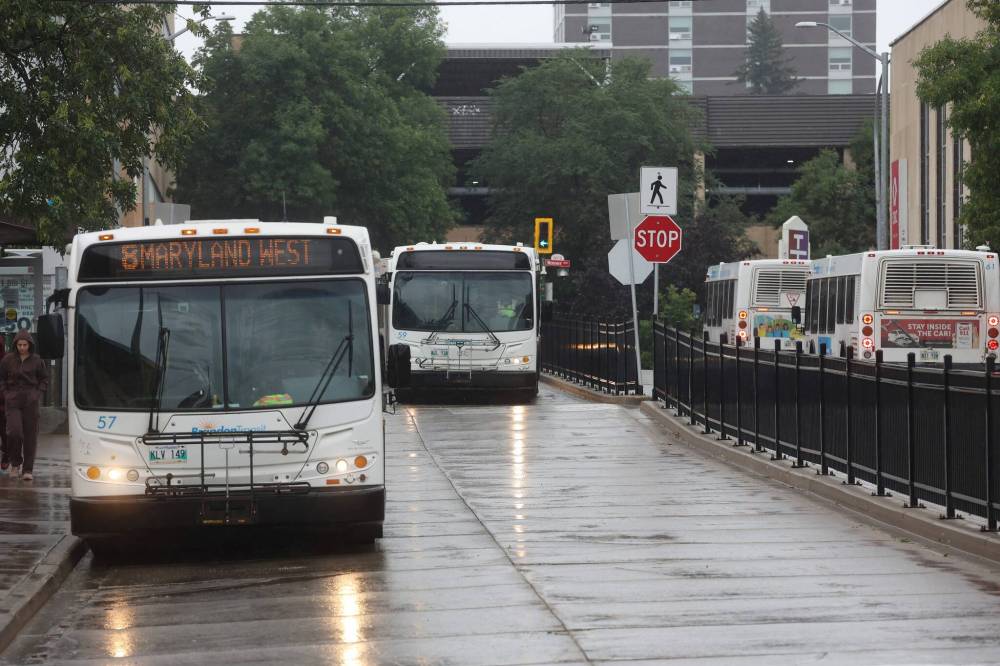
Brandon Transit buses queue at the downtown terminal on a rainy afternoon. (The Brandon Sun files)
And while there are reasons for the decision to slow-roll the rollout, the situation will likely not satisfy those pushing for faster change when it comes to city Transit services.
For the last several years, the city has been plodding forward on its five-year plan to move away from the current “hub and spoke” model in which all loops meet downtown. As Greg Brown, the city’s acting director of transportation told the Sun last Friday, “It’s a big deal.”
Though the city’s official community outreach for the modern Transit Master Plan kicked off in the spring of 2024, the operational catalyst and preliminary planning stages began in 2021 when the city launched a Transit On-Demand pilot project that lasted for exactly 10 months.
That pilot officially ended on Sept. 2. 2022 after it faced significant public pushback regarding wait times and tech barriers. Brandon Transit had also determined that the pilot didn’t achieve what the city was looking for, prompting city planners back to the option of restructuring the transit routes instead.
It was in 2023 that the city formally commissioned a comprehensive review of all routes and services. What came out of the year spent gathering internal information — along with the hiring of the Watt Consulting Group to guide the process — was the new Transit Master Plan, which went out for public scrutiny in 2024.
The first two bus route changes will come into effect on Oct. 5, when two current North Hill loops are replaced. One of the two new routes will stay on the North Hill, while the other route will travel south to make connections at the downtown terminal.
This will only be phase one of the changes, with the full change to seven reconfigured routes — including an express route along 18th Street — taking place over the next five years. That places the project’s completion even beyond the four-year mandate of the next council, which will be elected in October, meaning that four separate city councils will have had their fingerprints on the changes from the initial push for a pilot project to the completion of the Transit Master Plan.
And that’s assuming, of course, that the next council doesn’t see the need to tweak the five-year-plan in some way, or that public opinion gives Brandon Transit pause to rethink some particular aspect of it.
So yes, it does seem like a long time to get a Transit overhaul completed, particularly in a city our size. Yet the reality is that this kind of planning does take some effort.
For example, the City of Winnipeg went online with their full route overhaul on June 29, 2025, executing the single largest change to their Transit system in 142 years. Virtually every single bus route in that city was altered, replaced or updated in some way, and the changes took effect overnight — much like ripping off a Band-Aid.
Not only that, it took seven years to get to that point in the first place, with Winnipeg Transit inducting extensive passenger surveys and completing the foundational blueprint for a complete network makeover between 2018 and 2019. Winnipeg’s master plan was approved in spring of 2021, with council only giving the official approval in mid-2024.
Assuming of course that Brandon could financially afford such a stunt — an overnight transformation requires months of effort and significant funds to move bus stops and change route signs — our city would run the risk of experiencing the same negative fallout that Winnipeg Transit experienced after their route change overhaul.
Winnipeg was buried under an avalanche of negative feedback. In the first month alone, they received nearly 2,900 formal complaints, which ballooned to more tan 11,000 complaints by the nine-month mark. And the message riders gave the City of Winnipeg? The new system was a massive downgrade.
Ridership fell by 34 per cent, while Winnipeg Transit also saw an increase fare evasion, forcing the organization to forecast a massive $18.4-million revenue shortfall, according to a report by the CBC last June.
As a result, Winnipeg Transit has spent the last year doing damage control by adding extra stops back onto major routes, extending late-night service to fix coverage gaps and extending the bus transfer window. In fact, Winnipeg is still dealing with the fallout.
Brandon Transit, on the other hand, is a much smaller agency, and spreading planned route changes out over five years gives the system — and its riders — a little room to breathe.
Making phased changes allows both riders and bus drivers time to get used to the route changes. It also allows Brandon Transit to make necessary changes to the route if the phase change in question causes issues.
While Brandon’s method means a lower intensity of confusion and anger, it does force Transit users to deal with a longer duration of irritation and moving goalposts.
There’s no perfect here. It’s very likely that some tweaks to the system will be necessary, and even then, not everyone will like the upcoming changes. But with any luck, city planners have done their jobs properly and the first phase will be relatively smooth.
And hopefully, city residents will get on board.