
In documentary ‘Ba’s Book,’ Ashley Da-Le Duong recreates her family’s past to get them to talk about it
Advertisement
Read this article for free:
or
Already have an account? Log in here »
We need your support!
Local journalism needs your support!
As we navigate through unprecedented times, our journalists are working harder than ever to bring you the latest local updates to keep you safe and informed.
Now, more than ever, we need your support.
Starting at $15.99 plus taxes every four weeks you can access your Brandon Sun online and full access to all content as it appears on our website.
Subscribe Nowor call circulation directly at (204) 727-0527.
Your pledge helps to ensure we provide the news that matters most to your community!
To continue reading, please subscribe:
Add Brandon Sun access to your Free Press subscription for only an additional
$1 for the first 4 weeks*
- Enjoy unlimited reading on brandonsun.com
- Read the Brandon Sun E-Edition, our digital replica newspaper
*Your next Free Press subscription payment will increase by $1.00 and you will be charged $20.95 plus GST for four weeks. After four weeks, your payment will increase to $24.95 plus GST every four weeks.
Read unlimited articles for free today:
or
Already have an account? Log in here »
TORONTO – How do you convince your estranged family to sit down and talk about their trauma? Simple: You get them to direct actors in elaborate re-enactments of scenes from their youth.
The result is Ashley Da-Le Duong’s hybrid documentary “Ba’s Book,” which explores how growing up in central Vietnam during the war shaped her father, his siblings and their mother. It premiered Tuesday at the Toronto International Film Festival.
“Originally I was just going to do some interviews with my relatives,” Duong said on a video call from her home in Montreal. “But I noticed that they had a reluctance to talk about the war period. And I understood that, and I didn’t want to push them in that format.”
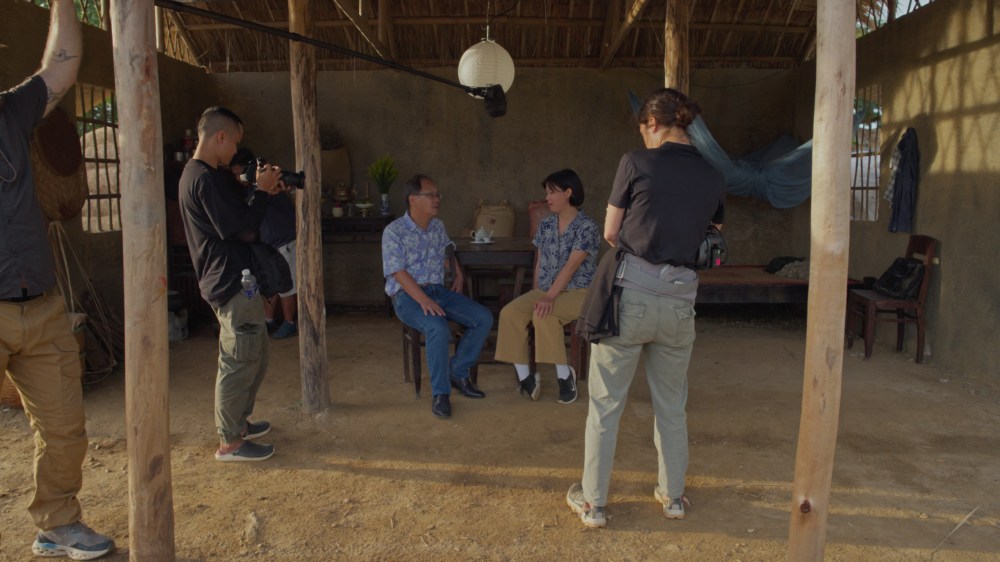
To make the film, Duong travelled to Vietnam and met her aunts and uncles. Eventually, she convinced her dad to join her there — his first time returning to the country of his birth since he was 22 years old.
The whole endeavour was only possible because Duong’s father, Anh Duong, wrote a memoir several years ago: “Dear Da-Le: A Father’s Memoir of the Vietnam War and the Iranian Revolution.”
Before writing the book, Ashley Duong said, her father never spoke of his young life. She didn’t even know he’d been at university in Iran during the revolution.
As the eldest son, he felt pressure to become successful and provide for his family as a civil war raged outside their home.
Because he didn’t speak of it, even Anh Duong’s family didn’t know what he’d experienced — and the memoir was written in English, which they don’t read.
To help her relatives open up during filming, Duong said she tried “a little experiment”: she cast two of her cousins as younger versions of her dad and aunt and filmed a scene with them.
Immediately, she said, her grandmother was ready to talk. Duong got some of the details wrong — she had the kids wearing shoes, which they didn’t do back then. Her grandmother was all too willing to correct her.
“I was like: OK, so this is clearly a method that works for my family, that people can be engaged in, that they can have some way to tell their story,” Duong said.
In one particularly revelatory scene, the actor portraying a young version of Duong’s father is re-enacting a moment when American soldiers threw cigarettes to him, and they land at his feet.
In the first take, the boy immediately picks up the cigarettes, but the real-life Anh Duong stops him to correct the record: he waited until the soldiers had gone before grabbing the cigarettes. He wanted them, but he resented the soldiers and didn’t want them to see him stoop down.
The scene’s second take is done according to Anh Duong’s direction, made all the more poignant for the viewer’s new understanding of its significance.
“At the end of the day, the whole exercise was really just for me to understand him better, to understand why he is the way he is, which had been always such a mystery to me growing up,” Ashley Duong said.
This report by The Canadian Press was first published Sept. 16, 2026.