
Annie Dillard, Pulitzer-winning author of ‘Pilgrim at Tinker Creek,’ dies at 81
Advertisement
Read this article for free:
or
Already have an account? Log in here »
We need your support!
Local journalism needs your support!
As we navigate through unprecedented times, our journalists are working harder than ever to bring you the latest local updates to keep you safe and informed.
Now, more than ever, we need your support.
Starting at $15.99 plus taxes every four weeks you can access your Brandon Sun online and full access to all content as it appears on our website.
Subscribe Nowor call circulation directly at (204) 727-0527.
Your pledge helps to ensure we provide the news that matters most to your community!
To continue reading, please subscribe:
Add Brandon Sun access to your Free Press subscription for only an additional
$1 for the first 4 weeks*
- Enjoy unlimited reading on brandonsun.com
- Read the Brandon Sun E-Edition, our digital replica newspaper
*Your next Free Press subscription payment will increase by $1.00 and you will be charged $20.95 plus GST for four weeks. After four weeks, your payment will increase to $24.95 plus GST every four weeks.
Read unlimited articles for free today:
or
Already have an account? Log in here »
NEW YORK (AP) — Annie Dillard, the Pulitzer-Prize winning author and essayist renowned for her poetic explorations of nature, love, spirituality and the art of writing in the “Pilgrim at Tinker Creek,” “The Maytrees” and numerous other works, has died. She was 81.
Her literary agent, Rob McQuilkin, said Dillard died Tuesday of natural causes at her home in South Wellfleet, Massachusetts.
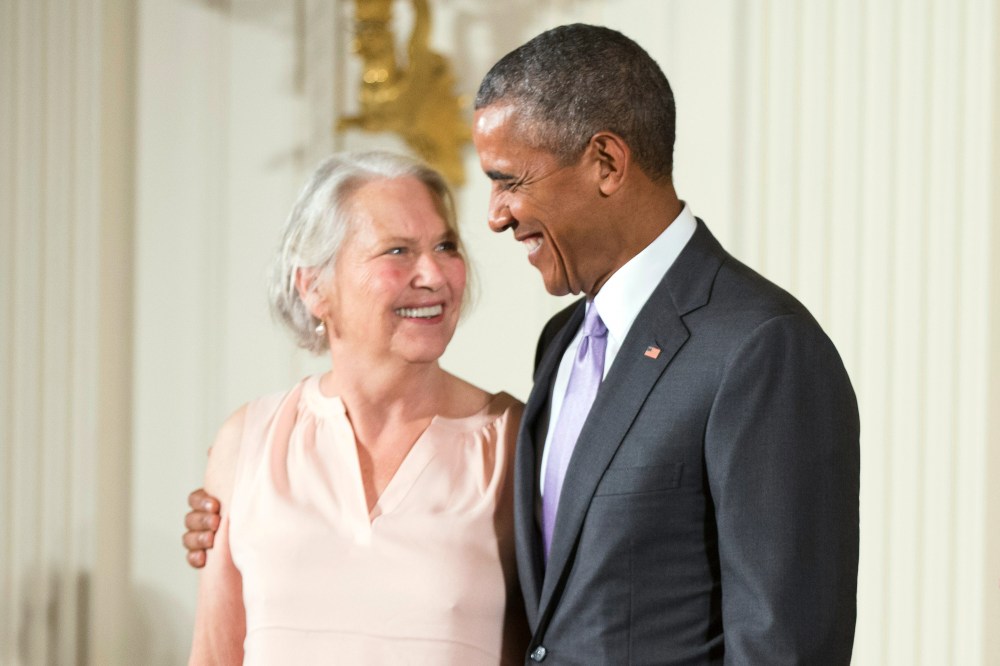
Starting in the mid-1970s, Dillard completed a wide range of books, from the poetry collection “Tickets for a Prayer Wheel” to what she would call the “jolly journalism” of “Encounters with Chinese Writers” to the novel of marriage, “The Maytrees,” a finalist for the PEN/Faulkner award in 2008. Seven years later, President Barack Obama presented her with a National Humanities Medal for her “profound reflections on human life and nature.”
Born Meta Ann Doak, she was a Pittsburgh native who in the 1987 memoir “An American Childhood” looked back at her early years and on her uniquely curious mind. She was raised by nonconformists who gave her a wide range to learn and to discover, and she remembered with awe her growing sense of knowledge and self-knowledge. Resistant for much of her life to organized religion, she would find the eternal in animals, mountains, her mother’s skin and in everyday objects. At age 13, she wrote, she was reading “books on drawing, painting, rocks, criminology, birds, moths, beetles, stamps, ponds and streams, medicine.”
Dillard had yet to turn 30 when “Pilgrim at Tinker Creek” established her as a major, new literary voice and heir to Henry David Thoreau as a sensitive and idiosyncratic observer of the natural world. Published in 1974 and winner of the Pulitzer for nonfiction, “Pilgrim at Tinker Creek” drew upon Dillard’s private writings about the surroundings of her home in Roanoke, Virginia. Invoking Thoreau, about whom she wrote her master’s thesis at Hollins College, she called her book “a meteorological journal of the mind,” in which she would explore “some of the sights of this rather tamed valley.”
“I am no scientist,” she wrote, likening herself to “an infant who has just learned to hold his head up” and gaze about “in bewilderment.”
“He hasn’t the faintest clue where he is, and he aims to learn. In a couple of years, what he will have learned instead is how to fake it: he’ll have the cocksure air of a squatter who has come to feel he owns the place,” she wrote.
Dillard taught for more than 20 years at Wesleyan University before retiring in 2002. She was married three times, most recently to the late literary biographer Robert Richardson, whom she met after sending him a fan letter admiring his biography of Thoreau. She had one child, Cody, with second husband Gary Clevidence. Her first husband was creative writing teacher Richard Dillard, whom she divorced in 1975 after 10 years of marriage.