
Letters to the Editor — Sept. 19, 2026
Advertisement
Read this article for free:
or
Already have an account? Log in here »
We need your support!
Local journalism needs your support!
As we navigate through unprecedented times, our journalists are working harder than ever to bring you the latest local updates to keep you safe and informed.
Now, more than ever, we need your support.
Starting at $15.99 plus taxes every four weeks you can access your Brandon Sun online and full access to all content as it appears on our website.
Subscribe Nowor call circulation directly at (204) 727-0527.
Your pledge helps to ensure we provide the news that matters most to your community!
To continue reading, please subscribe:
Add Brandon Sun access to your Free Press subscription for only an additional
$1 for the first 4 weeks*
- Enjoy unlimited reading on brandonsun.com
- Read the Brandon Sun E-Edition, our digital replica newspaper
*Your next Free Press subscription payment will increase by $1.00 and you will be charged $20.95 plus GST for four weeks. After four weeks, your payment will increase to $24.95 plus GST every four weeks.
Read unlimited articles for free today:
or
Already have an account? Log in here »
DO MANITOBANS REALLY WANT THIS?
The population of Manitoba is well over one million people. I’m not sure how many of that number are of voting age, but many more than the 72,000 who voted in the survey about time change. Fifty-eight per cent, or about 42,000 people, decided Manitoba should continue to have daylight time.
According to the Canadian Press article “Manitoba goes to year-round daylight time” in the Sept. 18 Brandon Sun, this means the people of Thompson, for example, will see sunrise after 10 a.m. on short winter days. I wonder how many people in the northern communities voted for this.
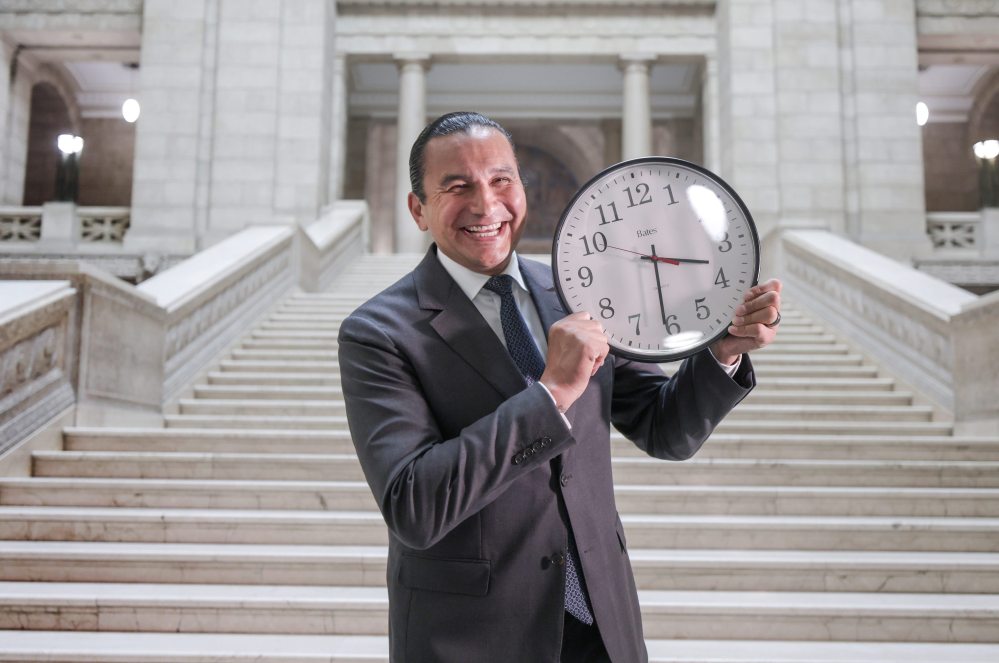
We are told in the same article that health experts wanted standard time to be made permanent as it is better for our health. Professor Inna Rabinovich-Nikitin, whose area of expertise is physiology, says keeping daylight time is worse than changing the clocks twice during the year. This appears to be scientific knowledge and we are encouraged, are we not, to pay attention to science.
A counter argument is that children will benefit from more light later in the day as it affects their activity level. Unfortunately, many rural school children who ride buses begin and end their winter days in the dark. If there is any extra daylight, it will most likely be spent in a vehicle.
The premier is pleased that the government has done something that the people wanted, but it was really only a few people perhaps from a very limited area in the province, and the choice defies scientific research.
Is this any way to make policy for all Manitobans?
V. BEELAERT
Russell
CITY DOESN’T ALWAYS SHOW ITS WORK
The City of Brandon has been working to change the balance of who should pay for development.
Much of that discussion has centred on the idea that “growth pays for growth.” It is an interesting — and clearly debatable — philosophy.
So, how are we doing? And what should taxpayers expect going forward?
Development cost charges (DCCs) are one part of this equation. They are fees charged to developers to help cover the cost of infrastructure and public services required to support new development.
To its credit, though questions remain, the city has made an effort to show its work on DCCs. It has explained formulas and calculations, outlined the philosophical choices involved in attributing costs and connected those choices to broader economic-development objectives.
That is exactly the kind of information the public needs when a municipality changes how development costs are allocated.
But there is another side to the development equation. When the city itself provides financial incentives to encourage development, where is the comparable demonstration of the work behind those decisions?
Consider the pickleball development.
Public land was transferred for $1, combined with a 10-year Tax Increment Financing agreement. Whatever one’s opinion of pickleball itself, this represents a material public investment in a private development. The question isn’t whether someone is for or against pickleball. The question is whether the city can demonstrate the rationale for the level of public investment it chose to make.
If the city can explain the calculations and policy choices behind DCCs, can it provide a comparable explanation for this investment?
What was the land worth? What alternatives were considered? Why was $1 the appropriate valuation? Why was a 10-year TIF the appropriate incentive? What public benefit was expected, and how was that benefit weighed against the value of the public contribution? And perhaps most importantly, what principles will guide the city’s next development investment?
The City of Winnipeg, by contrast, has demonstrated a higher level of public transparency in at least some comparable development arrangements. If other municipalities can show their work, why shouldn’t Brandon? It is not unreasonable for taxpayers to ask.
If additional incentives were required to make the project financeable, perhaps they were justified. But the public should be able to understand why.
If land financing was necessary, why was an outright $1 transfer preferable to a generous long-term lease with an option to purchase?
The developer could have had time to establish the project and raise the necessary capital, while the city could have ultimately sold the land at market value. Perhaps that would have been a better arrangement for both the city and the developer. Perhaps not. But that is precisely the point: what alternatives were considered, and why was this one chosen?
The city’s own land policy calls for consideration of the highest and best use of municipal land. That makes the question of how the land was valued — and why this particular arrangement was chosen — even more relevant.
The point isn’t that the city should never provide incentives. Municipalities may have good reasons to provide land, tax assistance, TIF agreements or other incentives to encourage development.
The point is that the same standard of explanation should apply when the city is spending or foregoing public value as when it is collecting from developers through DCCs.
Growth does not only have a cost when the city sends a bill to a developer. It also has a cost when the city gives up land value, tax revenue or other public benefits to make a development happen.
If “growth pays for growth” is going to be an important principle in Brandon’s development policy, then it should be defined and applied consistently.
It should not apply only when the city is collecting developer dollars.
The public deserves the same level of attention and accountability when elected officials allocate public assets through land sales, tax rebates, TIF agreements or other development incentives.
The city has already demonstrated that it can show its work on one side of the equation. Now it should do the same on the other.
It is not too late to explain what options were considered, what the city expected to achieve, why this particular allocation of public value was chosen, and what taxpayers should expect from future public-private development arrangements.
The City of Brandon should not ask for blind public trust. Trust should be earned.
And for a municipality, one of the best ways to earn that trust is simple: Show your work.
JOHN RAINER ANDERSON
Brandon
SEEKING SOME ANSWERS ON ACCESSIBILITY
Dear Mr. Mayor,
I am writing because I would like to know what you and your administration plan to do to improve accessibility in Brandon for people living with disabilities and debilitating chronic illnesses, and seniors.
I am also sending these concerns to the candidates running in Ward 4, as I believe the issues I am describing deserve attention both at the ward level and at the broader municipal level.
I live in the north end, and the condition of some of our roads and sidewalks has made basic mobility extraordinarily difficult. McDonald Avenue and Stickney Avenue are particular examples of infrastructure that can be extremely difficult, and at times effectively impossible, to navigate both with and without mobility aids.
This is not simply an issue of convenience or aesthetics. For people with mobility limitations, sidewalks and roads that are severely uneven, broken, poorly maintained, or heavily obstructed can determine whether we are able to leave our homes at all.
For me personally, using a walker can make walking somewhat easier on my legs, but the amount of shaking and vibration caused by the condition of the sidewalks — and, frankly, many of the surrounding areas — can result in significant pain, numbness and even complete loss of sensation in my arms and hands. It can also trigger excruciatingly painful symptoms related to my Chiari malformation.
The uneven surfaces create a constant risk of tripping, which happens to me on every outing. Cracks, uneven pavement and changes in elevation can also catch mobility aids and make them difficult to control.
The result has been profound isolation. There are places I need to get to, as well as places I would simply like to go for some fresh air and exercise, but the condition of the surrounding infrastructure can make that feel unsafe or physically impossible.
I would therefore like to know:
• Does the city have a plan to improve the accessibility of roads and sidewalks, particularly in areas where existing infrastructure is effectively inaccessible to people using mobility aids?
• Would you support prioritizing sidewalk repairs based not only on general infrastructure needs, but also on their accessibility and impact on residents using walkers, wheelchairs, scooters, canes and other mobility aids?
• How can residents with disabilities or significant mobility limitations have greater input into identifying accessibility problems and prioritizing repairs?
• Would you support a more systematic way for residents to report accessibility hazards and have those reports incorporated into infrastructure planning and repair priorities?
I also have another concern that I believe deserves municipal attention: yard maintenance and snow removal for residents living at or below the poverty line who also have disabilities, chronic illness or significant mobility limitations.
There are people who simply cannot physically maintain their yards, clear snow or keep walkways accessible, and who cannot necessarily afford to hire someone to do it for them. Disability can also result in someone living at or below the poverty line. Not everyone has a familial or social support system to turn to for help when times are difficult.
This can create a vicious cycle. Poverty and disability make it difficult to maintain a property. The resulting condition can lead to city fines or other consequences, while inaccessible walkways can result in Canada Post ceasing mail delivery. Losing mail delivery creates additional hardship, particularly for people who already have limited mobility and resources.
I would like to know whether you would consider supporting or advocating for a city-supported assistance program, subsidy, partnership or other mechanism that could provide affordable or free yard care and snow removal to low-income residents with disabilities, debilitating chronic illness, and seniors.
I recognize that not every solution necessarily falls directly within the authority of the mayor or city council. However, municipal leadership has an important role in identifying gaps, bringing departments and community organizations together and advocating for solutions when existing systems are failing vulnerable residents.
There is a growing feeling among some residents that parts of Brandon are being neglected compared with other areas of the city. I hope that is something municipal leadership will take seriously rather than dismiss as simply the normal wear and tear of an older neighbourhood.
Accessibility should not mean merely having a policy somewhere stating that the city is committed to accessibility. It needs to mean that a person using a walker can actually get down their street without being injured, that a wheelchair user can navigate their neighbourhood, that a senior does not have to risk falling because a sidewalk has deteriorated, and that someone living in poverty and dealing with disability or illness is not punished simply because they physically or financially cannot maintain their property to the same standard as someone with the money and physical ability to do so.
I would appreciate hearing what specific priorities, initiatives or changes you would support to address these issues, for the remainder of your term and if you are re-elected.
Thank you for your time, and I look forward to hearing your response.
Sincerely and respectfully,
TARRA STROO
Brandon
FAWCETT HAS STEPPED UP
We are approaching municipal elections here in Brandon.
I want to comment on our current mayor, Jeff Fawcett. Before the previous election, I understood Jeff to say that one priority for him would be to get more provincial attention paid to Brandon. In this past three to four years, I feel that he must get credit for doing so.
Since then, it seems that we see the premier here frequently, and especially so with the appointment of Glen Simard, the MLA for Brandon East, to cabinet. The location for the Peter Sawatzky Legacy Park was courted for Brandon’s Riverbank Discovery Centre by a team of people including Jeff.
It is satisfying to see our mayor participating in local activities and performances. Not only is Jeff present, but he’s often stepping in to help. He is one of the volunteer pilots of Brandon’s new Tri-Shaw.
Personally, I thank Jeff for stepping up in securing more provincial visibility for our community within Manitoba.
HELEN FRASER
Brandon