
‘Stitched it back’: Edmonton event where locals mend clothes promotes sustainability
Advertisement
Read this article for free:
or
Already have an account? Log in here »
We need your support!
Local journalism needs your support!
As we navigate through unprecedented times, our journalists are working harder than ever to bring you the latest local updates to keep you safe and informed.
Now, more than ever, we need your support.
Starting at $15.99 plus taxes every four weeks you can access your Brandon Sun online and full access to all content as it appears on our website.
Subscribe Nowor call circulation directly at (204) 727-0527.
Your pledge helps to ensure we provide the news that matters most to your community!
To continue reading, please subscribe:
Add Brandon Sun access to your Free Press subscription for only an additional
$1 for the first 4 weeks*
- Enjoy unlimited reading on brandonsun.com
- Read the Brandon Sun E-Edition, our digital replica newspaper
*Your next Free Press subscription payment will increase by $1.00 and you will be charged $20.95 plus GST for four weeks. After four weeks, your payment will increase to $24.95 plus GST every four weeks.
Read unlimited articles for free today:
or
Already have an account? Log in here »
EDMONTON – Pearce Carpenter says fixing the holes in the black balloon bottoms they bought from an Edmonton thrift store is their way of tackling fast fashion.
“There is so much textile waste in the world, so if we just fix old clothes, like holes in the crotch areas of pants, it’s one little quiet act of rebellion,” said Carpenter, who uses they and them pronouns, while stitching over the part of the pants where two holes once were.
“Crotches wear out so quickly in pants just from rubbing your thighs.”
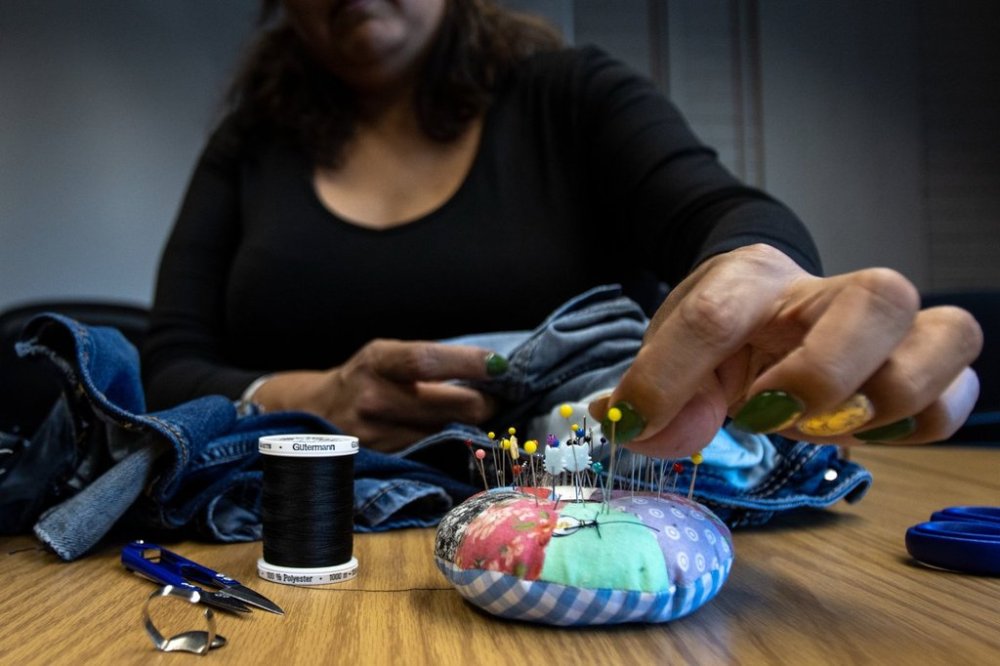
Before they started stitching, they said they lengthened the pants by cutting them near the ankles, adding a blue-coloured fabric with yellow squares and threading the ends back on.
“It’s such a fun way to add creativity to your wardrobe.”
Carpenter was among dozens who spent a part of their Saturday fixing old and beloved items at a clothing mending event at the University of Alberta called Human Ecology Clothing Repair Café.
Samantha Barrios Mendoza, a psychology student and event co-ordinator, said the gathering has been happening monthly for the last five years during the school year.
But the number of attendees has grown in the last year or so, likely due to the affordability crisis.
“I think people are starting to become more interested in learning how to mend because things are a little tight right now,” said Barrios Mendoza, as the sound of sewing machines and classical music hummed behind her.
“Why buy something new with hard-earned money when you can just repair something you love?”
Barrios Mendoza said many attendees believe repairing clothes can also reduce the environmental impact of fast fashion.
Fast fashion describes clothing produced quickly with cheap materials that copies popular styles from major fashion labels and designers. In recent years, fast fashion manufacturers have come under intensifying pressure to reduce their contributions to climate change.
The United Nations Environment Programme estimates that each year, the world generates fabric waste at a rate equivalent to a garbage truck’s worth being dumped or incinerated every second.
“There are new items and fabrics being pumped out every day in the fashion industry,” Barrios Mendoza said.
“So not buying new clothes and repairing is taking action for sustainability.”
Barrios Mendoza said that while repairing clothing does not reverse the climate crisis, it means a lot to the people who do it.
She said a woman once added floral trinkets to her wedding dress, and a mother used fabric she had kept since her kids were infants to make aprons for them after they grew up and moved away.
“People have made memories through mending,” Barrios Mendoza said.
Attendees are provided with needles, threads, fabrics and ribbons, as well as drinks and snacks.
Experts also attend some events to teach new repair methods.
Most of the mending consists of fixing holes.
“We also do a little bit of resizing. People will bring in their skirts or their shirts, and they’ll bring them down a size or up a size, or they’ll turn some fabric into a bag,” Barrios Mendoza said.
She said she got into mending when she was a teen.
“I have a bag that I’ve had for 15 years, and hole after hole, straps falling down, I’ve just stitched it back together,” she said.
The stitches remind her of how much she has improved her mending skills over the years.
“Now it has patches and little stitch marks, and I can see where I started learning how to sew and then how the stitch marks got more even.
“The bag is now a piece of me.”
Tacjana Maj-Pfleger, another event attendee, said she takes pride in the things she has fixed.
“I have this ethos where good clothing doesn’t have to be new clothing,” she said, while sewing fabrics onto the back of an old denim jacket to make it thicker.
“I’m fairly poor, honestly, but also, fast fashion is terrible.”
This report by The Canadian Press was first published Sept. 21, 2026.
–With files from The Associated Press