
Potash producer eyes major expansion
Advertisement
Read this article for free:
or
Already have an account? Log in here »
We need your support!
Local journalism needs your support!
As we navigate through unprecedented times, our journalists are working harder than ever to bring you the latest local updates to keep you safe and informed.
Now, more than ever, we need your support.
Starting at $15.99 plus taxes every four weeks you can access your Brandon Sun online and full access to all content as it appears on our website.
Subscribe Nowor call circulation directly at (204) 727-0527.
Your pledge helps to ensure we provide the news that matters most to your community!
To continue reading, please subscribe:
Add Brandon Sun access to your Free Press subscription for only an additional
$1 for the first 4 weeks*
- Enjoy unlimited reading on brandonsun.com
- Read the Brandon Sun E-Edition, our digital replica newspaper
*Your next Free Press subscription payment will increase by $1.00 and you will be charged $20.95 plus GST for four weeks. After four weeks, your payment will increase to $24.95 plus GST every four weeks.
Read unlimited articles for free today:
or
Already have an account? Log in here »
A western Manitoba potash producer could generate as much as $450 million in annual sales if it expands production over the next five years under an ambitious mining plan touted by the provincial government.
The Potash Agri Development Corporation of Manitoba (PADCOM) expansion plays a vital role in Manitoba’s move to increase its critical mineral output, company president Daymon Guillas said.
“PADCOM, without a doubt, can double, triple, quadruple our production in the next five years,” he told the Sun on Tuesday.
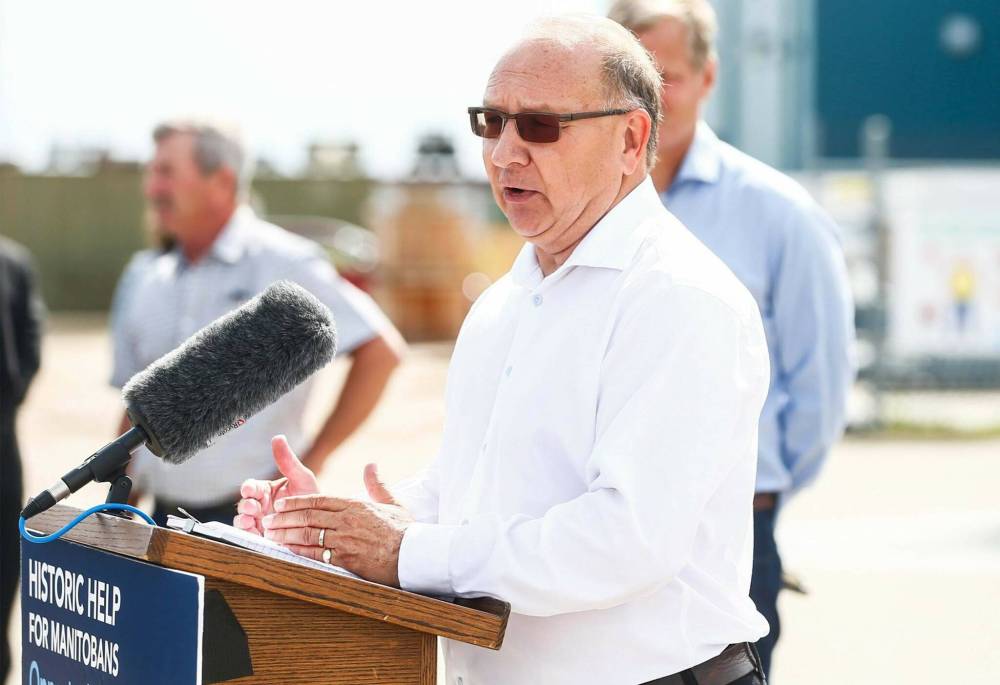
Daymon Guillas, president of the Potash Agri Development Corporation of Manitoba, said the company could add between 85 and 110 employees as production increases, with additional jobs expected to be created indirectly through businesses supplying the mining industry. (Mikaela MacKenzie/Winnipeg Free Press files)
PADCOM, Manitoba’s first and only potash mine, located near Harrowby in the Municipality of Russell-Binscarth, produces about 250,000 tonnes of potash annually, with its product sold in Canada and shipped through Churchill.
Premier Wab Kinew announced the mining expansion plan on Sept. 15 at the Canada Investment Summit in Toronto. The plan is intended to help move advanced mining projects toward production while improving the province’s ability to get minerals to international markets.
PADCOM’s plan to triple its current size would require about $400 million in investment and eventually “generate between $350 million and $450 million in annual sales,” Guillas said.
The company could also add between 85 and 110 employees as production increases, with additional jobs expected to be created indirectly through businesses supplying the mining industry, he said.
Guillas said mining activity generates demand for a range of services and materials, including power, equipment, mechanics, electricians, pumps and motors.
For every mining job created locally, another 1.5 jobs could be generated through spinoff activity. That means an expansion involving 100 mining positions could potentially create another 150 local jobs, he said.
The potential growth at PADCOM comes as Manitoba pursues a plan to triple critical mineral production and attract new investment into the province’s mining sector.
Guillas, who attended the recent investment summit in Toronto, said Manitoba has several mining projects that are ready to move forward but are waiting for power infrastructure.
He also pointed to improvements in the province’s mining approval process as another factor that could encourage investment.
“What used to take five years for a permit or three years or longer is now down to 100 days, 90 days,” Guillas said.
“Manitoba’s open for mining, and they’re organized. And that’s what attracts investors.”
For PADCOM, increased production would also open additional markets.
Guillas said the company expects to supply more potash within Canada while increasing shipments through the Port of Churchill to Europe. The expansion could also allow PADCOM to produce premium products such as sulphate of potash and potassium hydroxide in Manitoba rather than importing them.
The development of Churchill is an important part of that strategy, providing a northern route for Manitoba products to reach international markets.
Guillas said the investment summit also showed growing interest in Manitoba and the potential for the province to become less reliant on a single international customer.
Meanwhile, recent comments from U.S. President Donald Trump about seeking potash from sources other than Canada are not expected to affect Manitoba’s potash industry.
“Manitoba’s potash to the United States currently is zero,” Guillas said. “Saskatchewan sends about eight to nine million tonnes of potash to the U.S.”
Guillas said the U.S. would also face challenges replacing Canadian potash because of the volume required and the existing demand for Canadian supply.
“U.S. needs about 10 million tons per year of potash and Belarus total production is under eight million tons per year,” he said. “If Belarus supplied all their potash to the U.S., it wouldn’t be enough. But Belarus already has clients like China and India.”
» aodutola@brandonsun.com
» X: @AbiolaOdutola