
Ensuring an EU deal is as sweet as it sounds
Advertisement
Read this article for free:
or
Already have an account? Log in here »
We need your support!
Local journalism needs your support!
As we navigate through unprecedented times, our journalists are working harder than ever to bring you the latest local updates to keep you safe and informed.
Now, more than ever, we need your support.
Starting at $15.99 plus taxes every four weeks you can access your Brandon Sun online and full access to all content as it appears on our website.
Subscribe Nowor call circulation directly at (204) 727-0527.
Your pledge helps to ensure we provide the news that matters most to your community!
To continue reading, please subscribe:
Add Brandon Sun access to your Free Press subscription for only an additional
$1 for the first 4 weeks*
- Enjoy unlimited reading on brandonsun.com
- Read the Brandon Sun E-Edition, our digital replica newspaper
*Your next Free Press subscription payment will increase by $1.00 and you will be charged $20.95 plus GST for four weeks. After four weeks, your payment will increase to $24.95 plus GST every four weeks.
Read unlimited articles for free today:
or
Already have an account? Log in here »
“What’s in a name?,” wrote the famous playwright, as one of his characters pondered the pitfalls of a potentially perilous entanglement.
The meaning behind Shakespeare’s Romeo‑focused rumination is that the name of someone (or something) is not as important as the substance and character of the person/thing in question. And so it is with Prime Minister Mark Carney’s recent relationship‑fostering foray abroad and the invitation for Canada to become the first “associate member” of the European Union.
During her Sept. 16 State of the Union speech in Strasbourg, France, European Commission President Ursula von der Leyen said she hopes to enhance Canada’s relationship with Europe “to the highest level possible,” and then rather unexpectedly proposed the creation of a special status for Canada within the European Union.
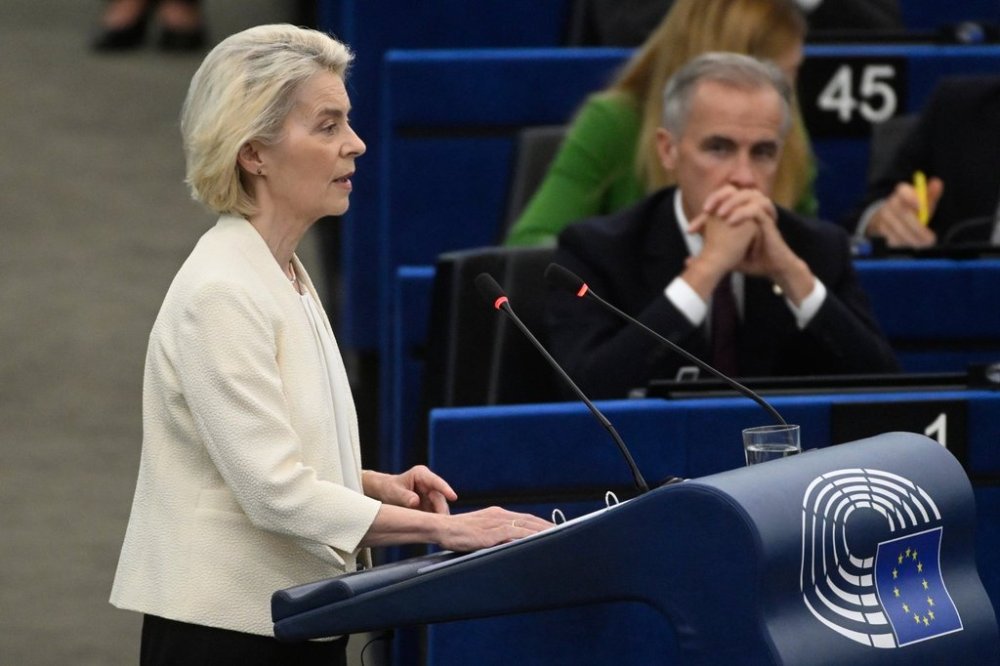
She cited the need to “urgently reimagine our partnerships” and “build global coalitions for our resilience and democracies” — a clear reference to the need for united action in response to U.S. President Donald Trump’s ongoing disruption of previously solid relations among traditionally like‑minded western democracies.
The invitation raised eyebrows on both sides of the Atlantic, with the heads of EU member states clearly having not been given advance notice of von der Leyen’s intentions and officials in Canada unsure of what the proposed associate‑member status might actually entail.
Making the task of deciphering the offer more challenging is the fact “associate member” isn’t actually something that exists within the EU’s treaty framework. So before any such status could be offered, parties within the often‑fractious EU community would have to agree on a definition before asking Canada to consider a deal.
In responding to the perhaps spontaneously worded invitation, Carney wisely chose to focus on the benefits of enhanced relations between Europe and Canada rather than the terminology by which it was described. Membership in the EU has to date been limited to nations within the titular geographic zone, and being part of the EU requires certain concessions in terms of sovereignty and the adoption of a common currency — conditions that would fall into the “non‑starter” category on this side of the pond.
Carney, who addressed the European Parliament the next day, instead described a “unique alliance” that would advance co‑operation in such realms as defence, artificial intelligence, critical minerals and energy security.
“We welcome this ambition,” he said. “An alliance for the future is a unique, positive approach that we will define together, building on our common strengths and based on shared values.”
Regardless of what it’s called, it’s an avenue worth exploring.
The subtext in all of this, of course, is that Trump has transformed his country from a dependable trading partner and a global defender of democratic principles into an erratic and wholly unreliable bully‑state whose foreign and economic policies are driven by whims, vendettas and tantrums rather than common sense or diplomatic principles.
And while geographic proximity and long‑standing trade ties mean the U.S. will continue to be Canada’s most important trading partner, the chaos of the continuing Trump debacle makes Carney’s aggressive effort to sell Canada abroad as an attractive option for other nations experiencing similar U.S.‑trade unravellings both wise and welcome.
And significantly, Carney was also quick to declare that any pursuit of deepened ties with the EU would first have to be subjected to parliamentary debate and votes — a shrewd, democracy‑minded move that effectively disarms those seeking to criticize his international deal‑seeking and further cements his status as the right leader, in terms of both tactics and temperament, for Canada during this perilous moment.
» Winnipeg Free Press