
Farmers use data and tech to boost profit, protect environment
Advertisement
Read this article for free:
or
Already have an account? Log in here »
We need your support!
Local journalism needs your support!
As we navigate through unprecedented times, our journalists are working harder than ever to bring you the latest local updates to keep you safe and informed.
Now, more than ever, we need your support.
Starting at $15.99 plus taxes every four weeks you can access your Brandon Sun online and full access to all content as it appears on our website.
Subscribe Nowor call circulation directly at (204) 727-0527.
Your pledge helps to ensure we provide the news that matters most to your community!
To continue reading, please subscribe:
Add Brandon Sun access to your Free Press subscription for only an additional
$1 for the first 4 weeks*
- Enjoy unlimited reading on brandonsun.com
- Read the Brandon Sun E-Edition, our digital replica newspaper
*Your next Free Press subscription payment will increase by $1.00 and you will be charged $20.95 plus GST for four weeks. After four weeks, your payment will increase to $24.95 plus GST every four weeks.
Read unlimited articles for free today:
or
Already have an account? Log in here »
Manitoba farmers are increasingly turning to soil sampling, variable-rate fertilizer application and other technologies to reduce environmental impacts while improving the profitability of their operations.
That was a key message during a recent tour of farms participating in the Lake Winnipeg Basin Project, which brought together representatives from government, municipalities, watershed districts, Indigenous communities, universities, non-profit organizations and agricultural businesses.
Scott Graham, an agronomy manager with Simplot, said the project gives farmers an opportunity to learn from one another while showing the public how agricultural methods can contribute to watershed health.
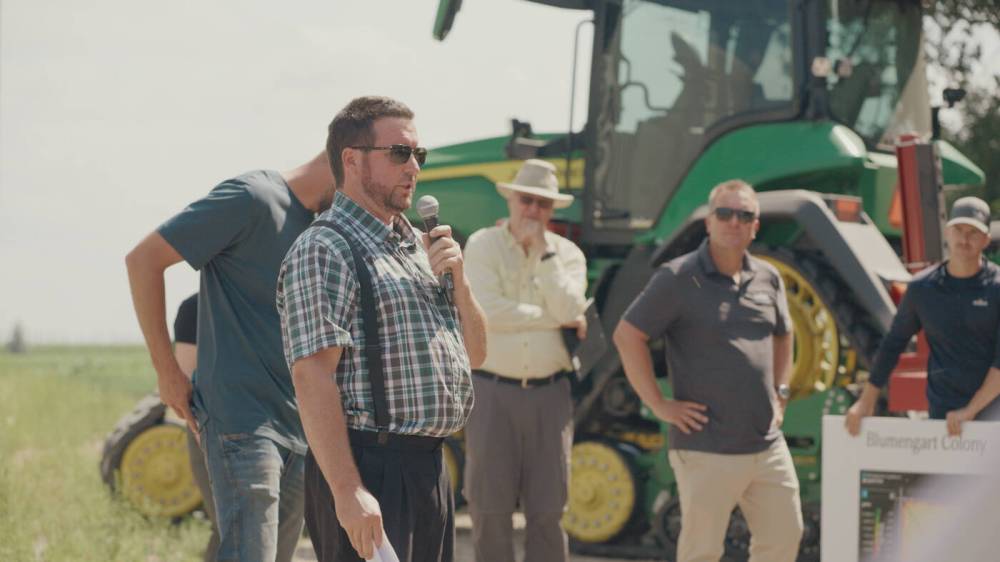
“Decisions really are data-driven on farms these days,” Graham said.
Farmers are using soil samples and yield monitors to identify differences across their fields and determine where crops and fertilizer can be most effectively used.
Areas that consistently produce poor yields may be taken out of crop production and planted with forage crops such as alfalfa, or returned to grassland.
“If there’s no yield and if it’s not profitable, the farmers aren’t going to do it,” Graham said.
The approach can benefit both farmers and the environment by reducing unnecessary fertilizer use and making better use of less productive land.
At Blumengart Colony near Plum Coulee, for example, soil and manure are tested before applications are made. Liquid hog manure is then applied at variable rates based on its nutrient content and the needs of the crop.
According to the project information, Blumengart injects liquid hog manure six to eight inches into the soil, reducing the potential for nitrogen to escape into the atmosphere or for nutrients to leave fields through runoff.
The operation also uses near-infrared spectroscopy to measure the nutrient content of manure as it is being applied and adjusts application rates accordingly.
That precision means the farm can make greater use of manure as a fertilizer source while using relatively little additional phosphorus fertilizer.
Other farms participating in the project are using technology to address different challenges.
WJ Siemens Farming Company Ltd. uses Veris soil mapping to identify areas affected by salinity. The information helps the farm determine which crops are best suited to different parts of its fields, with more salt-tolerant crops such as barley and forages used in affected areas.
The farm also uses soil-zone sampling to develop fertilizer prescriptions based on the productivity and nutrient requirements of different areas.
Yield monitors on combines provide another layer of information.
The monitors create maps showing how different parts of a field performed during harvest, allowing farmers to compare the results with soil maps and fertilizer applications.
Graham described the yield map as a kind of “report card” for the decisions made throughout the growing season.
Farmers are also using more traditional conservation practices alongside newer technology.
Blumengart Colony has established about 40 kilometres of shelterbelts, which can help reduce soil erosion and provide biodiversity benefits.
Graham said shelterbelts can also be managed to influence how snow and wind move across fields during the winter.
The Lake Winnipeg Basin Project began in 2021 as a collaboration between Simplot, Maple Leaf, Cargill, Ducks Unlimited Canada and the Potato Sustainability Alliance.
The original project involved four Manitoba farms and about 43,000 acres. Two additional farms were added in 2026, bringing the total to six farms and about 69,000 acres.
The participating operations grow potatoes, grains and oilseeds, with one of the newer farms also producing poultry and hogs.
The project is focused on demonstrating how sustainable farming can provide measurable environmental benefits at a watershed scale while supporting profitable and resilient farm operations.
One component of the project is examining phosphorus movement into Lake Winnipeg.
In a separate pilot project involving Corduroy Plains and McIntosh Ventures, water samples and pumping volumes were used to measure the amount of phosphorus diverted from the Boyne River watershed into five off-stream irrigation reservoirs.
Project organizers reported that 1.09 tonnes of phosphorus was removed from the Boyne River in spring 2026 and prevented from entering Lake Winnipeg.
Graham said the broader goal is to continue sharing information among farmers and identify additional opportunities to improve environmental performance without compromising the viability of agricultural operations.
Many farmers, he said, are motivated by the need to maintain their land for future generations.
“A lot of them are third, fourth, sixth generation, and they just want to continue taking care of that land and being good stewards of the land,” he said.
The project partners say the practices demonstrated during the tour show how farmers can contribute to efforts to reduce environmental impacts in watersheds that ultimately flow into Lake Winnipeg.
For Graham, continuing the conversation between farmers, researchers, governments and the public is an important part of that effort.
“The whole idea was to get people together and look at what farmers are currently doing, and look for future opportunities as well,” he said.
» Winnipeg Sun