
Missile attack on airport in Saudi Arabia’s capital kills 12 people and injures over 300
Advertisement
Read this article for free:
or
Already have an account? Log in here »
We need your support!
Local journalism needs your support!
As we navigate through unprecedented times, our journalists are working harder than ever to bring you the latest local updates to keep you safe and informed.
Now, more than ever, we need your support.
Starting at $15.99 plus taxes every four weeks you can access your Brandon Sun online and full access to all content as it appears on our website.
Subscribe Nowor call circulation directly at (204) 727-0527.
Your pledge helps to ensure we provide the news that matters most to your community!
To continue reading, please subscribe:
Add Brandon Sun access to your Free Press subscription for only an additional
$1 for the first 4 weeks*
- Enjoy unlimited reading on brandonsun.com
- Read the Brandon Sun E-Edition, our digital replica newspaper
*Your next Free Press subscription payment will increase by $1.00 and you will be charged $20.95 plus GST for four weeks. After four weeks, your payment will increase to $24.95 plus GST every four weeks.
Read unlimited articles for free today:
or
Already have an account? Log in here »
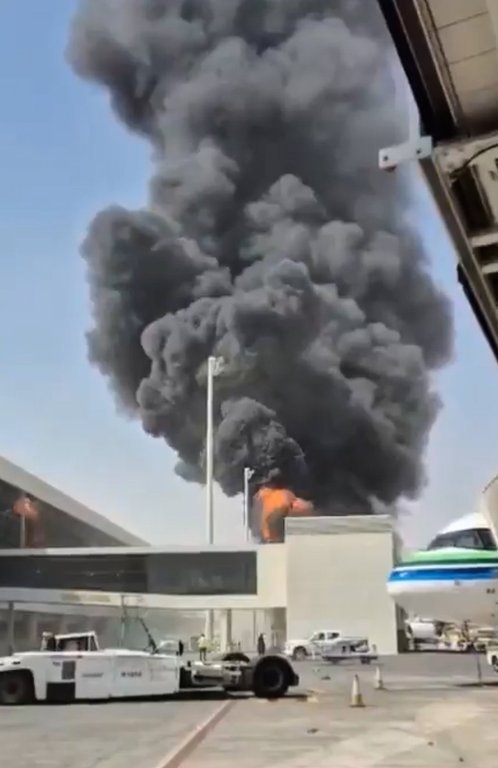
CAIRO (AP) — Saudi Arabia on Sunday extended the closure of the country’s main international airport, according to an online flight tracker, a day after a missile attack on the facility killed 12 people from several countries and left more than 300 injured in a major escalation of the war between Yemen’s Iran-backed Houthis and the kingdom.
A Saudi-led coalition blamed Saturday afternoon’s attack on the Houthis. It was the latest of several in the past week on King Khalid International Airport in the capital Riyadh and marked the deadliest attack in any Gulf Arab country since the start of the Iran war.
Saudi Arabia is the world’s top oil exporter and the attacks have sent up oil prices and rattled markets.
Following the attack, U.S. President Donald Trump said Saturday he was weighing whether the United States would join Saudi strikes against the rebels.
Airport operations were suspended Saturday. Authorities later extended the closure until at least 9 p.m. Sunday, according to Flightradar 24.
Also Sunday, the Houthi-run Health Ministry said 91 Yemenis were killed and 168 injured by the Saudi-led coalition in five weeks. It said 60% of those killed were women and children.
Mix of nationalities killed at Saudi airport
The attack struck an airport complex housing terminals 3 and 4 for domestic flights, a regional official said, speaking on condition of anonymity because they weren’t authorized to speak to the media.
The Saudi statement said the dead included four Saudi citizens, two Bangladeshi nationals, a Palestinian, a U.S. citizen, an Egyptian, a Jordanian, a Syrian and a Sudanese. It said the injured were being treated at several hospitals.
U.S. Secretary of State Marco Rubio acknowledged in a social media post that an American citizen had been killed in the attack, which he condemned.
The Egyptian man was a flight attendant identified as Azza Ramzy, 28, working for a Saudi airliner Flybas, according to the Egyptian state-run Al-Qahera New television.
Trump said he would consider joining strikes against rebels
The attack is expected to increase Saudi pressure on allies including the United States to provide military support for the kingdom, which has seemingly tried to avoid all-out war with the Houthis.
Shortly after the attack, U.S. President Donald Trump said he was evaluating whether the U.S. should join Saudi strikes against the rebels. “We may. We’re going to look at it,” he said. “We just found out about the recent attack. So we’ll make a decision. We move very quickly.”
Trump later Saturday said he planned to speak to Crown Prince Mohammed bin Salman. Asked if the U.S. might get involved, Trump responded, “We’ll find out.”
The Saudi-led coalition fighting the Houthis blamed them for the attack, calling it a “fully-fledged war crime” and vowing a firm response. The airport has no military facilities.
There was no immediate statement from the rebels, who earlier Saturday accused Saudi Arabia of striking Sanaa International Airport in the Houthi-held Yemeni capital.
The Houthis claimed attacks earlier in the week on King Khalid International Airport that killed three Saudis, including a pilot.
The surge in attacks, including against other Saudi airports, military facilities and oil infrastructure, has come in the week since a Saudi-led coalition launched a major military offensive against the Houthis.
For Iran, the fighting puts pressure on a key US ally
Until recently, the Houthis had been largely on the sidelines of the Iran war. Now the rebels are a way for Tehran to apply pressure on a key U.S. ally.
The Saudis and the Houthis began fighting in 2015 when the kingdom entered Yemen’s civil war on behalf of the internationally recognized government.
Relative calm after a 2022 ceasefire ended in July when the Houthis resumed attacks, saying the Saudis fired on the Sanaa airport as a plane from Iran was trying to land. That revived anger over the Saudi-led blockade that has largely isolated Houthi-run areas.
Now fighting has escalated, with the Saudi-led coalition providing air support for Yemeni government forces attempting to reverse recent Houthi gains along the Red Sea. Those gains gave the rebels better surveillance of shipping on a corridor that is a crucial alternative to the Strait of Hormuz, where Iran has been attacking ships.
Saudi Arabia is running low on missile interceptors and has asked France, Britain, Pakistan and Egypt to deploy air defense support to the region, regional officials told the AP last month, with one noting that the U.S. has seen its own stock dwindle during the war with Iran.
The Houthis this week warned global airlines “for the last time” about the potential consequences of operating in Saudi airspace, which they described as a theater for their military operations.
Before the latest attack, Air India, FlyDubai, Lufthansa Group and Pakistan International Airlines were among airlines suspending flights to and from Riyadh and other Saudi airports for varying periods.
___
Anna reported from Jerusalem. Associated Press writers Victoria Eastwood in Cairo, Collin Binkley in Washington and Sally Abou AlJoud in Beirut contributed to this report.