
Neelin students quiz mayoral candidates
Advertisement
Read this article for free:
or
Already have an account? Log in here »
We need your support!
Local journalism needs your support!
As we navigate through unprecedented times, our journalists are working harder than ever to bring you the latest local updates to keep you safe and informed.
Now, more than ever, we need your support.
Starting at $15.99 plus taxes every four weeks you can access your Brandon Sun online and full access to all content as it appears on our website.
Subscribe Nowor call circulation directly at (204) 727-0527.
Your pledge helps to ensure we provide the news that matters most to your community!
To continue reading, please subscribe:
Add Brandon Sun access to your Free Press subscription for only an additional
$1 for the first 4 weeks*
- Enjoy unlimited reading on brandonsun.com
- Read the Brandon Sun E-Edition, our digital replica newspaper
*Your next Free Press subscription payment will increase by $1.00 and you will be charged $20.95 plus GST for four weeks. After four weeks, your payment will increase to $24.95 plus GST every four weeks.
Read unlimited articles for free today:
or
Already have an account? Log in here »
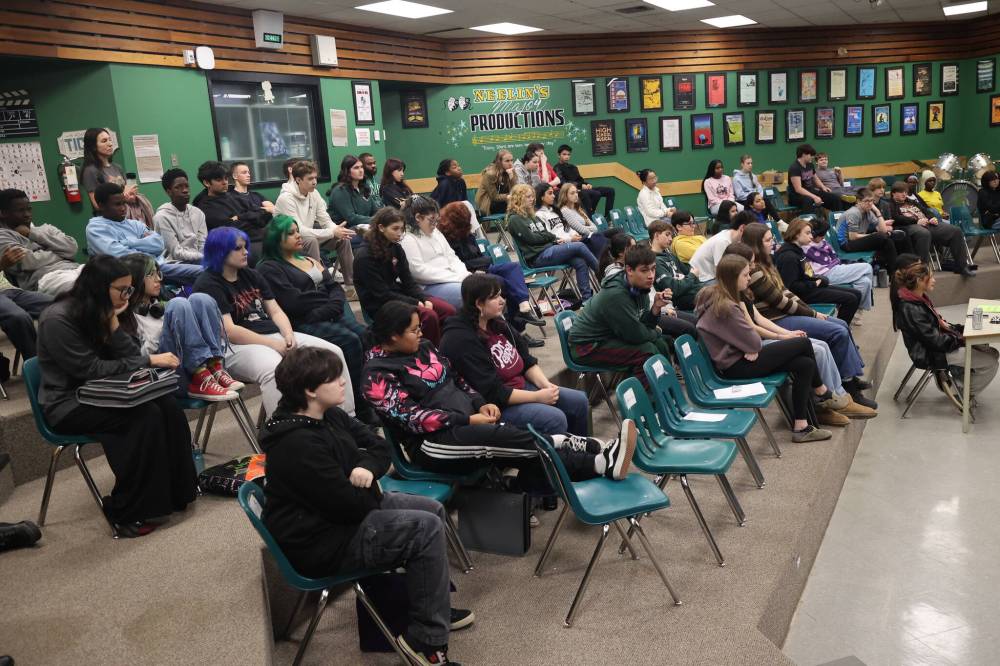
Public safety became a central concern Friday morning as École secondaire Neelin High School students hosted Brandon’s two mayoral candidates for an election forum in the school’s theatre.
The Grade 11 students, who organized the forum as part of their Canadian history studies, also questioned candidates Jeff Fawcett, the incumbent mayor, and Len Isleifson on topics ranging from transportation to the city’s future.
Asked how streets could be made safer for everyone, particularly women, Isleifson said safety has to be considered from the perspective of everyone who uses the city’s streets.
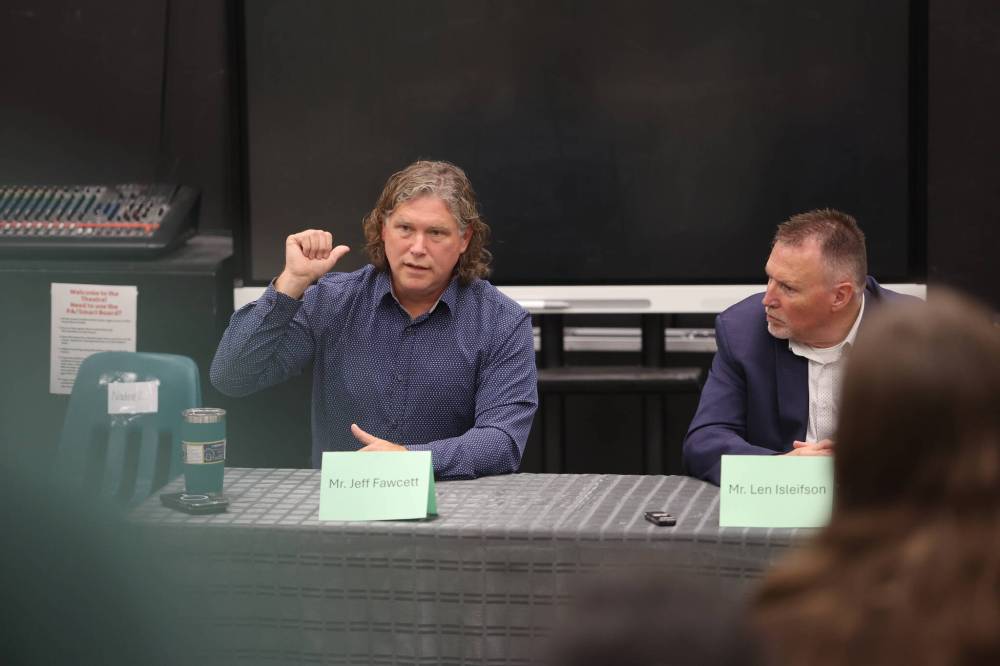
Mayor Jeff Fawcett (left) responds to a question while fellow candidate Len Isleifson looks on during the mayoral candidate forum organized by École secondaire Neelin High School students on Friday morning. (Photos by Abiola Odutola/The Brandon Sun)
“We need to continually keep in mind that we need to build a community that is safe for everybody, and everybody should feel safe walking around,” Isleifson said, calling for continuous investment “in public safety, police and cleaning up our community.”
He added: “If we can get businesses to extend their business hours and then get more people out and about, then it creates a safer element.”
He said he is not afraid to walk downtown alone, but “I’m also not going to do it at one in the morning when I really don’t have that purpose.”
Fawcett said the city has been working on safety through both infrastructure and community-based measures, including improved lighting and the addition of 12 cadets to city streets.
He said creating safer streets is not solely a policing issue.
“Some of us that have boys, we’ve got to make sure that we raise them to not be jerks and idiots,” he said. “That’s a big factor.”
He said people also need to challenge inappropriate behaviour when they see it.
“We got to model our own behaviour. Don’t be jerks, and if you know jerks, call them out and tell them you’re a jerk … Don’t ever do those kinds of things,” Fawcett said. “Take care of each other.”
The candidates also faced questions about Brandon’s public transportation system.
Fawcett pointed to major investments in transit during the past four years, including the purchase of four new buses and efforts to make the system more accessible and reliable.
He said the city’s U-Pass program has been particularly successful among college students, with buses sometimes running back-to-back during peak periods because of demand.
But Fawcett said the next step should be making transit more efficient.
“You can’t take an hour and a half to take a bus to work in a city like Brandon,” he said.
One option he said the city should consider is micro-transit, with smaller buses connecting residential neighbourhoods to major transit routes.
Isleifson agreed that transit is increasingly important due to the high cost of living.
“You look at the cost of having a vehicle, the cost of gasoline, the cost of insurance,” he said. “A lot more people are taking transit.”
He applauded the recent changes to transit service on Brandon’s North Hill, but identified other problems with the system.
Isleifson said he had spoken with a resident whose commute had become significantly longer because of the need to transfer buses.
There is a need, he said, for better transit access to Assiniboine College’s North Hill campus, where students currently have to cross First Street to reach a bus stop.
“Plans need to be living plans,” Isleifson said. “We need to have the ability to change the plan if something happens in the middle.”
The candidates also responded to a question about whether Brandon should expand housing onto farmland or focus on building upward.
Both agreed the city will eventually need to expand as its population grows.
“If you’re going to branch out into rural areas, you have to find some property that you want to purchase. Most of the property that is farmland is not ours; it’s in a different municipality,” Isleifson said.
“Our best option is infill first. At some point we may have to expand outward, but we need to protect our farmland and recognize that some land around the city, particularly in the south, is old swampland.”
Most of the building in Brandon over the last decade has been infill, Fawcett said.
“We’re doing as much of it as we can right now. We’ve annexed enough land for about 20 years of development, but we also need to respect private property rights and protect good farmland,” he said. “Infill is beneficial because areas like downtown have existing infrastructure and generate more tax revenue per acre.”
The school has held similar events during federal, provincial and municipal elections since the early 2010s, said Kerri Malazdrewicz, who teaches history and social science in the school.
She said about 50 to 60 students attended Friday’s forum, with the questions developed by the Grade 11 history students after reviewing campaign literature and discussing issues among themselves.
The exercise is designed to help students understand how government works and prepare them for participation as voters.
“Most of the students are 15 or 16 years old and will be eligible to vote in the next election at various levels. They will be able to be active citizens,” Malazdrewicz said.
“The students’ questions demonstrated a strong level of engagement and that the candidates provided useful insight into the complexities of municipal decision-making.”
» aodutola@brandonsun.com
» X: @AbiolaOdutola