
Expert says bus model involved in deadly Calgary crash considered ‘extremely safe’
Advertisement
Read this article for free:
or
Already have an account? Log in here »
We need your support!
Local journalism needs your support!
As we navigate through unprecedented times, our journalists are working harder than ever to bring you the latest local updates to keep you safe and informed.
Now, more than ever, we need your support.
Starting at $15.99 plus taxes every four weeks you can access your Brandon Sun online and full access to all content as it appears on our website.
Subscribe Nowor call circulation directly at (204) 727-0527.
Your pledge helps to ensure we provide the news that matters most to your community!
To continue reading, please subscribe:
Add Brandon Sun access to your Free Press subscription for only an additional
$1 for the first 4 weeks*
- Enjoy unlimited reading on brandonsun.com
- Read the Brandon Sun E-Edition, our digital replica newspaper
*Your next Free Press subscription payment will increase by $1.00 and you will be charged $20.95 plus GST for four weeks. After four weeks, your payment will increase to $24.95 plus GST every four weeks.
Read unlimited articles for free today:
or
Already have an account? Log in here »
CALGARY – An expert on low-carbon transportation says the roughly 1,000 compressed natural gas buses running in Canada are still considered “extremely safe” after one such bus was involved in a deadly crash in Calgary that claimed the lives of three people.
On Thursday, a chain-reaction crash happened when a transit bus hit several vehicles before rear-ending a parked bus, igniting an explosion that also left more than a dozen others injured.
Calgary police said one officer was taken to the hospital with injuries after running towards a bus as fire erupted.
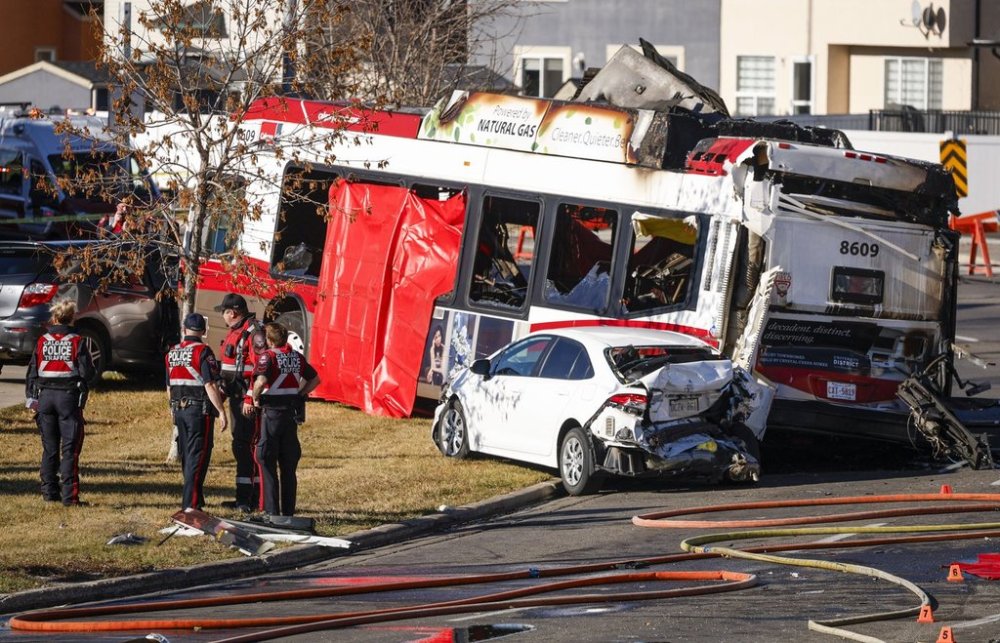
One of the 12-metre-long buses involved in the crash was powered by compressed natural gas, a kind of fuel considered cheaper and more environmentally friendly than diesel gas.
Buses that run on compressed natural gas are common in public transit and have been in operation for the past two decades, said Josipa Petrunic, president and CEO of Canadian Urban Transit Research and Innovation Consortium (CUTRIC), a national non-profit focused on low-carbon transit research and planning.
“It’s considered extremely safe technology, so we all need to find out what happened to create an unsafe environment in a crash situation,” Petrunic said.
There are 958 compressed natural gas-powered buses operating in Ontario, Alberta and B.C., according to a CUTRIC database report.
Petrunic said there are several heavy-duty safety mechanisms involved in building these buses, including a series of tools and technologies designed to manage leakage and reduce the risk of fire. Their tanks are also designed to withstand heavy impacts.
Usually, the most unsafe part of these buses, and any form of public transportation, is the lack of seatbelts, Petrunic said.
A spokesperson from Nova Bus confirmed that it was the manufacturer of the bus that was rear-ended in Thursday’s crash and the company is in contact with Calgary Transit.
The spokesperson also said that it was “premature to speculate on the cause before a thorough investigation has been completed.”
“Safety remains Nova Bus’s highest priority, and we are offering our full cooperation to Calgary Transit and the relevant authorities as they work to establish the facts.“
Calgary Transit procures its buses from manufacturers that go through Altoona testing, a rigorous certification process for any new bus model to assess its durability and reliability before being rolled out into their fleet, said Petrunic.
The agency has nearly 250 CNG buses, which represents about 20 per cent of its fleet, according to the agency’s website. The website says the city plans to buy about 150 more this year to replace diesel buses.
As investigators continue to look into the cause of the crash, Petrunic said industry leaders will be looking into what factors went into the collision.
“A series of events had to have occurred in tandem for this cataclysmic event to occur leading to death,” said Petrunic. “A transit crash shouldn’t result in passenger deaths.”
This report by The Canadian Press was first published Oct. 17, 2026.