
Mayoral rivals talk growth, taxes, DCCs
Advertisement
Read this article for free:
or
Already have an account? Log in here »
We need your support!
Local journalism needs your support!
As we navigate through unprecedented times, our journalists are working harder than ever to bring you the latest local updates to keep you safe and informed.
Now, more than ever, we need your support.
Starting at $15.99 plus taxes every four weeks you can access your Brandon Sun online and full access to all content as it appears on our website.
Subscribe Nowor call circulation directly at (204) 727-0527.
Your pledge helps to ensure we provide the news that matters most to your community!
To continue reading, please subscribe:
Add Brandon Sun access to your Free Press subscription for only an additional
$1 for the first 4 weeks*
- Enjoy unlimited reading on brandonsun.com
- Read the Brandon Sun E-Edition, our digital replica newspaper
*Your next Free Press subscription payment will increase by $1.00 and you will be charged $20.95 plus GST for four weeks. After four weeks, your payment will increase to $24.95 plus GST every four weeks.
Read unlimited articles for free today:
or
Already have an account? Log in here »
The city’s two mayoral candidates outlined their approaches to growing municipal revenue without relying solely on higher taxes during the Brandon Chamber of Commerce debate Wednesday morning.
The candidates also staked out their positions on property tax increases and development cost charges.
The debate between incumbent Jeff Fawcett and challenger Len Isleifson was held at Victoria Inn’s Imperial Ballroom with about 90 members of the business community in attendance.
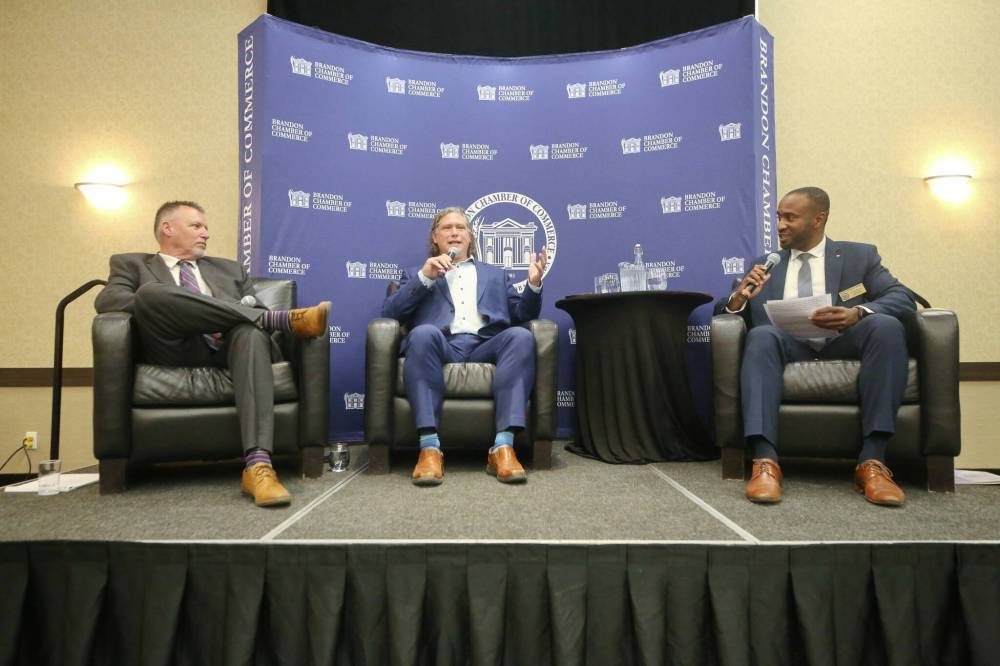
Sitting between mayoral candidate Len Isleifson (left) and Brandon Chamber of Commerce president Emelio Brown, incumbent Mayor Jeff Fawcett responds to a question during a Breakfast with the Mayoral Candidates event hosted by the Chamber at the Victoria Inn on Wednesday morning. (Matt Goerzen/The Brandon Sun)
On the topic of revenue growth, Fawcett said the city needs to bring more provincial and federal dollars into Brandon while expanding its industrial and commercial tax base.
“Every dollar you’re paying in tax, eight cents of it is municipal and the other 92 cents is federal and provincial. We need more than the eight cents,” Fawcett said.
“We’re doing lots on our end,” he added. “You can see the money that we’ve been bringing in from the province and the federal government over the last number of years. We’ve got a bunch of investments going in right now.”
Isleifson said the Brandon Municipal Airport is one potential source of new revenue.
“I know the chamber and economic development have been working on bringing in an eastern flight. If we can secure that, then you can look at landing fees, parking fees, things like that that would generate extra revenue coming into the city,” he told the audience.
Isleifson also said the city had to tap into other levels of government as revenue sources.
“You create partnerships with the provincial and federal governments, and you look for grants. There are some amazing funding out there from Canadian Mortgage and Housing Corporation and organizations like that within the federal departments,” Isleifson said.
Growing the city’s population and commercial and industrial sectors, he said, would allow Brandon to broaden its tax base rather than simply increase tax rates.
When asked what annual tax increase he would champion, Fawcett said the city likely needs a minimum of one more year of relatively high increases before moving toward a longer-term target.
Council approved a 6.7 per cent increase in the municipal portion of property taxes for 2026 — equal to a $153 increase for the average home worth $302,500.
“We probably got at least another year of somewhat similar,” Fawcett said. “Ultimately, the goal would be a CPI plus one or two.”
He said a fixed tax target could leave the city unable to respond to changing financial circumstances.
“You have to be able to adapt,” Fawcett said. “In every year when we do our budget, we look at decisions we make at that budget and how does it affect the next year’s budget.”
Isleifson proposed a specific target annually for the next four years.
“My vision would be to look at a four and a half per cent for the next four years,” Isleifson said.
Economic development was another major focus, with both candidates identifying infrastructure and electricity capacity as critical foundations for attracting industrial investment.
Fawcett said the city now has an opportunity to attract more industry because of improvements to its infrastructure, adding that industrial development depends on having the basics in place before incentives are considered.
“We are making sure that there is developable land. We are making sure that they have power and enough power, particularly for things like industry,” Fawcett said.
Development cost charges emerged as a key point of disagreement, particularly in relation to housing affordability.
Isleifson said he supports DCCs to fund infrastructure, but that some of the planned increases are excessive.
“We need those development cost charges,” he said. “I just feel that they’re too high, too fast.”
He cited mobile-home developments as an example.
“When you have someone who does not have the ability to purchase a $400,000 or $500,000 home, so they purchase a mobile home, now we’re going to add to the cost,” Isleifson said.
He said DCC increases should be reconsidered in consultation with developers and the community.
“I would love to pull it back from the Public Utilities Board, have the new council look at it, make recommendations, and then really do some consultation with the community and with the developers,” he said.
Fawcett defended the city’s approach, saying DCC increases have been phased in and that the charges are tied to infrastructure needed to accommodate growth.
“It is still not offsetting growth costs,” Fawcett said. “The general public is still paying to extend and build the growth.”
He said reducing DCCs would not eliminate those infrastructure costs.
“If we lower the development cost charges, it doesn’t mean that there’s less money needed to do it,” Fawcett said. “It just means the rest of the taxpayers paid for that.”
The debate was moderated by chamber president Emelio Brown.
The municipal election is Oct. 28.
» aodutola@brandonsun.com
» X: @AbiolaOdutola