
Canada working closely with EU on foreign aid as U.S. pulls back, Sarai says
Advertisement
Read this article for free:
or
Already have an account? Log in here »
We need your support!
Local journalism needs your support!
As we navigate through unprecedented times, our journalists are working harder than ever to bring you the latest local updates to keep you safe and informed.
Now, more than ever, we need your support.
Starting at $15.99 plus taxes every four weeks you can access your Brandon Sun online and full access to all content as it appears on our website.
Subscribe Nowor call circulation directly at (204) 727-0527.
Your pledge helps to ensure we provide the news that matters most to your community!
To continue reading, please subscribe:
Add Brandon Sun access to your Free Press subscription for only an additional
$1 for the first 4 weeks*
- Enjoy unlimited reading on brandonsun.com
- Read the Brandon Sun E-Edition, our digital replica newspaper
*Your next Free Press subscription payment will increase by $1.00 and you will be charged $20.95 plus GST for four weeks. After four weeks, your payment will increase to $24.95 plus GST every four weeks.
Read unlimited articles for free today:
or
Already have an account? Log in here »
OTTAWA – Canada’s deepening ties with Europe could help fill some of the massive gaps left behind as the United States pulls back from foreign aid and embraces a “transactional” approach, says the secretary of state for international development.
“When we put all our heads together, I think the opportunities are endless,” Randeep Sarai told The Canadian Press.
He said this effort includes recent talks with the European Union on leveraging private dollars and philanthropy for aid, while maintaining some government funding for the world’s most vulnerable.
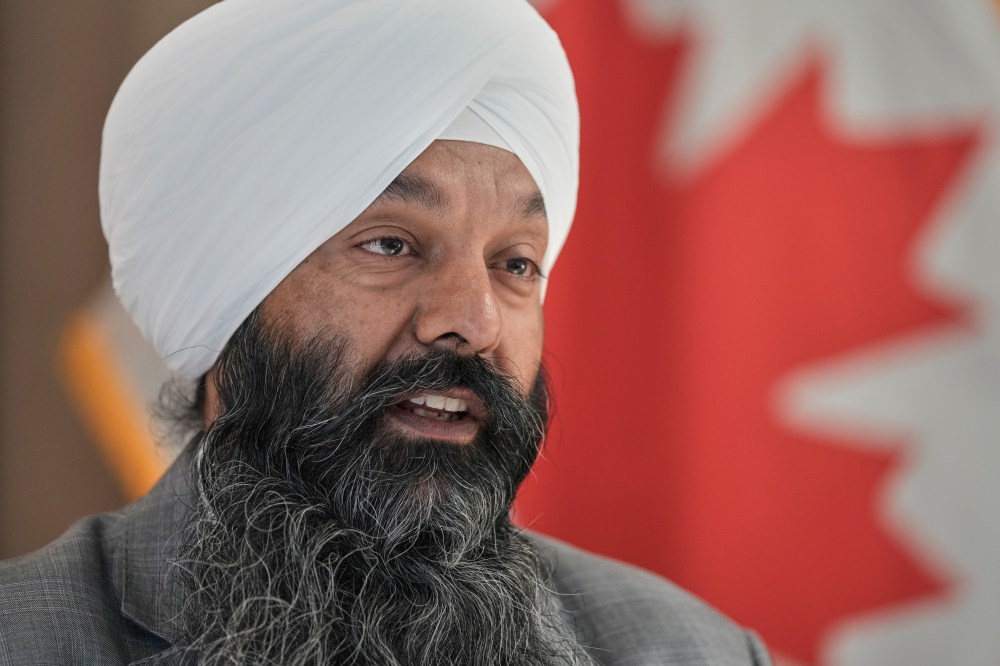
Sarai is overseeing a shift in foreign aid as the government of Prime Minister Mark Carney cuts back on global health spending and encourages more private funding in development projects.
Ottawa is cutting spending across government, seeking new trade partners and boosting the defence budget to make Canada less vulnerable to U.S. President Donald Trump’s tariffs and threats of annexation.
The Trump administration shut down the United States Agency for International Development, USAID, leading to what Harvard University researchers estimate to be hundreds of thousands of preventable deaths.
In April, the Organization for Economic Co-operation and Development reported that the U.S. in 2025 accounted for 17 per cent of spending by rich countries on foreign aid, down from 30 per cent a year prior.
U.S. spending on foreign aid dropped by 57 per cent in 2025.
Most major donor states, including Canada, have cut back on aid funding. Ottawa spends about 1.6 per cent of its budget on foreign aid.
“Taxpayer dollars are very valuable. So if we can bring in the private sector along with them, the goal is (that) eventually the private sector will invest on their own. But initially, we’ll use the taxpayer dollars to entice them,” Sarai said.
Sarai added that Europe has looked to Carney for guidance on so-called blended finance because of his experience as a United Nations official.
Carney’s UN role was to advise governments on climate finance, including ways for governments to work with the private sector and philanthropists to transition to net-zero carbon emissions.
Ireland hosted a meeting of EU development ministers earlier this month and invited Canada to attend.
Sarai said much of the discussion in Dublin was about how to leverage private capital without abandoning support for the world’s most vulnerable people.
Sarai said Canada and European countries are also working with other nations with a reputation for robust foreign aid, including Japan, Korea and Gulf nations.
He said American officials have “come back, to some degree” on aid spending by funding vaccines for children in poor countries.
“Their aid has to benefit the American economy and American people,” Sarai said.
“They have very clear guidelines on that and transactional nature of it, but that’s their direction. So I would say it’s very different from the other G7 partners, but at least we know where we’re at.”
The push for more private dollars in aid has many critics.
Co-operation Canada, a coalition of most Canadian aid groups operating abroad, said the sector supports innovative funding, with some caveats.
“If we are to use public funds to incentivize private capital, then there need to be some guardrails around … that we’re we’re using our public funds in the most efficient way possible,” said Paul Farran, the group’s advocacy director.
He said aid dollars shouldn’t be used to subsidize endeavours that the private sector wouldn’t have otherwise funded.
“Our international assistance should first and foremost be used to alleviate poverty and inequalities,” Farran said.
Sarai said Canada is not going to surrender its support for the world’s poorest to market forces.
He said that applies to Canada’s programming in the 32 nations the UN describes as the world’s least developed countries, as well as projects that focus on sexual health and reproductive rights.
He said the government has a different approach in high-growth countries, where it pursues “mutual economic prosperity” through projects that benefit Canadian companies and investors while creating jobs abroad.
“The Vietnams, Indonesias, Philippines in the world, we believe that they can now take care of those areas themselves. We don’t need to invest in those particular areas for them,” he said.
Sarai cited a new aid project in Thailand which will see Canada’s development finance institution FinDev lend cash for microloans to women in rural areas looking to launch or expand businesses.
Canada is lending roughly $85 million, which is being matched by $280 million from the Japanese bank SMBC and the Asian Development Bank.
Last month, The House finance committee, which has a majority of Liberal MPs, called on Carney last month to provide predictable and clear aid funding in the Nov. 5 budget.
Aid groups told the committee that the federal government says its supports for refugees inside Canada amount to more than 17 per cent of its total development assistance. While that’s a standard reporting practice for western countries, the aid groups said it makes it hard to tell how much Canadian cash is actually going abroad.
The MPs on the committee argued aid spending should be “guided by poverty and fragility” and should have “increasing transparency in the international assistance envelope.”
The MPs also urged Canada to “reaffirm gender equality and women’s economic empowerment as drivers of poverty reduction and, therefore, as central priorities.” Carney caused confusion a year ago by suggesting Canada no longer has a feminist foreign policy.
Co-operation Canada supports those calls and is urging Carney to reverse cuts to global health programs.
Farran said Canada should earmark $5.5 billion annually for “core” development aid abroad, which would boost funding for things like building schools or helping women advocate for political rights.
He also said Ottawa owes the public more clarity on how it is spending foreign aid and where it’s cutting back.
This report by The Canadian Press was first published Oct. 23, 2026.