
In the news today: Canada-EU summit ends, U.S. midterms loom, time change ends
Advertisement
Read this article for free:
or
Already have an account? Log in here »
We need your support!
Local journalism needs your support!
As we navigate through unprecedented times, our journalists are working harder than ever to bring you the latest local updates to keep you safe and informed.
Now, more than ever, we need your support.
Starting at $15.99 plus taxes every four weeks you can access your Brandon Sun online and full access to all content as it appears on our website.
Subscribe Nowor call circulation directly at (204) 727-0527.
Your pledge helps to ensure we provide the news that matters most to your community!
To continue reading, please subscribe:
Add Brandon Sun access to your Free Press subscription for only an additional
$1 for the first 4 weeks*
- Enjoy unlimited reading on brandonsun.com
- Read the Brandon Sun E-Edition, our digital replica newspaper
*Your next Free Press subscription payment will increase by $1.00 and you will be charged $20.95 plus GST for four weeks. After four weeks, your payment will increase to $24.95 plus GST every four weeks.
Read unlimited articles for free today:
or
Already have an account? Log in here »
Here is a roundup of stories from The Canadian Press designed to bring you up to speed…
Canada-European Union summit in Montreal concludes today with digital trade on agenda
A major summit Prime Minister Mark Carney is hosting with European Union leaders is set to conclude today with announcements on digital trade and academic exchanges.
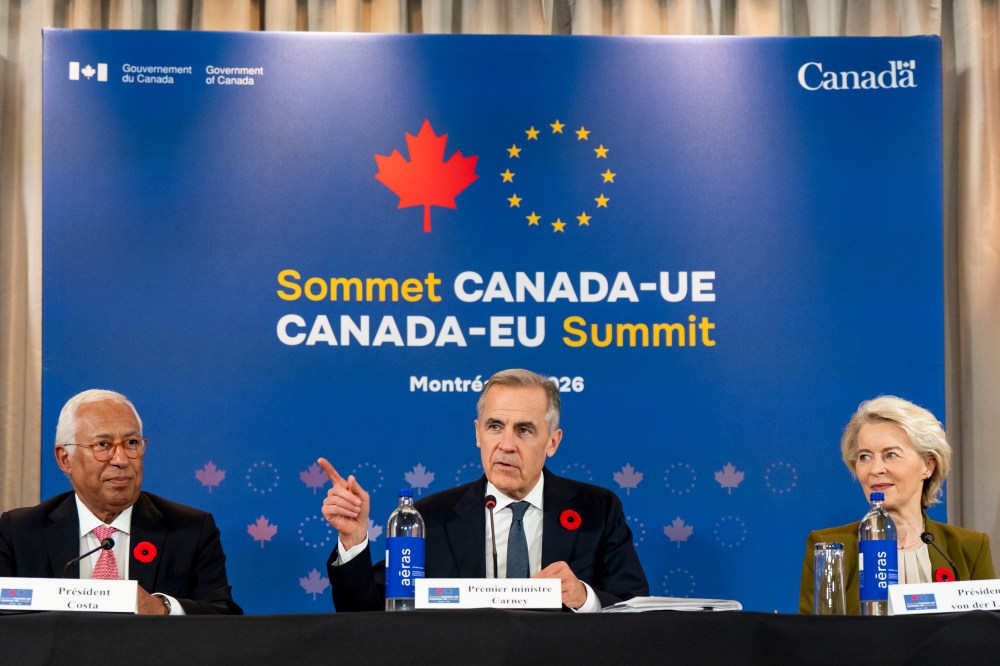
Carney welcomed European Commission President Ursula von der Leyen and European Council President Antonio Costa to the Canada-EU summit in Montreal on Thursday.
While these meetings have been happening for years, this one sees Canada and the EU scaling up their efforts to deepen their commercial and diplomatic relationship.
Conservatives have criticized the summit, noting that nine of the 28 countries in the EU have yet to ratify a decade-old trade deal with Canada.
—
Money woes, war and Trump — what’s motivating U.S. voters ahead of the midterms
U.S. President Donald Trump has been telling supporters to vote like he’s on the midterm ballot next Tuesday — but most voters are heading to the polls looking for politicians ready to tackle affordability.
Christopher Sands, director of Johns Hopkins University’s Center for Canadian Studies Christopher Sands, says the biggest issue for voters in nearly every poll is the economy.
Recent polling found eight in ten registered voters, including large majorities of Republicans and Democrats, say lowering the cost of living should be one of the highest priorities for Congress.
Sands says Trump’s skill at getting national attention through rallies and social media could actually backfire on his party.
—
Houston resists calls for legislation as AI data centre backlash grows
Some residents in Cape Breton are becoming increasingly alarmed about a proposed data centre project in their region.
Julissa Stewart says she panicked when she learned about the plans for an 18,600-square-metre AI data centre at an industrial site about 20 minutes away from her home in southern Cape Breton.
Stewart and other residents say they want new legislation to ensure the proponents observe binding conditions to protect the environment and local ratepayers.
Earlier this month, EverWind Fuels announced it intends to set up a $10 billion AI data centre in Point Tupper that would come online by the end of 2027.
More than 24,000 people have signed a petition against the project on the website Change.org.
—
Business groups clock hurdles as time change comes to an end in some regions
This Sunday will mark the first time many in Western Canada won’t turn the clocks back an hour.
That includes most of British Columbia, Alberta, Manitoba, some of northwestern Ontario and the Northwest Territories.
Businesses are embracing the move to do away with the twice-yearly clock change, though experts say it will be a bit of an adjustment.
University of British Columbia economist Patrick Baylis says productivity may take a hit, as more darkness in the morning could throw workers’ sleep out of whack.
—
Textbook terror: University course sinks teeth into the art of the horror film
Halloween is tomorrow, and a unique film course at the University of Calgary is looking at why the horror film genre is deeper than people might think.
Assistant professor Julia Chan heads the course and says the genre tells us about ourselves, our cultures and how to confront our fears.
She says it holds up a mirror to society and shows us what we’re afraid of and why.
Some students say they specifically seek out horror films this time of year to coincide with the supernatural spirit of Halloween.
—
This report by The Canadian Press was first published Oct. 30, 2026.