
Movie Review: In ‘I Play Rocky,’ a middleweight crowd-pleaser about the making of a classic
Advertisement
Read this article for free:
or
Already have an account? Log in here »
We need your support!
Local journalism needs your support!
As we navigate through unprecedented times, our journalists are working harder than ever to bring you the latest local updates to keep you safe and informed.
Now, more than ever, we need your support.
Starting at $15.99 plus taxes every four weeks you can access your Brandon Sun online and full access to all content as it appears on our website.
Subscribe Nowor call circulation directly at (204) 727-0527.
Your pledge helps to ensure we provide the news that matters most to your community!
To continue reading, please subscribe:
Add Brandon Sun access to your Free Press subscription for only an additional
$1 for the first 4 weeks*
- Enjoy unlimited reading on brandonsun.com
- Read the Brandon Sun E-Edition, our digital replica newspaper
*Your next Free Press subscription payment will increase by $1.00 and you will be charged $20.95 plus GST for four weeks. After four weeks, your payment will increase to $24.95 plus GST every four weeks.
Read unlimited articles for free today:
or
Already have an account? Log in here »
“I Play Rocky,” Peter Farrelly’s comic and crowd-pleasing tale about the making of “Rocky,” might seem like a one-two punch of pure nostalgia. It’s been almost exactly 50 years since Sylvester Stallone’s breakthrough boxing classic first arrived in theaters. You need hardly more than a few Philadelphia steps or a holler of “Adrian” to summon its still-ubiquitous cultural presence.
But while “I Play Rocky” is far from lacking in memory-lane sentimentality, it’s more aimed at now than it might appear. Today’s movie industry is so corporate and risk-averse that Farrelly’s “Rocky” revival is most enjoyable as a reminder that the movies are a quixotic, even goofy undertaking. Some of the best of them are inherently bad ideas.
The miracle of “Rocky” is really that someone actually said yes to making it. Stallone in his mid-20s had little more to his name than some soft-core pornography. There was scant evidence of audiences clamoring for a boxing drama. And yet Stallone, despite his humble status in Hollywood and, let’s say, unique manner of speech, didn’t just want to sell his script; he insisted on starring in it.
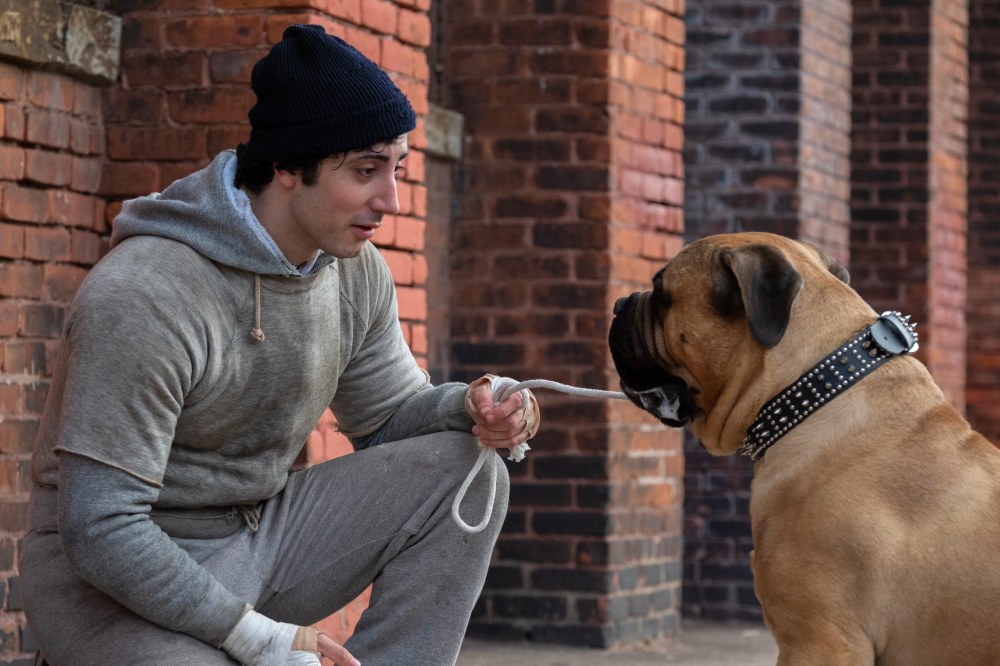
That’s why, while Anthony Ippolito’s winning performance as Stallone may be at the center of “I Play Rocky,” the movie belongs to its skeptical producers and its apoplectic executives. Tracy Letts plays United Artists boss Sandy Maddox, a composite character. “Rocky” producers Irwin Winkler and Robert Chartoff are played by P.J. Byrne and Toby Kebbell, respectively. They are all agog when Stallone, recently homeless, turns down millions, resolute with his demand: “I play Rocky.”
This is Stallone’s own underdog story, one that neatly mirrors Rocky Balboa’s unlikely rise. But it’s the film’s belief in the algorithm-adverse nature of the movies that makes “I Play Rocky” a fun, if featherweight romp.
Farrelly, who spent his career making comedies (“Dumb and Dumber” and “There’s Something About Mary”) before transitioning into more dramatic films like the best-picture winning “Green Book,” makes “I Play Rocky” with some of the same spirit. He puts punchy, almost slapdash scenes alongside each other, rejecting preciousness for screwball momentum. The movies, “I Play Rocky” suggests, should be a lark.
Stallone’s stubborn rise, by now its own myth, is breezily condensed in Peter Gamble’s script. It starts in New York where Sylvester is still Mike Stallone, and making little headway in the few auditions he lands. But his showbiz dreams are earnest. That sincerity is surely part of why Sasha (AnnaSophia Robb), a box-office cashier at a theater, agrees to go out with him. She becomes Stallone’s first wife and, when they move to Los Angeles, the typist of his scripts.
And there are a lot of them. Stallone wrote more than a dozen screenplays before “Rocky.” Success didn’t come overnight, and it’s this relentlessness that makes Stallone’s story endearing. How many muscle-bound leading-men wannabes in Hollywood, then or now, put in that much work?
That basis in fact benefits “I Play Rocky” since it sometimes leans toward fairy-tale. Ippolito, previously best known for playing Al Pacino in “The Offer,” nails Stallone’s demeanor and voice without slipping into caricature — a feat considering how many Stallone impressions have come and gone over 50 years. But the performance is too sweet and saintly. Stallone had to be more than a naive savant to pull off what he did. Ippolito plays Rocky, not Stallone.
After watching the 15-round Muhammad Ali-Chuck Wepner fight in a bar, Stallone staggers home and, in just three-and-a-half days, “Rocky” pours out of him. “That’s me on the page,” he says, exhausted.
“I Play Rocky” eventually gets to the making of the film, but by then it’s beginning to run out of gas. The centerpiece of the movie is the negotiation over the script, with Winkler and Chartoff playing middlemen ferrying back-and-forth offers. Stallone is parking cars when he turns down $360,000 — a figure four times the initial offer — to option the script without his casting.
Byrne and Kebbell are terrific as a pair of savvy, veteran producers who can hardly believe the project they’ve hitched their wagon to, and yet they keep the faith. Letts’ studio chief, still smarting from missing out on “The Godfather” — another 1970s smash that at the outset looked like an ill-conceived turkey — gloriously fumes his way through his scenes.
They eventually settle on a much lower number and a much-reduced budget ($1 million) for “Rocky,” meaning a threadbare production that moves to Philadelphia to avoid the unions in New York. The notoriously efficient John G. Avildsen (Jay Duplass) is brought in to direct.
Once the cameras are rolling — including, the movie acknowledges, an early use of the Steadicam — “I Play Rocky” slides more into nostalgic recreation. But you can still sense Farrelly’s affection for moviemaking that follows instinct. In that way, “I Play Rocky” is not so unlike a much different making-of drama: Richard Linklater’s “Nouvelle Vague,” about French iconoclast Jean-Luc Godard and 1960’s “Breathless.”
A running gag in the movie is how actors exaggerate their talents to win a role. When Carl Weathers (Stephan James) turns up to play Apollo Creed, he eventually admits not knowing how to box — a confession Stallone also has to make. That this will turn into the biggest movie of the year makes “I Play Rocky” an affectionate ode to the oft-quoted, frequently forgotten William Goldman quote: In the movies, “Nobody knows anything.”
“I Play Rocky,” an Amazon MGM Studios release in theaters Friday, is rated PG-13 by the Motion Picture Association for strong language, brief sexual material, and smoking. Running time: 128 minutes. Two and a half stars out of four.