
Alberta’s governing UCP endorses proposed riding map NDP says is rigged
Advertisement
Read this article for free:
or
Already have an account? Log in here »
We need your support!
Local journalism needs your support!
As we navigate through unprecedented times, our journalists are working harder than ever to bring you the latest local updates to keep you safe and informed.
Now, more than ever, we need your support.
Starting at $15.99 plus taxes every four weeks you can access your Brandon Sun online and full access to all content as it appears on our website.
Subscribe Nowor call circulation directly at (204) 727-0527.
Your pledge helps to ensure we provide the news that matters most to your community!
To continue reading, please subscribe:
Add Brandon Sun access to your Free Press subscription for only an additional
$1 for the first 4 weeks*
- Enjoy unlimited reading on brandonsun.com
- Read the Brandon Sun E-Edition, our digital replica newspaper
*Your next Free Press subscription payment will increase by $1.00 and you will be charged $20.95 plus GST for four weeks. After four weeks, your payment will increase to $24.95 plus GST every four weeks.
Read unlimited articles for free today:
or
Already have an account? Log in here »
EDMONTON – Alberta’s governing United Conservatives have officially endorsed changes to provincial riding boundaries that the Opposition NDP says are rigged to help the UCP win the next election.
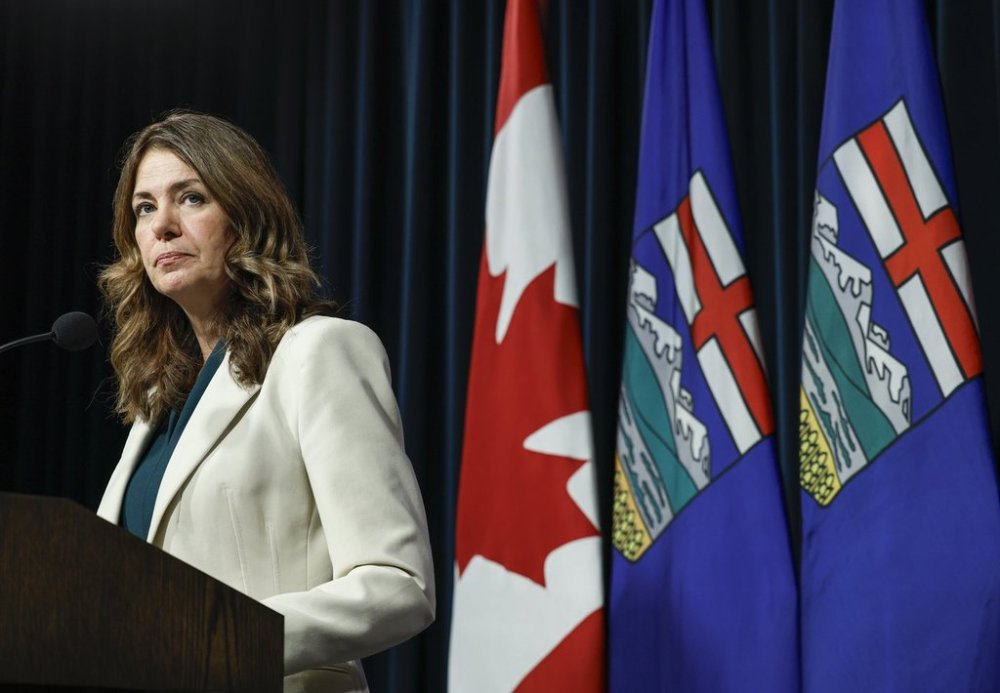
Premier Danielle Smith’s UCP caucus, in a vote split along party lines, voted Wednesday to endorse the riding changes and put the new boundaries into a bill to be debated in the house.
Justice Minister Mickey Amery has said he expects legislation to pass by the end of the year ahead of the scheduled election in October of 2027.
The riding report came from a panel with a majority of members selected by the UCP.
The NDP says the report dilutes urban ridings in Lethbridge and Calgary by merging them with adjacent rural areas to favour the UCP in a process known as gerrymandering.
Gerrymandering, which is common in the United States, sees electoral districts drawn up not for reasons of shared geography and priorities but by voting patterns in order to assist one political party.
Speaking during a debate of the proposals Wednesday, Amery defended the rural-urban hybrid ridings that have become the focus of debate, saying they already exist in Alberta.
“Hybrid ridings also do something else: they bring together communities that share services, employment, infrastructure and economic interests, regardless of whether a municipal boundary happens to run between them,” said Amery.
With 2024 legislation, Smith’s government removed the requirement that electoral boundaries respect municipal boundaries as a guiding principle.
The NDP has charged that the latest process to redraw the report was illegitimate from the start, and pleaded until the last minute for the UCP to instead revert to the map recommended by an independent public commission.
Nenshi said Wednesday the changes are designed to help vulnerable UCP ministers keep their seats.
“It strikes a knife into the heart of Alberta’s democracy,” he said.
The latest redrawing has been a controversial and complicated affair since the premier rejected the main recommendations of a public boundaries commission early this year. The commission came back with a split report.
Bucking political norms, Smith’s government voted down the commission’s majority position in the legislature and restarted the process with a new advisory panel.
Traditionally, Alberta’s chief justice helps find a current or retired judge to chair and oversee the work. But earlier this year, the acting Alberta chief justice declined to participate, calling the new process “irregular.”
The panel, chaired by retired Alberta justice Brian O’Ferrall, was given direction based on some recommendations from the previous commission’s chair, including expanding the number of ridings to 91 from 87 to preserve two rural ridings that were to be dissolved.
Smith has said urban representation, amid population growth in cities, shouldn’t come at the expense of rural Alberta.
But Nenshi told the house Wednesday the panel went well beyond those marching orders without justification and without considering public feedback.
The proposals would split the southern city of Lethbridge into four ridings from its current two. It would have one strictly urban riding while the other three would see some neighbourhoods linked to sprawling adjacent rural areas.
It also includes additional hybrid ridings for the west side of Calgary.
In question period earlier Wednesday, Smith called Nenshi’s allegations “ridiculous,” and said if anyone gerrymandered the maps to benefit the UCP, “they failed miserably.”
She said under the proposed maps, if the UCP were to win the popular vote by the same margins as it did in the 2023 election, the NDP would gain three seats and the UCP would gain one.
“(Nenshi’s) trying to set it up so that people will doubt the integrity of elections,” she said.
This report by The Canadian Press was first published Nov. 4, 2026.
-With files from Jack Farrell