
‘Error in judgment’: Defendant in Galloway trial regrets tweets about author
Advertisement
Read this article for free:
or
Already have an account? Log in here »
We need your support!
Local journalism needs your support!
As we navigate through unprecedented times, our journalists are working harder than ever to bring you the latest local updates to keep you safe and informed.
Now, more than ever, we need your support.
Starting at $15.99 plus taxes every four weeks you can access your Brandon Sun online and full access to all content as it appears on our website.
Subscribe Nowor call circulation directly at (204) 727-0527.
Your pledge helps to ensure we provide the news that matters most to your community!
To continue reading, please subscribe:
Add Brandon Sun access to your Free Press subscription for only an additional
$1 for the first 4 weeks*
- Enjoy unlimited reading on brandonsun.com
- Read the Brandon Sun E-Edition, our digital replica newspaper
*Your next Free Press subscription payment will increase by $1.00 and you will be charged $20.95 plus GST for four weeks. After four weeks, your payment will increase to $24.95 plus GST every four weeks.
Read unlimited articles for free today:
or
Already have an account? Log in here »
VANCOUVER – A defendant in Steven Galloway’s defamation lawsuit says she regrets some of her online posts about the author, and has withdrawn legal defences of some of those statements.
Mandi Gray was testifying Thursday in the British Columbia Supreme Court trial of Galloway’s lawsuit, which alleges Gray and others defamed the former University of B.C. professor by publishing unproven allegations of rape and sexual assault on social media.
Gray, now an assistant professor at Trent University, said she was first contacted on Facebook by the woman who accused Galloway of rape.
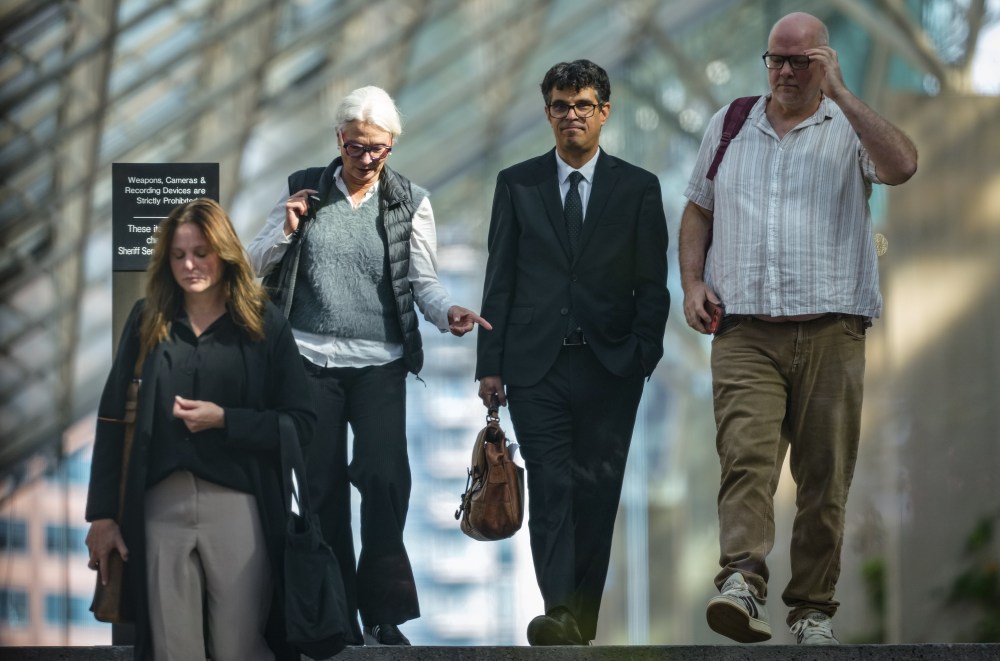
She testified that she regretted publishing some of her statements on Twitter, now X, and recognized how readers could interpret them as a “statement of fact.”
Galloway has denied the allegations and was never charged, while a former judge hired by the university to investigate found the sexual assault claims unsubstantiated. His accuser is no longer asserting in her defence that Galloway assaulted her, rather that she reported he had done so.
The university fired Galloway, who has said the claims that emerged more than a decade ago destroyed his career.
Gray’s lawyer, Vanshika Dhawan, said on Thursday that her client was no longer defending some of her online statements as responsible communications or arguing they were made honestly under “qualified privilege.”
Gray said she was “taking accountability” for the “error in judgment.”
Her lawyer told the court, however, that Gray was still defending two of the seven statements at issue as fair comment.
Gray said the social media platform wasn’t a place for “nuanced thought” and she had been perplexed and angry at the time.
The court heard Gray had been involved in a high-profile sexual assault trial during her time at York University in Toronto, in which the conviction of the man she alleged raped her was overturned on appeal.
Gray said she and Galloway’s accuser, a woman known as A.B., who cannot be named due to a publication ban, connected and eventually became friends.
She testified she had seen the woman’s mental health deteriorate significantly during the investigation of her allegations against Galloway by a retired B.C. Supreme Court judge, Mary Ellen Boyd.
Gray said that her understanding of the Boyd report was that “the most serious allegation was not substantiated,” but she didn’t know exactly what that meant.
“How would I know? I didn’t know what (the university) considered to be the most serious,” Gray said. “I was left with questions.”
The court previously heard from a publishing industry expert who said Galloway, author of the hit novel “The Cellist of Sarajevo,” had potentially lost millions of dollars in future income.
The court heard earlier Thursday from Norman Stowe, a reputation rehabilitation, public relations and crisis management expert, who said Galloway could have done more to rehabilitate his reputation after he was accused of rape.
“To be blunt, I’ve worked with clients who had far less going for them than Mr. Galloway in terms of the capacity to go out and defend your reputation or rehabilitate your reputation,” said Stowe, a managing partner of the public affairs company Pace Group, called as a witness for Galloway’s accuser.
Stowe produced a report for A.B. and told the court that while he had never worked on a file involving a rape accusation, efforts to rehabilitate someone’s reputation involve the same steps regardless of the nature of the issue.
The trial heard Stowe’s report included examples of other high-profile people who experienced reputational damage, such as Bill Clinton, Martha Stewart and Tiger Woods.
But he agreed under cross-examination that allegations against them were not in the same “universe” as a rape accusation.
Stowe said some of Pace Group’s high-profile clients have included the Vancouver Airport Authority following the death of Robert Dziekanski — who died after being tasered by Mounties at the airport in 2007 — and BC Ferries after the sinking of the Queen of the North.
“We have also worked on several cases that involve sexual activities. I can’t say much more than that,” he said.
The court heard Stowe believed Galloway had a “strong path to reputational rehabilitation” and could have resumed some version of his writing career.
But he conceded under questioning by Galloway’s lawyer, Daniel Burnett, that his report incorrectly stated the author had made no efforts to do so.
Burnett said Stewart, Clinton and Woods were all “guilty” of what they’d been accused of, and asked Stowe about a different approach to restoring the reputation of someone who is innocent.
Stowe said he didn’t have access to some documents in Galloway’s case, including the full report by Boyd.
Stowe told the court Boyd’s report could have been used as leverage in rehabilitating Galloway’s reputation, along with support from those in the literary community who had publicly called for due process for the author.
But Stowe said “there was no plan, no linking these things together to help him get past this and rehabilitate so he could reclaim some part of his personal life and professional life.”
Stowe believed Galloway had many opportunities “to bring all these things together, but that never seemed to materialize,” he said.
He said he thought the author had “sort of given up,” thinking “his life was over.”
Stowe agreed that rape allegations are “powerful.” But he said Galloway’s attempts to refute the claims against him were not part of a plan to rehabilitate his reputation, and the efforts “sort of started and then stalled.”
Stowe said he didn’t review social media posts about Galloway, which Burnett said came in “waves … over years and years” leading to the defamation lawsuit.
Several people originally named as defendants in Galloway’s lawsuit, filed in 2018, have settled with him and offered public apologies.
The trial continues on Monday.
This report by The Canadian Press was first published Nov. 5, 2026