
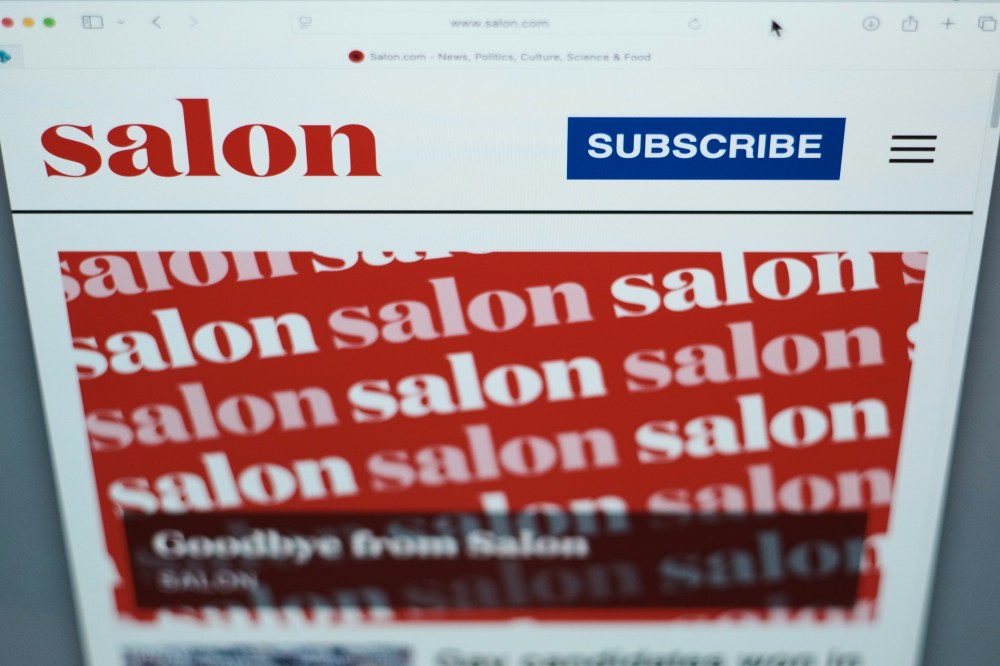
Online magazine Salon, an early staple of internet discourse, announces it will shut down
Advertisement
Read this article for free:
or
Already have an account? Log in here »
We need your support!
Local journalism needs your support!
As we navigate through unprecedented times, our journalists are working harder than ever to bring you the latest local updates to keep you safe and informed.
Now, more than ever, we need your support.
Starting at $15.99 plus taxes every four weeks you can access your Brandon Sun online and full access to all content as it appears on our website.
Subscribe Nowor call circulation directly at (204) 727-0527.
Your pledge helps to ensure we provide the news that matters most to your community!
To continue reading, please subscribe:
Add Brandon Sun access to your Free Press subscription for only an additional
$1 for the first 4 weeks*
- Enjoy unlimited reading on brandonsun.com
- Read the Brandon Sun E-Edition, our digital replica newspaper
*Your next Free Press subscription payment will increase by $1.00 and you will be charged $20.95 plus GST for four weeks. After four weeks, your payment will increase to $24.95 plus GST every four weeks.
Read unlimited articles for free today:
or
Already have an account? Log in here »
WASHINGTON (AP) — Salon, one of the early internet’s most influential websites that featured sharp voices and political and cultural journalism with a liberal sensibility, announced Thursday it would shut down after 31 years of publication. “It has been an extraordinary privilege,” the outlet said in a farewell note.
The announcement, seen as a surprise, cited the fact that “the business realities of independent digital journalism have changed profoundly over the years.” It did not immediately indicate what would become of its employees, though some reported they had lost their jobs. A spokesperson for the outlet said 19 full-time employees had been affected, as well as a handful of private contractors.
“Over three decades, Salon has brought together politics, culture, criticism and ideas in a way that was distinctly our own,” the unsigned farewell note said. “Our journalism examined power and politics, questioned assumptions, surfaced stories that deserved attention and made room for perspectives that were too often overlooked. Our writers and editors helped shape conversations about the forces changing our lives.”
It began shortly after the internet went big
Salon began its life in the mid-1990s, barely three years after the internet itself went mainstream and a time when the “World Wide Web” was still written out in that fashion. It launched a decade before the newspaper and print magazine markets imploded — and a decade, too, before the rise of social media fragmented the journalism world.
As its name suggested, Salon was initially styled as an online magazine and meeting place, a site where more provocative opinions and stories that might not be at home in daily newspapers or even then-dominant newsweeklies like Time or Newsweek could surface and generate discussion. It quickly became a place where writers wanted their work to appear.
“The timing was right — readers were tired of bland, market-tested media products, and the internet allowed us to launch something original, something with a strong voice,” founder David Talbot said on the outlet’s five-year anniversary in 2000.
It drew a cadre of high-profile writers and people who would become famous, including Jake Tapper and Glenn Greenwald. Two of its editors-in-chief, Talbot and Joan Walsh, went on to become prominent progressive political voices as well.
As the internet grew, so did Salon’s competition. Slate emerged the following year, and soon after, online magazines became the order of the day. Eventually, older print publications like The Atlantic began putting more content online and the marketplace of online ideas grew. Salon used Princess Diana’s death in 1997 to go beyond its culture-and-criticism roots and wade into breaking-news coverage.
Salon’s
archives will remain online for now
Salon told The Associated Press that it had no immediate plans to take down its online archives, which include three decades of stories from across the world and across topics and genres.
In its statement, Salon also made a point of thanking its readers.
“You came to Salon for the journalism, the dialogue, the essays, the criticism, the unexpected discoveries and the sense that there was a place on the internet where ideas mattered,” it said. “You read, shared, challenged, subscribed, wrote to us and kept coming back. Your engagement made Salon a publication and a community, and it gave our work meaning. We are so grateful for the time you spent with us.”
—
Noveck reported from New York.