
His wife died by suicide. He wants the government to reconsider its MAID bill
Advertisement
Read this article for free:
or
Already have an account? Log in here »
We need your support!
Local journalism needs your support!
As we navigate through unprecedented times, our journalists are working harder than ever to bring you the latest local updates to keep you safe and informed.
Now, more than ever, we need your support.
Starting at $15.99 plus taxes every four weeks you can access your Brandon Sun online and full access to all content as it appears on our website.
Subscribe Nowor call circulation directly at (204) 727-0527.
Your pledge helps to ensure we provide the news that matters most to your community!
To continue reading, please subscribe:
Add Brandon Sun access to your Free Press subscription for only an additional
$1 for the first 4 weeks*
- Enjoy unlimited reading on brandonsun.com
- Read the Brandon Sun E-Edition, our digital replica newspaper
*Your next Free Press subscription payment will increase by $1.00 and you will be charged $20.95 plus GST for four weeks. After four weeks, your payment will increase to $24.95 plus GST every four weeks.
Read unlimited articles for free today:
or
Already have an account? Log in here »
If you or someone you know is thinking about suicide, support is available 24-7 by calling or texting 988, Canada’s national suicide prevention helpline.
Poring over photographs spilled across his kitchen table, David Slater picks one up that captured his late wife mid-laughter.
She’s posing at an ancient temple in Greece, holding out a navy skirt in one hand, as if preparing for a curtsy. There are dozens more like it: Diane McDowell draped in a pink pashmina outside the Taj Mahal; sunglasses hanging from her neck as she grins with a family of elephants in Botswana.
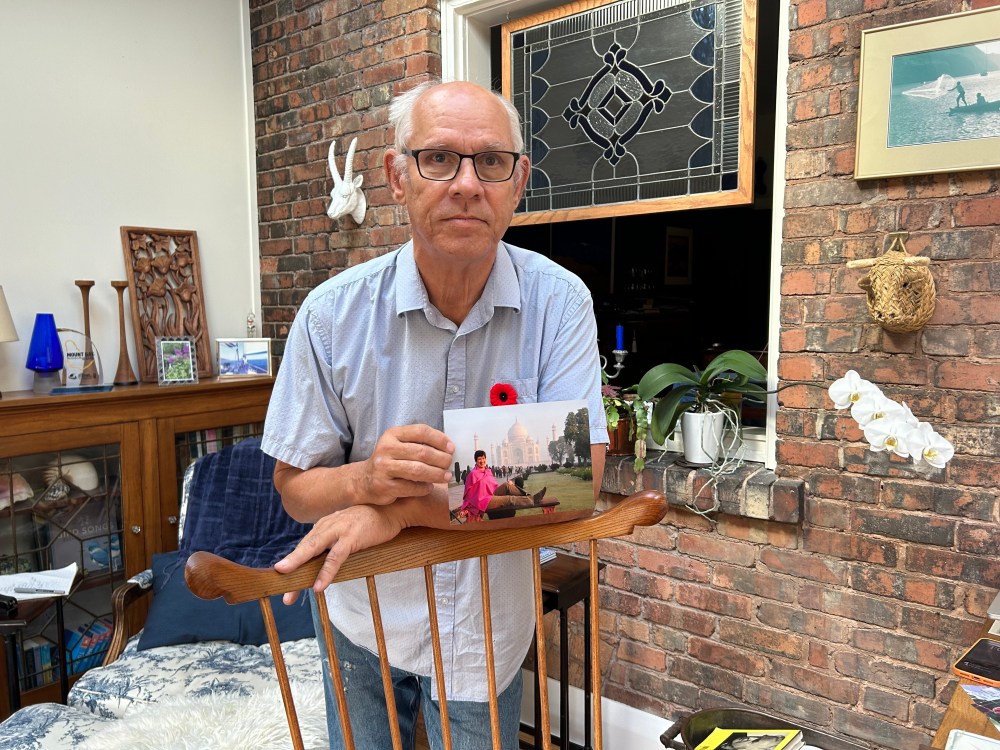
Travel was an escape from the depression she kept at bay for decades with therapy, medication and exploration. “She had kept it in remission,” as Slater put it. “But when the time came, it wasn’t going to go back. She had passed the point of remission.”
Things she once loved — gardening for hours in her Toronto backyard, slipping on a pair of shiny loafers, sailing through the Caribbean — became reminders of her lost joy, out of reach.
McDowell, 71, wanted a medically assisted death, but was not eligible, Slater said.
She died by suicide on Oct. 25.
Slater recalls a conversation they had about a month and a half earlier, when his wife of 36 years said, “I don’t want to die, but I don’t want to live like this.” He pauses as a rush of tears spills from his eyes. “And that’s MAID in a nutshell.”
He believes MAID should be an option for mental illness, and he wants members of Parliament to consider the potential consequences of new legislation introduced by Justice Minister Sean Fraser in late October, which, if passed into law in the coming months, would ban people with mental illness as a sole underlying condition from accessing MAID.
Slater said he knows his wife’s life would have ended either way, but with MAID, “the dignity with which she lived her life would have been maintained.”
The justice minister read McDowell’s obituary and was moved by the tragedy. He recently lost a friend who also struggled with mental illness. However, Fraser said he had to make a decision on MAID in the absence of consensus from the medical community, and erred on the side of caution because of the permanence of the decision to end one’s life.
“And you do your best to, in the presence of a wide range of opinions, take decisions that have the potential to preserve life where possible, without being inconsiderate towards people who don’t see a path for themselves,” Fraser told The Canadian Press in a quiet room on Parliament Hill.
“People whose experience has been characterized by extraordinary pain and suffering, but who I can’t say with certainty, after having spoken to experts and people with lived experience, that there’s not a possibility for a recovery.”
Fraser said he was heeding concerns from many psychiatrists who said there was no way to parse out if someone could get better with the right treatment, even if it appeared they had tried everything. He also said he spoke to people who would not be alive today if MAID had been an option, and were happy to still be here.
Some experts in the field, meanwhile, have warned that restricting access to MAID for mental illness would result in people dying by suicide, instead of surrounded by family on their own terms. Obituaries published over the past several years, during which a planned expansion of MAID access was delayed, suggest there have been such cases.
Fraser said this policy decision was not “an accounting exercise,” weighing the fatal stakes of either withholding or granting MAID to people with mental illness.
“I’m not blind to the struggle that people have when they live with mental illness with deadly consequences,” Fraser said, pausing and becoming visibly emotional as he spoke about his close childhood friend, who he lost just weeks ago after a more than 20-year battle with mental illness. They had grown apart as adults, but remembers him as smart, funny, and talented, on a path to immense success before his life changed.
“And they tried everything, too,” he said, speaking of his friend and clarifying that MAID was not a part of his story.
MCDOWELL’S STORY
Depression was a part of McDowell’s life before she met Slater in her early thirties. She managed it with medication and therapy. Slater says she was quieter at low periods, but never cancelled social plans or missed a day at the litigation firm, where she was a founding partner and worked for more than 30 years. At the office, she had a reputation for her grace, empathy and professionalism.
McDowell retired from the law firm in 2012. The couple did not have children — “we have holidays,” Slater said they liked to quip.
They spent the winters sailing the Caribbean, summers back home in Toronto, and then rented an apartment for about three months in the south of France.
McDowell’s father was in the Air Force and she lived in Germany, France and across Canada throughout her childhood. She was one of the first in her family to graduate from university and managed the pub at Queen’s University to pay for summer travels, Slater said with pride.
Several years into retirement, feeling good in her golden years, McDowell asked her family doctor to go off of her medication for depression and began tapering her dose, her husband said.
They were on a boat in Grenada when she woke up one morning and told Slater she had to go home. “Something is not right,” he recalls her saying. That was the beginning of this “more difficult journey.”
She immediately went back on medication. It didn’t help, nor would any of the treatments her doctors tried in the coming years, including transcranial magnetic stimulation, electroconvulsive therapy or ketamine.
“It came on like a ton of bricks. It was shocking,” he said.
Slater recalls waking one night to the sound of their brass headboard banging against the wall. “She was shaking so hard that I thought she was actually having an epileptic fit,” he said.
He later learned she had had an anxiety attack. It sometimes took eight or nine hours for her surge of panic to subside.
“They say the actual attacks are usually like only four or five minutes, but it’s the getting over them that takes a huge drain,” he said.
Six months after Grenada, McDowell spent a month in the psychiatric ward at Toronto General Hospital. Not long after she was discharged, Slater recalls his wife — someone who would not even answer the door in sweatpants — not getting dressed.
“It took me a long time to understand. Probably. I knew she was ill and, you know, you’ve heard the old, ‘oh, just snap out of it.’ Well, there’s no snapping out of it. And why would a woman who has had the life she had — had the most amazing retirement — why would she choose to lie on the bed and suffer?”
It finally sunk in, he said. His wife had a fatal illness.
She spent another three months back in the psychiatric ward under intense supervision, balancing medications and lots of one-on-one therapy. She also went to Homewood Health Centre, a mental health treatment facility in an old mansion on a river in Guelph, for about nine weeks.
“There was no stone left unturned,” Slater said.
“When things really started to look poor, she did talk about MAID. I would have supported her in that. I told her I would,” he added. MAID was not unfamiliar to Slater. His father received the end-of-life procedure at the age of 89 after a stroke.
“My dad’s quality of life, when he was approved, was way better than Diane’s quality of life when she wasn’t even allowed to apply,” he said.
But as a lawyer and a pragmatic person who read the newspaper every day, McDowell knew she was not eligible, and she was not hopeful that would change in the near future.
They looked at going to Switzerland, which has an end-of-life program that receives international applicants. McDowell feared she would be hospitalized again if her doctors found out she wanted MAID.
FUNERAL REMARKS BY MP
McDowell’s funeral took place Nov. 7 and everyone — from her psychiatrist to her hairdresser — showed up, along with Liberal member of Parliament Robert Oliphant, her neighbour for 16 years on their midtown cul-de-sac.
Oliphant co-chaired a parliamentary committee tasked with making recommendations to the government on MAID in 2016. He spoke at McDowell’s funeral, saying he would commit once again to drawing attention to and pushing for fair and rightful access to MAID for people with mental illness.
“Diane’s death is something that I think makes it, again, personal for me,” Oliphant said in an interview from his house, kitty-corner from where she lived.
Soon, he is to vote on the government’s MAID legislation. It won’t be a straightforward decision, he said, as a vote in favour would close the door on mental illness but open the door to advance requests for people with dementia and other conditions that take away their capacity to consent. “I will have to decide on where ultimately I come down on it,” he said.
“Maybe it does take the death of an innocent person to spark us to say, no, we have to help this to not happen to another person.”
‘IT COULD HAVE BEEN DIGNIFIED’
If MAID was an option, Slater said, his wife could have been surrounded by family when she died. They could have talked about the little café they adored on the back side of the Notre-Dame, where they would end up at 2 a.m. for an ice cream and coffee after wandering the streets of Paris.
“The fact that I couldn’t sit and talk to her about that on her deathbed. You know? That’s wrong,” he said.
He imagines that she would have said, “I do not want to do this, but I have to because I have no choice. She would’ve said, ‘I love you very much.’ I could have held her hand,” he said, breaking into a deep, sorrowful sob.
“It could have been dignified.”
This report by The Canadian Press was first published Nov. 12, 2026.
Canadian Press health coverage receives support through a partnership with the Canadian Medical Association. CP is solely responsible for this content.