
Alberta implementing new oil royalty payment system to encourage production
Advertisement
Read this article for free:
or
Already have an account? Log in here »
We need your support!
Local journalism needs your support!
As we navigate through unprecedented times, our journalists are working harder than ever to bring you the latest local updates to keep you safe and informed.
Now, more than ever, we need your support.
Starting at $15.99 plus taxes every four weeks you can access your Brandon Sun online and full access to all content as it appears on our website.
Subscribe Nowor call circulation directly at (204) 727-0527.
Your pledge helps to ensure we provide the news that matters most to your community!
To continue reading, please subscribe:
Add Brandon Sun access to your Free Press subscription for only an additional
$1 for the first 4 weeks*
- Enjoy unlimited reading on brandonsun.com
- Read the Brandon Sun E-Edition, our digital replica newspaper
*Your next Free Press subscription payment will increase by $1.00 and you will be charged $20.95 plus GST for four weeks. After four weeks, your payment will increase to $24.95 plus GST every four weeks.
Read unlimited articles for free today:
or
Already have an account? Log in here »
CALGARY – Alberta’s government unveiled a new royalty payment program Friday that it says is aimed at incentivizing development in the oil industry.
The application-based framework would give companies a guaranteed 10-year royalty schedule for new projects or eligible expansions.
They would pay two per cent of revenues for the first five years then see one per cent hikes annually until reaching a maximum six per cent.
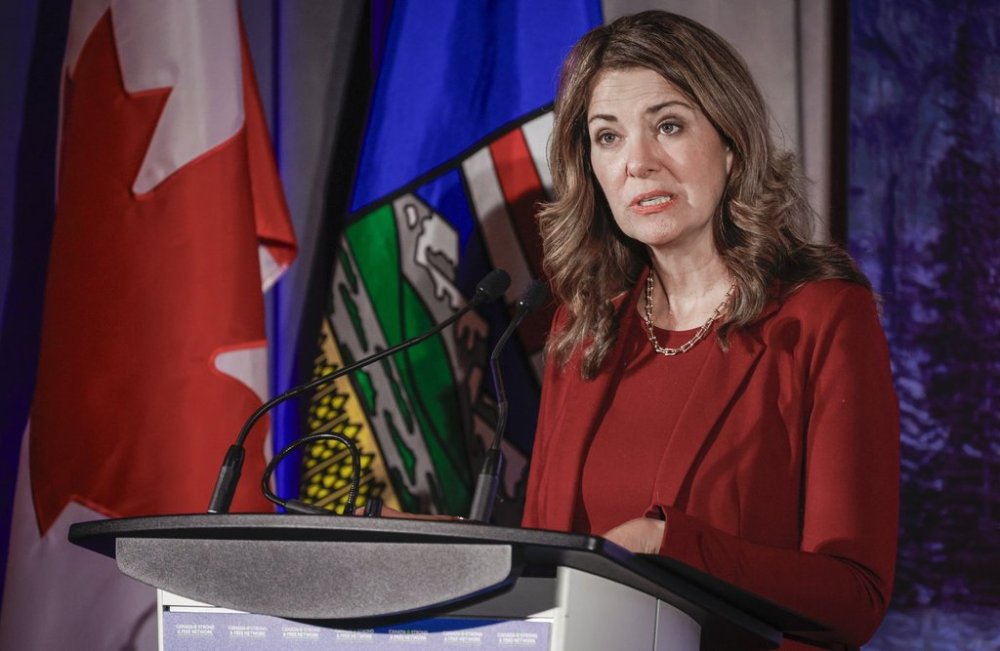
Premier Danielle Smith said the goal is to stimulate investment and boost long-term oil production. It comes as her government is trying to fill Pacific Link, the pipeline the province is trying to build to the West Coast.
“To meet our goal of doubling oilsands production in the coming decade or so, we need hundreds of billions of dollars in new investment,” Smith told reporters, adding that Alberta needs to compete with the United States and Venezuela.
“Investors have choices about where they put that money, and we want them to put it here in Alberta.”
The premier also touted the benefits for Albertans when increased royalties are collected down the road from higher levels of production.
“Although royalty revenues from these new projects will be modest to start, eventually it means tens of billions of additional royalty revenues for the public programs and infrastructure that Albertans rely on,” she said.
The new royalty program is expected to be in place next year.
Earlier this month, several major players in Alberta’s oilsands posted multibillion-dollar profits in their latest quarterly reports.
The heads of those companies and others stood behind the premier as she made the announcement.
Kendall Dilling, president of a conglomerate of major oil producers called the Oil Sands Alliance, acknowledged the “optics” of the new program’s timing but said companies aren’t making expansion decisions based on today’s oil prices.
“We’re trying to predict what oil prices are going to be five, 10 years down the road. We can’t control that. So what we can control is things like predictable royalty rates for the first 10 years of a project,” he said.
“Those are the things that allow us to make the decision (to grow) that’s forward-looking like that.”
Rich Kruger, chief executive officer of Suncor, said Smith’s United Conservative Party government should be applauded for the new program.
“Make no mistake, when this industry does well in Alberta, Alberta does well,” he said.
“Record profits for the industry this year, record royalties, record taxes,” he said, “and that goes beyond Alberta, it goes federally as well.”
Janetta McKenzie, with the clean energy think tank Pembina Institute, criticized the new program, saying it hands more of the value of Alberta’s oil to corporate shareholders rather than Albertans.
“At a time when the industry is amassing billions in windfall profit due to the conflict in the Middle East, the private sector is absolutely capable of financing production expansion if they believed in sustained long-term oil demand,” she said in a statement.
Under the new program, the province said a project would fall back under the existing royalty payment system once its 10-year period expires.
Oil companies currently pay rates on a sliding scale, depending on the benchmark price of oil and whether a company has recouped the capital it puts into building a project.
If a company is still in what’s called the pre-payout phase, it pays rates between one per cent and nine per cent of gross revenue depending on the price of West Texas Intermediate, with the maximum taking effect when oil hits US$120 per barrel.
As of Friday afternoon, West Texas Intermediate was trading at about US$88 per barrel.
Finance Minister Jason Nixon, as well as government officials who briefed reporters, were unable to say exactly how much oil companies could save under the new program.
The officials said it would depend on the individual project and unpredictable factors outside the government’s control.
Only projects that plan to produce 5,000 barrels of oil per day would be eligible for the new program.
Nearly five million barrels of oil are produced per day in the province, said Smith.
Prime Minister Mark Carney designated the Pacific Link pipeline as a project of national interest last month.
The pipeline, with a price tag between $35 billion and $44 billion, would carry upwards of one million barrels of crude oil per day from Bruderheim, Alta., to a port near Delta, B.C.
This report by The Canadian Press was first published Nov. 13, 2026.
— By Jack Farrell in Edmonton