
Alberta seeks to strike First Nation court challenge of Smith’s sovereignty act
Advertisement
Read this article for free:
or
Already have an account? Log in here »
We need your support!
Local journalism needs your support!
As we navigate through unprecedented times, our journalists are working harder than ever to bring you the latest local updates to keep you safe and informed.
Now, more than ever, we need your support.
Starting at $15.99 plus taxes every four weeks you can access your Brandon Sun online and full access to all content as it appears on our website.
Subscribe Nowor call circulation directly at (204) 727-0527.
Your pledge helps to ensure we provide the news that matters most to your community!
To continue reading, please subscribe:
Add Brandon Sun access to your Free Press subscription for only an additional
$1 for the first 4 weeks*
- Enjoy unlimited reading on brandonsun.com
- Read the Brandon Sun E-Edition, our digital replica newspaper
*Your next Free Press subscription payment will increase by $1.00 and you will be charged $20.95 plus GST for four weeks. After four weeks, your payment will increase to $24.95 plus GST every four weeks.
Read unlimited articles for free today:
or
Already have an account? Log in here »
EDMONTON – Alberta’s government wants a judge to throw out a First Nation’s constitutional challenge of its sovereignty act, arguing it hasn’t shown any impact on treaty rights.
Lawyers were in Edmonton court Friday to argue over the government’s application to have the court strike the claim from Onion Lake Cree Nation and stop it from proceeding to trial.
Court of King’s Bench Justice Grant Dunlop reserved his decision.
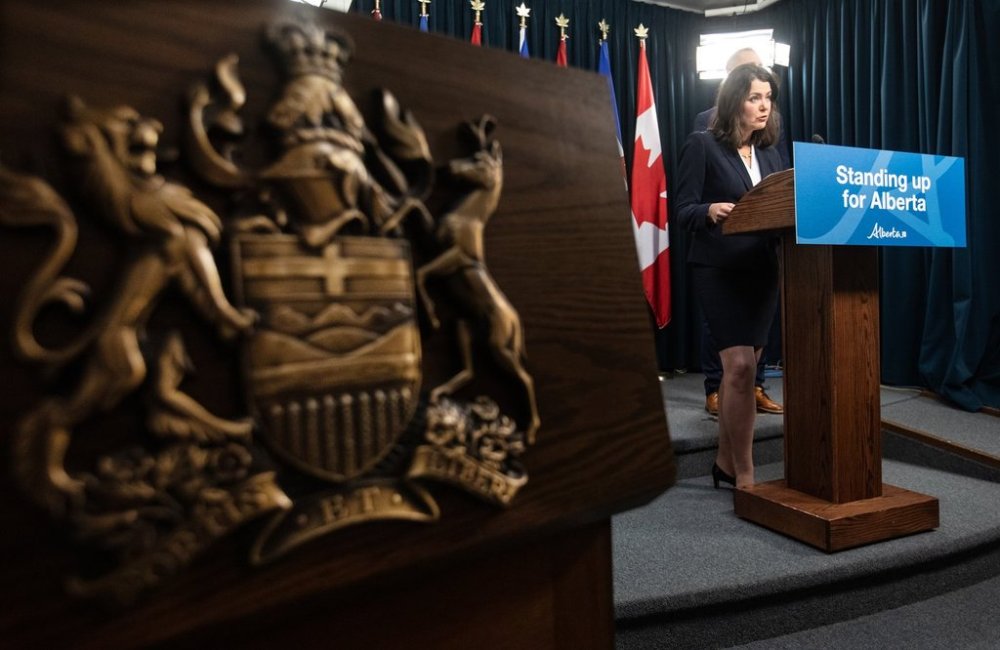
Premier Danielle Smith won leadership of the United Conservative Party with the sovereignty act as her signature proposal in 2022, and it became her flagship first law.
Smith said the Alberta Sovereignty within a United Canada Act was needed to push back against federal encroachment into provincial jurisdiction.
When she invoked it for the first time, Smith conceded she didn’t need the law to implement new measures to fight against Ottawa’s energy regulations and that the act’s use was symbolic.
Onion Lake Cree Nation, which straddles the Alberta-Saskatchewan boundary, argues the act is unconstitutional because it goes against the Treaty 6 relationship with the Crown.
It has asked the court to declare it unenforceable.
Chief Pete Chief said the law was passed without meaningful consultation and raises serious questions about treaty rights and the limits of provincial authority.
He said those questions deserve to be heard by the court.
“Our treaty rights existed long before Alberta was created, and those rights did not disappear when the province came into existence,” Chief told reporters outside Court of King’s Bench.
The province argues the act doesn’t authorize anything that would go against the Canadian Constitution or federal law, and that the First Nation’s claim doesn’t show the act has affected any treaty rights.
Government lawyer Heather Campbell said Onion Lake didn’t provide any facts or evidence in its claim to show treaty rights have been infringed upon.
“On its face, it’s not unconstitutional,” she said of the law.
Campbell said the First Nation’s challenge amounts to premature, abstract speculation and unsupported hypotheticals.
The province’s application to strike the claim, filed in July 2025, also seeks legal costs, saying Onion Lake’s claim is an abuse of process.
Campbell said the government had no legal obligation to consult with First Nations before passing the law.
Onion Lake Cree Nation disagrees.
Lawyer Robert Hladun said that under the Constitution, governments have a duty to consult if legislation could possibly affect treaty rights.
“This isn’t rocket science or something that is speculative,” he said.
He also pointed to regulations related to the enforcement of federal firearms policy enacted by Smith’s government under the sovereignty act last year.
Hladun said because Treaty 6 guarantees rights to hunting, trapping and fishing, many rules regulating firearms are up to the nation, not the province.
Michael Marchen, another lawyer for Onion Lake, said Alberta declaring federal legislation unconstitutional, through legislature motions under its sovereignty act, creates a problem that demands the court step in.
“There’s a live legal issue to be determined,” he said.
Onion Lake also filed a similar court claim in Saskatchewan in 2023 over the Saskatchewan First Act, which asserts provincial jurisdiction over non-renewable resources, on similar grounds.
In Alberta, the four-year-old legal challenge last made headlines in early 2025, as the long-simmering debate over separatism bubbled over.
Smith’s government tweaked provincial law, lowering the threshold for citizen petitions to prompt a referendum, including on the issue of secession. That drew protest from Indigenous leaders across the province.
At the time, Onion Lake Cree Nation Chief Henry Lewis said the moves signalled that Smith was pushing a separatist agenda, disregarding treaty rights.
Smith has maintained she wants Alberta to remain in Canada but that she supports giving Albertans a say through direct democracy.
On Oct. 19, Albertans voted overwhelmingly against beginning the legal process to hold a second, binding referendum on separating from Canada.
On Friday, Justice Minister Mickey Amery’s office declined to comment on the Onion Lake challenge because the matter is before the courts.
“The Alberta Sovereignty within a United Canada Act helps ensure Alberta’s voice remains firm on our priorities and gives us a way for our province to take strong and effective action against destructive federal policies,” it said in a statement.
This report by The Canadian Press was first published Nov. 13, 2026.