
Strong calving season provides glimmer of hope for endangered right whales
Advertisement
Read this article for free:
or
Already have an account? Log in here »
We need your support!
Local journalism needs your support!
As we navigate through unprecedented times, our journalists are working harder than ever to bring you the latest local updates to keep you safe and informed.
Now, more than ever, we need your support.
Starting at $15.99 plus taxes every four weeks you can access your Brandon Sun online and full access to all content as it appears on our website.
Subscribe Nowor call circulation directly at (204) 727-0527.
Your pledge helps to ensure we provide the news that matters most to your community!
To continue reading, please subscribe:
Add Brandon Sun access to your Free Press subscription for only an additional
$1 for the first 4 weeks*
- Enjoy unlimited reading on brandonsun.com
- Read the Brandon Sun E-Edition, our digital replica newspaper
*Your next Free Press subscription payment will increase by $1.00 and you will be charged $20.95 plus GST for four weeks. After four weeks, your payment will increase to $24.95 plus GST every four weeks.
Read unlimited articles for free today:
or
Already have an account? Log in here »
HALIFAX – The most recent calving season for North Atlantic right whales was one of the strongest on record, providing a glimmer of hope for the critically endangered species.
But as scientists gather Monday in Halifax for the annual meeting of the North Atlantic Right Whale Consortium, some experts are renewing calls for more protection for the majestic mammals.
Despite the recent baby boom — 24 calves were born during the 2025-2026 season, the most since 2009 — a preliminary estimate released Monday says the annual population as of 2025 decreased by two per cent to 382 whales.
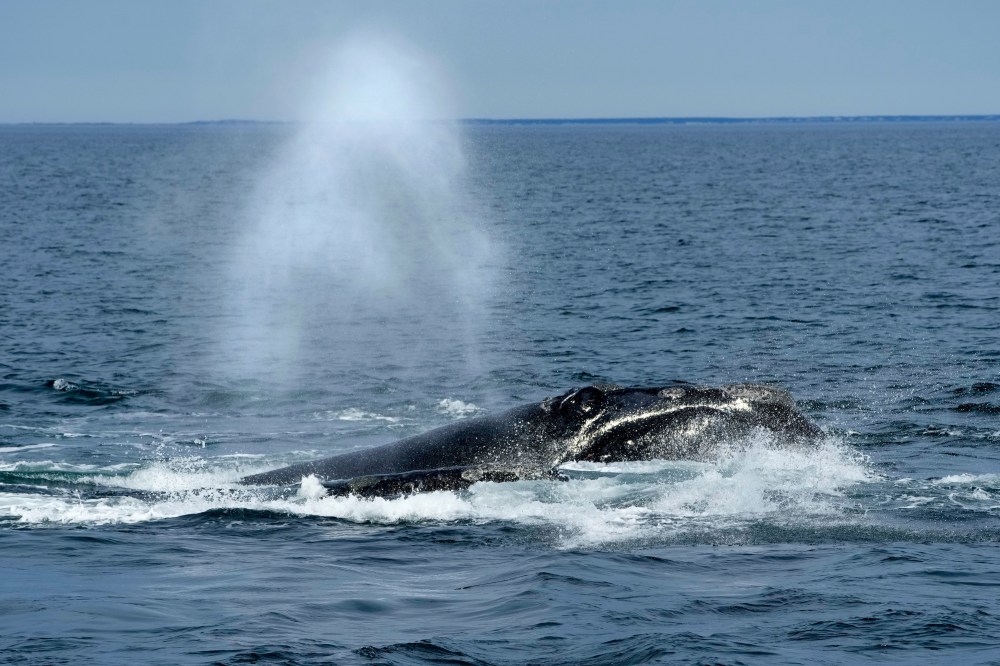
Lindsey Jones, a scientist who manages the New England Aquarium’s North Atlantic right whale catalogue, said the notable uptick in births may be a short-lived blessing.
“We just need to help ensure that those calves can survive to maturity and contribute to further population growth,” Jones said in a recent interview from Boston.
She said right whales continue to face threats from human activity, the most lethal of which are vessel strikes and entanglements in fishing gear. That’s why the need for better regulations and more protective measures will be on the agenda for this week’s conference.
As an example, Jones said speed limits imposed on ships entering designated slow-down zones off the east coast of the United States currently apply to ships 65 feet or longer. But she said those rules should also apply to smaller vessels.
As well, she said more testing is required for ropeless fishing gear, which is designed to prevent entanglements.
The calls for change come as U.S. President Donald Trump’s administration has taken steps to delay new protections for the whales. There is currently a regulatory pause on any additional measures until 2028.
Meanwhile, the U.S. House of Representatives recently passed a bill that would extend that pause to 2035. The bill is now before the U.S. Senate.
Jones said if the bill becomes law, it would threaten the species’ recovery.
“It would be a pretty big hit … if the measure goes forward,” she said.
In May, The Canadian Press obtained an internal memo from Fisheries and Oceans Canada that showed experts within the department believed the bill could have grave consequences for right whales.
North Atlantic right whales are a migratory species typically found along the east coast of North America, from Florida to Newfoundland and Labrador. A portion of the population gathers to feed each summer in the Gulf of St. Lawrence.
Heather Pettis, a scientist and chair of the North Atlantic Right Whale Consortium, said the latest estimate shows the population is not yet on a path to recovery.
“Recovery for this species depends on sustained, protective actions in both the U.S. and Canada,” she said in a statement.
Earlier this year, the consortium documented two right whale deaths. A four-year-old male was found dead off the coast of North Carolina in January after becoming entangled in snow crab gear from Canada. And a three-year-old female was found dead in February off the coast of Virginia, but the cause of death could not be determined.
Scientists also recorded eight human-caused injuries this year, including one blamed on a vessel strike and seven due to fishing gear.
Jones said these threats can prevent right whales from reaching an age where they can reproduce. Earlier this year, three females, all of them around nine or 10 years old, gave birth to calves for the first time, she said.
“North Atlantic right whales are a long-lived species and take a long time to grow to maturity,” she said.
Jones said human impacts not only prolong the period for right whales to produce their first calf but also increase the amount of time between calves.
“Right whales should be able to give birth every three or four years, but we’ve seen extended inter-calving intervals of five to seven-plus,” she said. “There’s some whales that only give birth once every decade. And that’s a concern … in such a small population.”
Federal agencies in Canada and the United States have measures in place to reduce the impact of vessel traffic and fishing gear.
Transport Canada implements speed restrictions and enforces a vessel exclusion zone in the Shediac Valley of the Gulf of St. Lawrence during the summer to reduce the risk of collisions. Meanwhile, Fisheries and Oceans Canada enforces seasonal fishing closures and other measures to reduce the risk of entanglement.
In the United States, the National Oceanic and Atmospheric Administration implements vessel slowdowns seasonally. And several states also implement measures to reduce the risk of entanglements.
It’s believed the right whale population peaked at about 21,000 before aggressive hunting drastically reduced their numbers. By the 1920s, fewer than 100 remained.
They are called right whales because they were considered by whalers to be the “right” whales to hunt. They floated when killed and produced high amounts of whale oil.
After a ban on hunting was imposed in 1935, the population grew to 483 by 2010. But a steep decline began in 2017 after 12 whales died in Canadian waters and another five died in U.S. waters, with most of the deaths linked to entanglements and vessel strikes.
Since 2020, however, their numbers have been slowly increasing.
This report by The Canadian Press was first published Nov. 16, 2026.